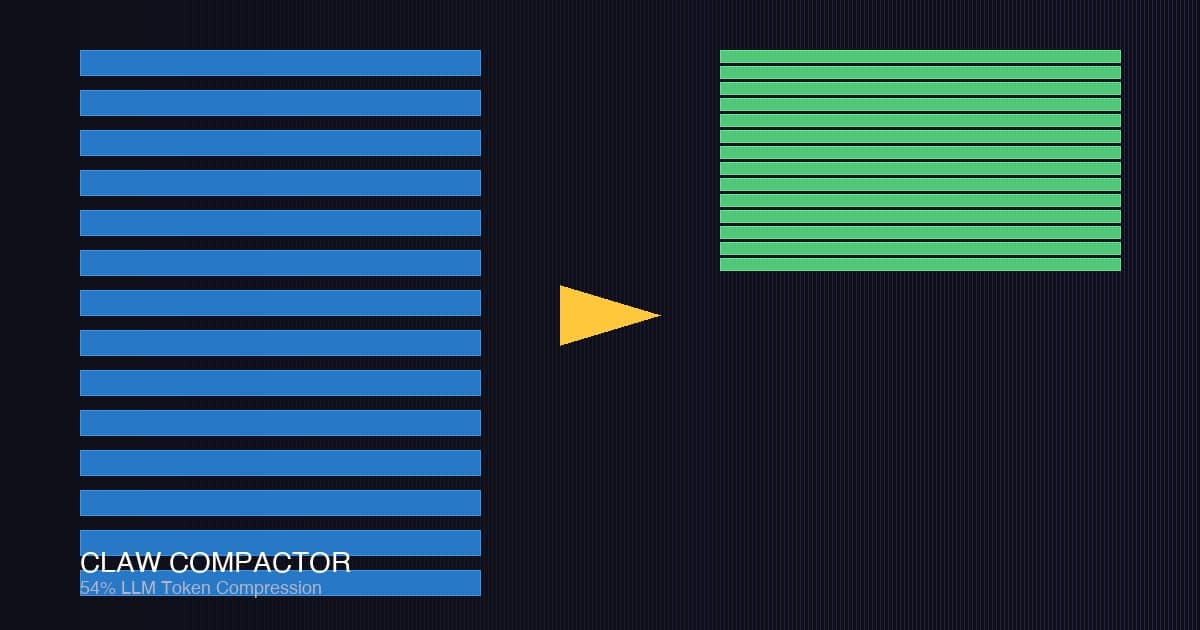

An open-source project called Claw Compactor hit the Hacker News front page today, and the numbers are simple enough to evaluate quickly: 54% average compression on LLM API context, 82% on JSON payloads, 25% on source code. No ML inference. No model weights. No dependencies. A 14-stage deterministic pipeline that you can reverse with a hash lookup.
If you are running agents, retrieval pipelines, or any workload that sends structured data into an LLM API, this is the kind of tool that changes the unit economics of the whole stack.
A compression engine built for the token meter, not the model
Most approaches to prompt compression try to be clever about what to cut. LLMLingua and its successors use a secondary model to score token importance, then prune. That works, but it adds inference latency, a dependency on an auxiliary model, and a quality floor that degrades unpredictably under heavy compression.
Claw Compactor takes a different route entirely. Its Fusion Pipeline is a fixed sequence of 14 deterministic stages — think structural analysis, redundancy elimination, schema normalization, whitespace compaction, and token-boundary-aware rewriting. No neural network in the loop. The pipeline runs the same way every time on the same input, which makes it auditable, testable, and reproducible in a way that model-based compressors are not.
The benchmarks back that up. At aggressive compression settings, Claw Compactor scores a ROUGE-L of 0.653, which the project's README reports as 88% higher than LLMLingua-2 at the same compression ratio. That is a meaningful gap. ROUGE-L is an imperfect proxy for semantic fidelity, but at these ratios, an 88% advantage means the deterministic pipeline is preserving substantially more usable content than the learned approach.
JSON is where the savings get dramatic
The 54% average is interesting, but the 82% compression on JSON is the number with the most operational weight. JSON is the dominant format in agent tool calls, API response payloads, retrieval-augmented generation context, and structured data dumps. It is also the format where tokens are most wasted — curly braces, repeated keys, nested boilerplate, and verbose schema structures all consume tokens without adding semantic value.
An 82% reduction on JSON context means a retrieval pipeline that currently stuffs 50,000 tokens of product catalog data into a prompt could send the same information in roughly 9,000 tokens. That is a different cost tier. It also opens headroom for longer conversations, more retrieved documents, or richer tool call histories without hitting context window limits.
The 25% compression on source code is more modest, which makes sense. Code is denser, less redundant, and more sensitive to structural changes. But even 25% matters in coding agents that pack file contents, diffs, and test output into every prompt.
Reversibility removes the usual compression trade-off
The harder objection to prompt compression has always been recoverability. If you compress aggressively and something breaks, you need the original. Claw Compactor addresses this with a hash-addressed RewindStore — every compressed segment is keyed to a hash of the original, and the original can be reconstructed on demand.
That design choice matters more than it sounds. It means compression is not a destructive preprocessing step. It is a reversible transformation that sits between your application and the API. If a compressed prompt produces an unexpected model response, you can inspect the original, rerun without compression, and isolate whether the issue was compression-related. That kind of debuggability is table stakes for production use but missing from most compression tools.
1,676 tests and SWE-bench integration
The project ships with 1,676 tests and reports benchmarks against SWE-bench, which is the standard evaluation suite for coding agent tasks. That test surface is unusually large for an open-source utility library, and it signals that the authors are serious about correctness at the edge cases — the places where aggressive compression could silently corrupt a prompt and produce subtly wrong model behavior.
Zero dependencies is the other detail worth noting. In a landscape where LLM tooling often pulls in half of PyPI or npm, a self-contained compression engine is easier to audit, easier to deploy, and one fewer supply chain risk in a pipeline that already has enough of them.
The API cost arithmetic
The math is direct. If your monthly LLM API spend is driven by context tokens — and for agent workloads, retrieval pipelines, or batch processing, it usually is — then a 54% average compression rate roughly halves that line item. No provider switch, no model downgrade, no rewrite of your prompts. You run the same workload through a preprocessing step and pay for fewer tokens.
At 82% compression on JSON-heavy payloads, the savings are even steeper. An agentic workflow that passes structured tool results back and forth across multiple turns can easily accumulate hundreds of thousands of tokens per session. Compressing that context by four-fifths changes the conversation about whether the workflow is economically viable at scale.
The catch, of course, is quality. A ROUGE-L of 0.653 at aggressive settings means roughly 35% of the original content's surface form is altered. Whether that matters depends entirely on the task. For structured data extraction, summarization, and retrieval — where the model needs facts, not exact phrasing — that level of fidelity is usually fine. For tasks that depend on precise wording, legal language, or code that must be reproduced character-for-character, you would want to benchmark on your own data before trusting the defaults.
Fifty-four percent is a procurement number now
Open-source LLM infrastructure tools tend to get adopted bottom-up — an engineer finds the project, tests it on a staging workload, and shows the cost delta to whoever approves the API budget. Claw Compactor is built for exactly that adoption path. Zero dependencies, reversible, deterministic, heavily tested, and the savings show up on the next invoice.
The broader signal is that the LLM cost stack is developing its own optimization layer, independent of the model providers. Providers compete on capability and price per token. Tools like Claw Compactor compete on how many tokens you actually need to send. Those are complementary pressures, and both push the effective cost of LLM-powered work downward.
For anyone budgeting an AI project right now, the question is no longer just which model to use or which provider to choose. It is whether you are sending twice as many tokens as the task requires — and whether a preprocessing step you can deploy this week would cut that number in half.
AI Pilot Readiness Checklist
Turn the idea into a pilot you can defend.
AI agent articles are easy to bookmark and hard to operationalize. Use the readiness questions as a shared way to decide whether a workflow is specific enough, safe enough, and measurable enough to pilot. If they surface a strong candidate, BaristaLabs can review it with you and help shape a first version that fits your systems, approval process, and risk tolerance.
Please do not submit PHI, customer records, credentials, or confidential workflow exports.
Practical AI Workflow Notes
Want more practical AI operations ideas?
Get short notes on applying AI inside real small-business workflows — from document handling and customer follow-up to internal reporting, compliance, and automation guardrails.