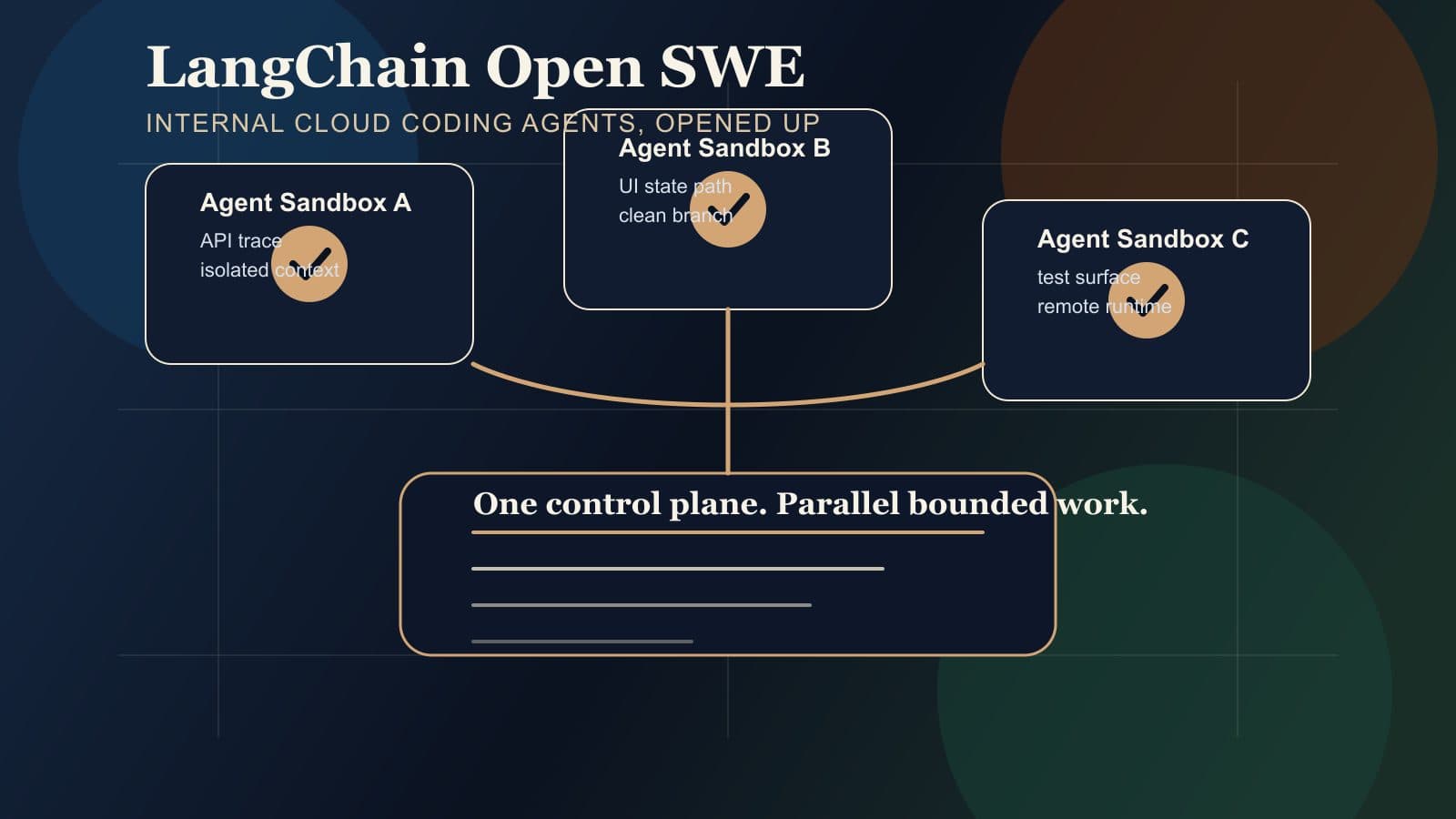

Harrison Chase put Open SWE back in the conversation on March 17, arguing that every company should be able to run cloud coding agents internally. That line lands because it names a real divide in the market. Stripe, Ramp, and Coinbase can afford to build internal agent infrastructure as a strategic capability. Most companies cannot. Open SWE is the open-source attempt to close that gap.
The important shift is not that coding agents exist. That story is old. The shift is that the cloud-native operating model for coding agents is becoming easier to copy: isolated remote environments, bounded context per task, and parallel branches of work that do not turn one giant chat thread into sludge.
Cloud agents are leaving the special-project phase
Until now, internal cloud coding agents have mostly been a luxury product for companies with enough engineering depth to build orchestration, sandboxes, permissions, logging, and review loops from scratch. That made the pattern look more exclusive than it really was.
Open SWE changes the economics by packaging the pattern in the open. Teams can self-host the framework, run agents in remote environments instead of local laptops, and keep each task separated instead of letting one overloaded context absorb every side quest. That alone makes parallelism more practical. One agent can inspect a failing API route while another traces the frontend state path and a third checks the test surface, without all three investigations contaminating one another.
Isolation matters more than another demo benchmark
This is why cloud coding agents keep showing up inside the companies moving fastest. Isolation is not cosmetic. It is operational discipline.
A remote environment gives each agent a cleaner workspace, tighter blast radius, and a better handoff point for humans. It also makes it easier to route multiple jobs at once without inheriting all the ambiguity of a shared local machine. For ops leads and technical owners, that is the real unlock: not "AI writes code," but "AI work can be supervised like a system instead of babysat like a tab."
Coinbase is the preview
Coinbase is a useful data point because it shows where this category is heading. Brian Armstrong recently said AI agents now write more than half of Coinbase's code and resolve 60% of support tickets, with stablecoin wallets in the stack for agent payments. That is not a cute productivity anecdote. It is a sign that agent infrastructure is becoming part of normal operations.
Open SWE does not magically turn every company into Coinbase. What it does is make the underlying architecture less exotic. The distance between "elite internal platform" and "practical internal toolchain" just got shorter.
The moat is moving downmarket
The strongest open-source projects do not win by matching enterprise systems feature for feature on day one. They win by making the old premium pattern cheap enough, visible enough, and portable enough that more teams can adopt it.
That is why Open SWE matters. The story is bigger than LangChain, and bigger than one framework release. Internal cloud coding agents are leaving the era where only the biggest engineering organizations get to experiment seriously. My read: this is the OSS moment for cloud agents, and it will compress the advantage previously reserved for companies rich enough to build the whole control plane themselves.
AI Pilot Readiness Checklist
Turn the idea into a pilot you can defend.
AI agent articles are easy to bookmark and hard to operationalize. Use the readiness questions as a shared way to decide whether a workflow is specific enough, safe enough, and measurable enough to pilot. If they surface a strong candidate, BaristaLabs can review it with you and help shape a first version that fits your systems, approval process, and risk tolerance.
Please do not submit PHI, customer records, credentials, or confidential workflow exports.
Practical AI Workflow Notes
Want more practical AI operations ideas?
Get short notes on applying AI inside real small-business workflows — from document handling and customer follow-up to internal reporting, compliance, and automation guardrails.