
Anthropic S-1: five Claude access risks to plan around
Anthropic's S-1, filed Oct. 26, says it once disabled two Claude models for every customer and may change rate limits again. Here is what to plan for.

Sean McLellan
Lead Architect & Founder

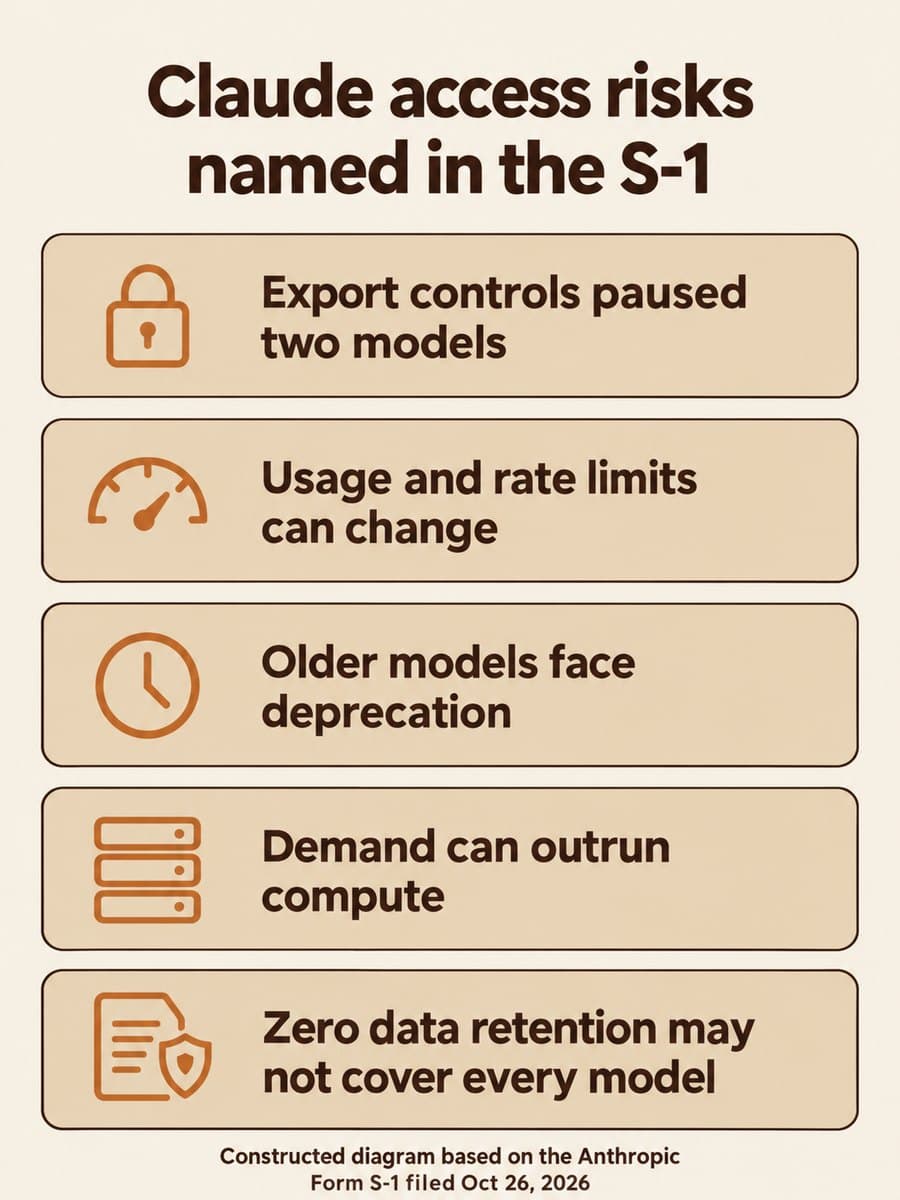
Anthropic's Form S-1, filed with the SEC on October 26, 2026, confirms something Claude customers had only seen from the outside: in June 2026 the company turned off two models, Fable 5 and Mythos 5, for every customer to comply with U.S. export restrictions. The same filing says Anthropic has changed usage limits, rate limits and model capabilities before and may do so again, that compute demand has historically outrun supply, and that Zero Data Retention does not fit every model class. If a customer-facing workflow runs on Claude, those disclosures belong in your vendor review this quarter.
This is not investment commentary. The S-1 is a sales document for shares, and its risk factors are written to be broad. But risk factors are also the one place a vendor describes, under legal liability, the ways its service can change on you. Five of them affect how Claude customers should plan.
What did Anthropic disclose about Claude access?
The filing names these customer-facing risks, in Anthropic's own wording:
Scroll sideways to see all 2 columns.
| Risk | What the S-1 says |
|---|---|
| Export controls | In June 2026 the Commerce Department "imposed worldwide export restrictions on our Fable 5 and Mythos 5 models," and Anthropic "disabled Fable 5 and Mythos 5 for all of our customers." |
| Limits and capabilities | "We have also changed, and may in the future change, usage limits, rate limits, or model and product capabilities." |
| Deprecation | Customers on older models "may resist migration," and "any accelerated or forced deprecation could result in customer attrition, contractual disputes, or reputational harm." |
| Compute capacity | "Demand for compute has historically exceeded available capacity," and a shortfall could mean "service disruptions, degraded response times, or limitations on customer and user access." |
| Data retention | The safety framework "has required and may continue to require monitoring and retention incompatible with ZDR for certain model classes." |
The filing also describes a concrete incident behind the capacity risk. In March 2026, Anthropic "experienced a service outage and periods of degraded performance" caused by "a significant and rapid increase in usage demand, compute constraints in certain components of our infrastructure, and other factors."
The June shutdown shows which fallback works
The export-control episode is the most useful detail for planning, because it shows the shape of the outage. The restriction targeted specific models, not Anthropic as a whole. The S-1 says "access to our other models was not affected," and that Anthropic redeployed Fable 5 and Mythos 5 after it updated its safeguards with the U.S. government and Commerce lifted the restrictions. The filing does not say how long the models were off.
BaristaLabs' interpretation: a second cloud channel for the same model would not have helped here, since Anthropic disabled the models for all customers. A tested fallback to a different model, whether another Claude model or another provider's, would have. The filing also warns that "similar export controls could recur, could remain in place longer, or could extend to additional models or capabilities." If your strongest workflows depend on the newest frontier model, those are the ones most exposed to this kind of pause.
If you route Claude through a cloud marketplace, the channel question is still worth asking for other reasons. The S-1 says Claude is available on AWS, Google Cloud and Azure, with Anthropic keeping a direct contract with the customer, and that marketplace sales were about 48% of revenue in the first half of 2026. We compared those routes in Claude on Google Cloud: Anthropic-managed vs. Vertex AI.
Can Anthropic change Claude rate limits or retire models?
Yes, and the filing says it already has. Anthropic writes that some of its changes to limits or capabilities "have resulted, and could in the future result, in claims that our disclosures regarding model access or capabilities were inadequate or misleading." In the other direction, it says safety and model-welfare considerations "may lead us to limit or delay the deprecation of older models."
For a buyer, the practical reading is that the model list, rate limits and retirement dates are operating variables, not fixed terms. Treat a model change the way you would treat a breaking API change: pin model versions in code, track retirement notices, and test the replacement before the date. API behavior can shift too, as shown when a newer Claude API version started rejecting some sampling parameters.
Does Zero Data Retention cover every Claude model?
Not necessarily. The S-1 says "a substantial portion" of Anthropic's traffic runs under Zero Data Retention terms, where it keeps "only classifier scores, not prompts or outputs." It then says the safety framework has required retention "incompatible with ZDR for certain model classes," and that this has caused some customers to move to other providers.
The filing points to one bridge. Under Enterprise Frontier Safeguards, announced in September 2026, activity data is stored in the customer's own cloud account under the customer's encryption keys, and until that rollout is complete, eligible customers get zero data retention on Fable 5 and Fable 5.1. If your data policy assumes ZDR, confirm it model by model in writing rather than assuming one account setting covers every model you call. Agent stop rules matter for the same models; see what the Mythos 5 AISI incident means for agent stop rules.
Who should act on this
- Teams with a customer-facing workflow on one Claude model. A model pause or a limit change shows up to your customers first.
- Regulated teams that rely on ZDR. Retention terms can differ by model class, per the filing.
- Companies that sell to the U.S. government. The S-1 says the Department of War's supply-chain risk designation was upheld 2-1 by the D.C. Circuit on September 25, 2026, that Anthropic has asked for rehearing by the full court, and that the outcome could affect sales "to government agencies and other customers that sell products and services to the U.S. government." If you hold federal contracts, ask counsel whether Claude use needs a review.
- Heavy agent users. The filing says agentic products "consume significantly more compute per user interaction than single-turn API calls," which puts them closest to any capacity limit.
A four-step Claude vendor review

BaristaLabs recommends one review, sized to an afternoon for most teams:
- Map each workflow to its model. List every production workflow that calls Claude, the exact model ID, the channel (direct API or a cloud marketplace) and who owns it.
- Name a fallback model or provider. For each workflow customers would notice, pick a different model and run your own test prompts against it now, not during an outage. The June pause shows that a different model, not a different channel for the same model, is what keeps work moving.
- Confirm retention terms per model. Get the ZDR or retention terms for each model you use in writing, including any model you plan to switch to.
- Alert on limit and outage changes. Watch for 429 and overload errors in your logs, subscribe to Anthropic's status page and model deprecation notices, and route both to the workflow owner.
If you want help running this review across several tools, see our AI consulting service.
Sources and scope
- Anthropic, PBC, Form S-1 registration statement, filed with the SEC on October 26, 2026. All quotes above are from this filing, read October 26, 2026.
This article covers only the customer-facing risk factors and business descriptions in the S-1. Several figures in the filing, including the offering price and some recent-quarter results, were left blank at filing and may change in later amendments. BaristaLabs did not test model availability, rate limits or retention settings for this article, and nothing here is investment advice.
Claude vendor risk
Know what happens when a Claude model goes dark
Bring a list of the workflows that call Claude. BaristaLabs can help you match each one to its model and channel, choose a tested fallback, check retention terms model by model, and set alerts for limit and status changes.
Start with the one workflow customers would notice first.
Turn this idea into a pilot
Which workflow should go first?
Use the readiness check to compare impact, effort, risk, owner, and next step before requesting a review.
- 3-5 minutes
- Deterministic score
- No sensitive data
Practical AI Workflow Notes
Want more practical AI operations ideas?
Get short notes on applying AI inside real small-business workflows — from document handling and customer follow-up to internal reporting, compliance, and automation guardrails.