Anthropic Crossed $19 Billion in Annual Revenue. The Enterprise AI Race Just Changed Hands.
Anthropic hit $19B in annual revenue run rate — jumping from $9B to $19B in ten weeks — while its share of U.S. enterprise AI spending surged from 4% to 40% in one year. The company that was an also-ran in enterprise is now the frontrunner.

Sean McLellan
Lead Architect & Founder
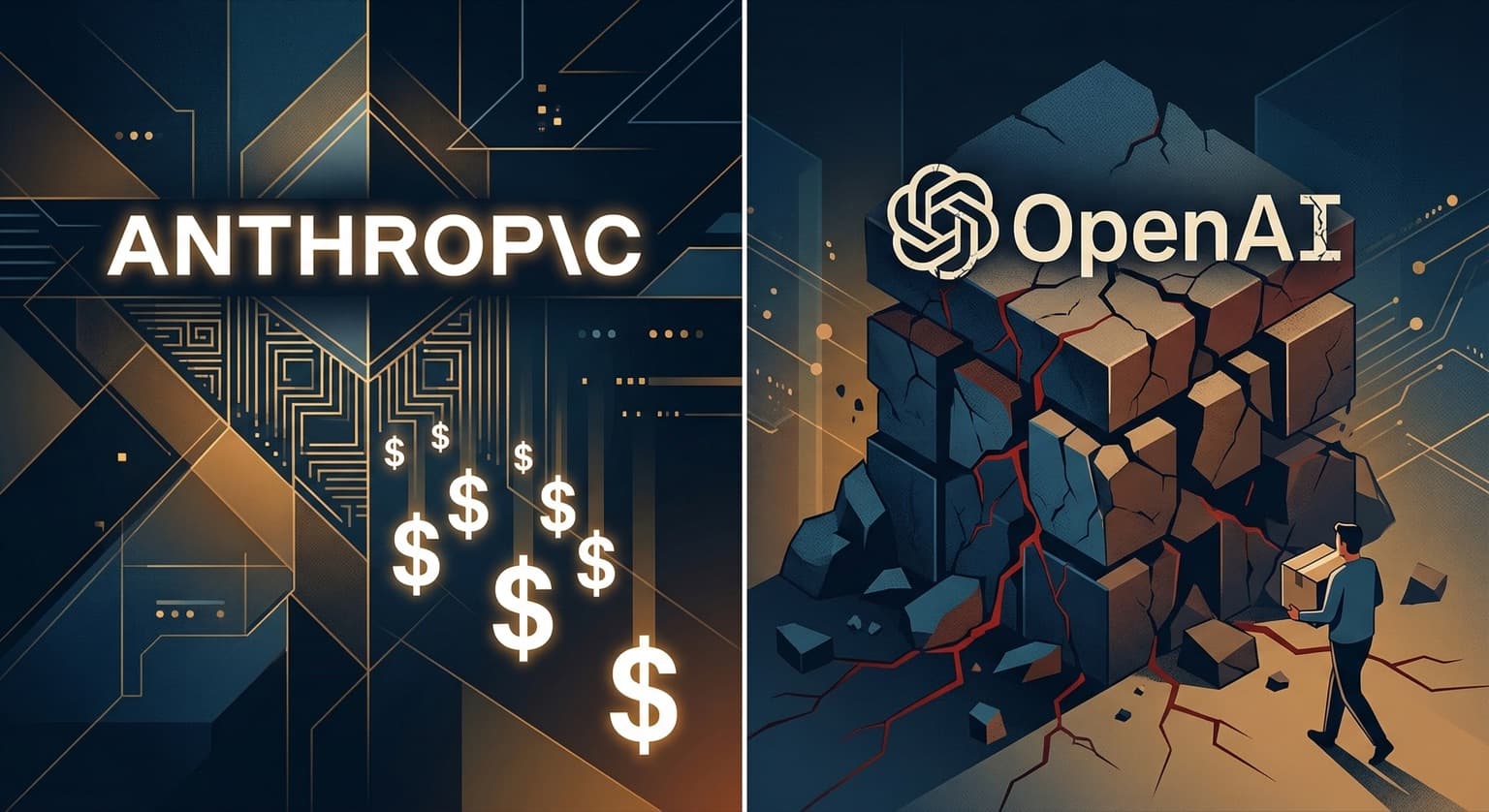
Anthropic is now generating $19 billion in annual revenue run rate. Ten weeks ago, that number was $9 billion. A company doubling its run rate in the time it takes most enterprises to close a procurement cycle is not normal growth. It is a phase change.
The milestone, confirmed by multiple sources familiar with Anthropic's financials, marks the fastest revenue acceleration in enterprise AI history. For context, OpenAI took roughly a year to move from $5B to $12B ARR. Anthropic covered the same absolute dollar gap in less than three months.
The Enterprise Share Flip
The raw revenue number is impressive. The market share story is seismic.
Twelve months ago, Anthropic held approximately 4% of U.S. enterprise AI spending. OpenAI held 50%. Today those numbers have inverted to a degree nobody predicted: Anthropic commands 40% of the market while OpenAI has contracted to 27%.
That is not a gradual shift. It is a power-law redistribution that happened in a single calendar year.
Eight of the ten largest Fortune companies now run production workloads on Claude. The adoption pattern followed a consistent sequence: teams started with Claude for internal coding and document analysis, expanded into department-wide agent deployments through Cowork, and then consolidated vendor contracts as usage data made the ROI case undeniable.
The enterprise buyers who drove this shift were not chasing hype. They were chasing reliability. Anthropic's Constitutional AI approach and its willingness to build compliance tooling -- audit trails, data residency controls, role-based access -- gave procurement teams what they needed to say yes at scale. OpenAI's consumer-first DNA made that same conversation harder, and the gap showed up in renewal rates.
Claude Code: The Surprise Growth Engine
Buried inside that $19B number is a product line that barely existed eighteen months ago. Claude Code now generates $2.5 billion in annualized revenue as a standalone product. That makes it larger than most publicly traded developer tools companies.
The adoption metrics are equally startling. Claude Code now authors 4% of all public commits on GitHub. One in twenty-five commits pushed to the world's largest code repository is written by a single AI product from a company that shipped its first model in 2023.
That 4% figure understates the real footprint. It only counts public repositories. Enterprise usage -- where Claude Code has its deepest penetration -- happens overwhelmingly in private repos that GitHub's public statistics never see. Internal estimates from two large Claude Code customers suggest the tool writes between 15% and 30% of their new code.
The revenue trajectory makes sense when you consider the pricing dynamics. Claude Code charges based on compute consumed, and developers who start using it do not stop. The retention curves are nearly vertical -- once a team integrates Claude Code into their CI/CD pipeline, it becomes infrastructure. You do not rip out infrastructure.
The SaaS Shockwave
If the revenue and market share numbers describe what happened at Anthropic, the stock market reaction to Cowork describes what happened to everyone else.
When Anthropic launched Cowork with its full enterprise plugin suite, the SaaS sector absorbed a $285 billion single-day market capitalization loss. Thomson Reuters dropped 16%. RELX fell 14%. LegalZoom cratered 20%. The total damage to enterprise software valuations has now crossed $1 trillion.
The market is not punishing these companies for being bad at what they do. It is repricing them for a world where their moats -- proprietary data formatting, workflow lock-in, per-seat licensing of commodity features -- dissolve when an AI agent can replicate the same output in seconds.
Thomson Reuters built a $70 billion business on the premise that legal and financial professionals need specialized software to access and analyze structured information. Cowork's legal plugin does not replace Westlaw. But it handles enough of the routine work -- contract review, clause extraction, regulatory cross-referencing -- that the marginal value of a Westlaw seat drops. Multiply that dynamic across every vertical SaaS category and you get a trillion-dollar repricing.
This is not theoretical disruption. It is showing up in pipeline data. Multiple enterprise SaaS vendors have reported that Cowork deployments are appearing as line items in competitive displacement analyses for the first time this quarter.
Where This Leaves the Field
The enterprise AI landscape in March 2026 looks nothing like the one analysts projected a year ago. Anthropic leads in enterprise market share, revenue velocity, and developer adoption. OpenAI remains a formidable competitor with deep consumer distribution and a massive installed base, but its enterprise narrative has shifted from dominance to defense. Google's Gemini holds a structural advantage through Workspace integration that neither rival can replicate, yet has not converted that distribution into proportional enterprise AI revenue.
The $19B number will be outdated within weeks at this trajectory. The more durable signal is the enterprise share flip -- a market that was 50/4 in OpenAI's favor is now 40/27 in Anthropic's. That kind of preference shift, once it reaches critical mass in procurement committees and IT governance boards, tends to be self-reinforcing. The vendors that win the compliance conversation win the renewal, and the vendors that win renewals set the integration standard for the next wave of buyers.
Anthropic did not get here by building the flashiest demo or the biggest consumer app. It got here by building the product that enterprise buyers could actually deploy. In a market that spent two years confusing hype with adoption, that turned out to be the only thing that mattered.
Agent Governance Scorecard
Move from agent excitement to operating clarity.
If your team is debating how and where agents should run, the scorecard gives business and technical stakeholders a shared language for risk. Use it to spot the gaps BaristaLabs should account for in an agent pilot or implementation roadmap.
Built for agent architecture and risk-review discussions.
Turn this idea into a pilot
Which workflow should go first?
Use the readiness check to compare impact, effort, risk, owner, and next step before requesting a review.
- 3-5 minutes
- Deterministic score
- No sensitive data
Practical AI Workflow Notes
Want more practical AI operations ideas?
Get short notes on applying AI inside real small-business workflows — from document handling and customer follow-up to internal reporting, compliance, and automation guardrails.