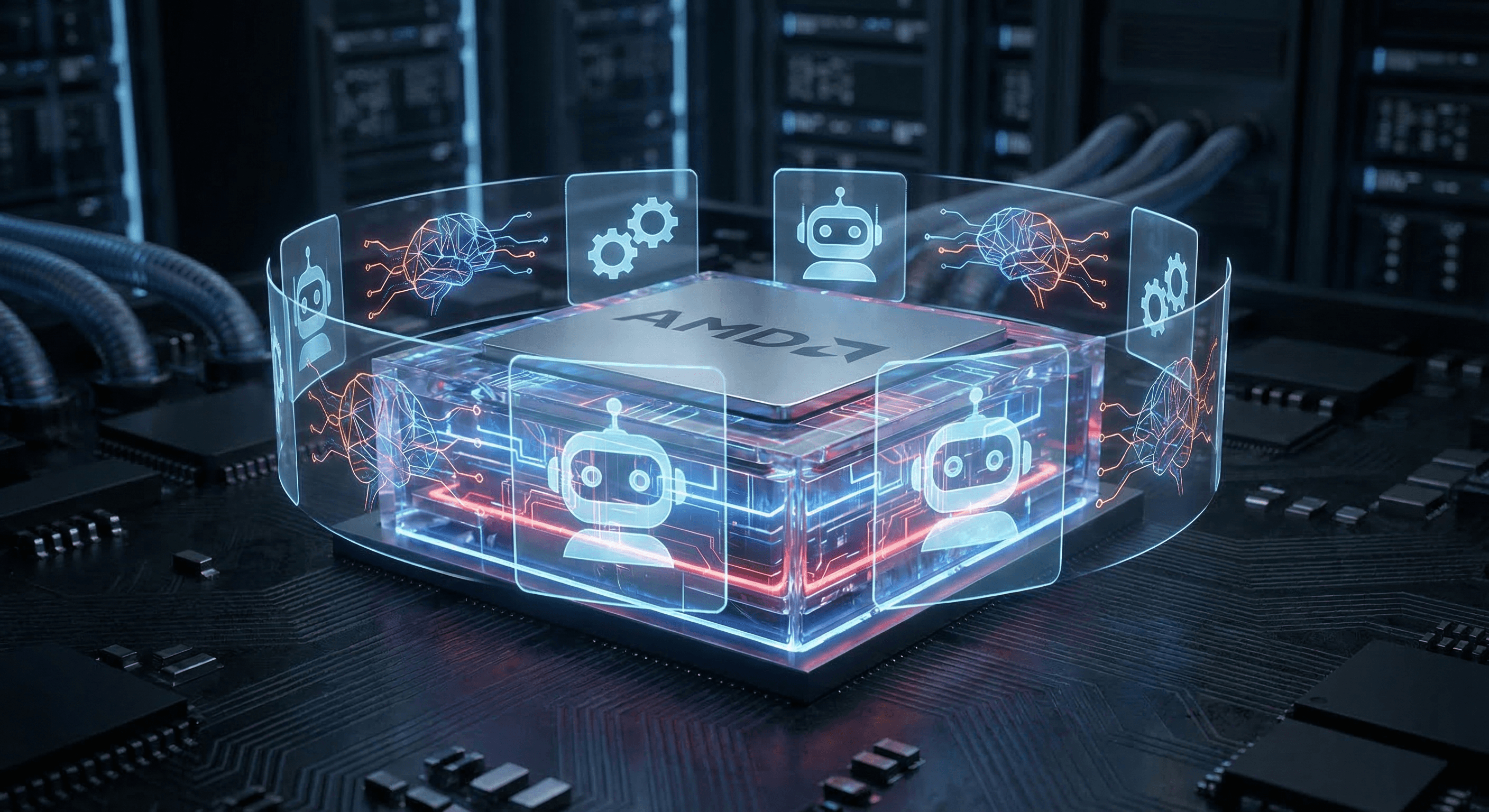

AMD is no longer satisfied with the phrase "AI PC."
The more aggressive framing behind its latest Ryzen AI push is that the next machine should behave like an Agent Computer: a personal system with enough on-device AI compute to keep agents running in the background, handling work continuously, and only escalating to the cloud when the task actually needs it. That is a more important shift than another benchmark slide because it changes the premise of the hardware category. The PC stops being a place where you occasionally ask an assistant a question. It becomes a local operator for ongoing software work.
That framing is believable now because AMD's current Ryzen AI stack is not just a CPU with an AI sticker on it. The company has spent the last two product generations combining CPU, GPU, and NPU resources into one client platform, with Ryzen AI systems now shipping in the roughly 50 to 60 TOPS range depending on the family. In January, AMD said its new Ryzen AI 400 and PRO 400 chips deliver up to 60 NPU TOPS for Copilot+ class PCs. Earlier Ryzen AI 300 systems were already positioned around 50 TOPS. That is enough local inference capacity to move a surprising amount of agent behavior off the network and onto the machine sitting on a desk.
The useful part of the announcement is the job description
Most AI PC marketing still describes the computer as a smarter endpoint. AMD's agent framing implies something else: the machine is supposed to host an ongoing worker.
That matters because autonomous agents behave differently than chat assistants. They watch folders. They monitor inboxes. They summarize meetings while the call is still happening. They update records after the user walks away. They prepare drafts, rerank options, and keep state across long spans of time. Once that is the target workload, local compute starts looking less like a convenience feature and more like core system design.
An agent that depends on a roundtrip to a remote model for every tiny decision inherits network latency, API cost, and privacy exposure at every step. An agent that can do the first pass locally is much cheaper to keep alive all day.
That is the real architectural shift hidden inside AMD's announcement. The industry is moving from AI as a foreground tool to AI as a background system operator.
Why local-first wins the boring economics
Cloud models still matter, but cloud-only agent design gets expensive faster than a lot of buyers expect.
Latency is the obvious problem. If an agent needs to classify an email, decide whether a document changed, pull entities out of a note, check for a trigger phrase, and keep doing that dozens or hundreds of times a day, cloud hops turn routine work into a queue. Local execution makes those micro-decisions feel instantaneous enough that the agent can stay ambient instead of theatrical.
Privacy is the second reason. Plenty of businesses do not mind sending a polished prompt to a hosted model. They do mind streaming internal documents, customer notes, invoice data, HR drafts, or legal intake material through remote services all day if the first pass could have happened locally.
Then there is the line item nobody enjoys discovering after rollout: cost per query. A person using ChatGPT a few times a day is one thing. A background agent touching dozens of workflows, polling systems, reranking results, and summarizing constant changes becomes a metered service with an appetite. Local models do not make inference free, but they do move a chunk of repetitive work onto hardware you already bought.
Always-on behavior is the fourth advantage. A cloud assistant feels like software you open. A local agent feels like software that keeps watch.
The buying signal is not subtle anymore
If a business is buying net-new PCs in 2026 and expects those systems to stay in service for the usual three-to-five-year window, this AMD framing should change the timing discussion.
The question is no longer just whether the machine is "AI capable." That label is already too soft. The better question is whether the system belongs to the generation built for resident agent workloads instead of occasional prompt-response tasks.
That creates a blunt purchasing rule: if the next planned refresh is more than 18 months away, there is a real risk of buying the wrong generation right before local agent workflows become standard operating behavior. Buying a machine optimized for yesterday's AI usage pattern is how companies end up replacing laptops sooner than they intended or shoving every serious automation task back into the cloud.
That does not mean every office should panic-buy a premium laptop tomorrow. It means hardware selection is now tied directly to workflow design. If the plan for 2026 and 2027 includes local summarization, offline document handling, on-device coding help, browser agents, or resident back-office assistants, then NPU-class client hardware is no longer an enthusiast spec. It is part of the operating model.
What can actually run on these machines
This is where the hype needs a knife taken to it.
Fifty to sixty TOPS is real. It is also not magic. It is enough for a meaningful slice of local AI work, especially when the workload is quantized, specialized, or delegated across CPU, GPU, and NPU resources. It is not enough to make a thin laptop behave like a rented cluster.
What fits locally today:
- Small and mid-sized local language models for drafting, classification, summarization, retrieval, and coding assistance
- Speech tasks such as transcription, translation, speaker labeling, and meeting notes
- Vision tasks like OCR, image tagging, quality checks, and lightweight document understanding
- Agent subroutines that need constant low-latency decisions rather than giant bursts of reasoning
What still tends to want the cloud:
- Large frontier-class models with long context windows
- Heavy multimodal jobs involving high-resolution video, large batch generation, or deep reasoning chains
- Team-wide shared agent systems that need central orchestration, memory, and policy enforcement across many users
- Spiky workloads where buying local capacity for everyone is less efficient than renting remote compute on demand
The practical pattern is hybrid. Let the machine handle the always-on first mile. Escalate to the cloud for the expensive last mile.
That is also why AMD's pitch is stronger as an architecture story than as a claim that every workload should stay on-device. The smart deployment model is not local-only purity. It is local-first triage.
When the laptop becomes a night shift
AMD's "Agent Computer" framing is the first honest description of where client hardware is heading. The next good business PC is not merely a faster laptop with an NPU bolted onto the spec sheet. It is a machine designed to host a layer of low-latency software labor all day, quietly, privately, and cheaply enough that the workflow survives contact with accounting. The limitation is equally clear: laptop-class AI silicon can run plenty of useful local agents, but it still cannot replace cloud-scale models for large reasoning or heavy multimodal work. That is fine. The important shift is that the PC purchase decision now includes a new question: can this machine keep an agent working after the human stops typing?
AI Pilot Readiness Checklist
Turn the idea into a pilot you can defend.
AI agent articles are easy to bookmark and hard to operationalize. Use the readiness questions as a shared way to decide whether a workflow is specific enough, safe enough, and measurable enough to pilot. If they surface a strong candidate, BaristaLabs can review it with you and help shape a first version that fits your systems, approval process, and risk tolerance.
Please do not submit PHI, customer records, credentials, or confidential workflow exports.
Practical AI Workflow Notes
Want more practical AI operations ideas?
Get short notes on applying AI inside real small-business workflows — from document handling and customer follow-up to internal reporting, compliance, and automation guardrails.