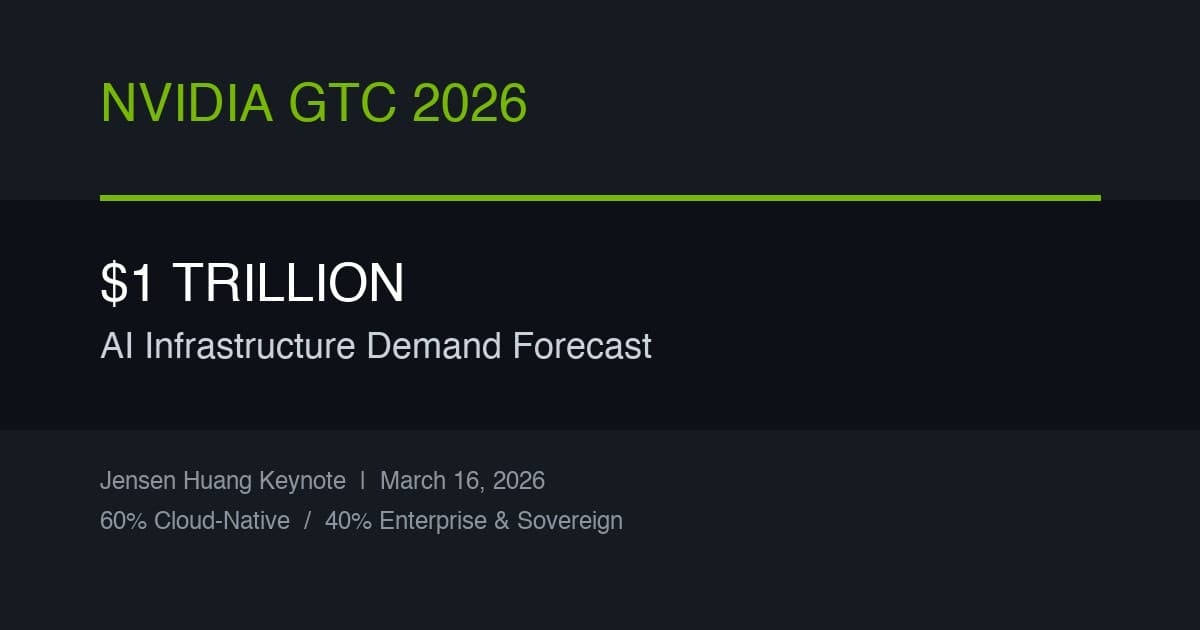

Four months ago, Jensen Huang pegged cumulative AI infrastructure demand at $500 billion through 2027. At GTC 2026 on March 16, he doubled it to $1 trillion.
That is not a rounding error or a stage flourish. A 100% revision to a forward demand estimate in under half a year means the inputs to the model changed faster than the forecast cycle itself. For anyone planning infrastructure capacity, model deployment budgets, or tooling investments, the prior assumptions are now stale.
The 60/40 Split Worth Watching
Huang broke the trillion-dollar figure into a ratio: roughly 60% cloud-native spend, 40% enterprise and sovereign AI. That split carries more signal than the headline number.
The cloud-native majority is expected. Hyperscalers have been racing to lock in GPU allocation for the next two years, and Nvidia's order book reflects commitments already made. The 40% enterprise and sovereign figure is the newer story. Governments and large organizations are building their own AI compute rather than renting it. Sovereign AI initiatives in the EU, Middle East, and parts of Asia have moved from policy papers to procurement in the last year. Enterprise buyers are reserving capacity not because they have workloads ready today, but because they expect the cost of waiting to be higher than the cost of reserving.
For operators and platform builders, the practical read is this: cloud remains the default path, but a growing share of serious AI spend is happening outside the hyperscaler perimeter. That 40% creates demand for on-premise tooling, private inference endpoints, and infrastructure that does not assume an AWS or Azure account.
Inference Reflection and the Claude Code Mention
Huang spent notable time on what he called "inference reflection," the idea that models reasoning through multi-step problems at inference time is now a production reality, not a research curiosity. His framing positioned this as a shift in where compute demand lands. Training remains expensive, but the growth curve is tilting toward inference workloads that run continuously rather than in batch training cycles.
He singled out Anthropic's Claude Code as "a new inflection," pointing to agentic coding as a concrete example of inference-heavy workflows generating sustained compute demand. When the CEO of the company selling the GPUs calls a specific product an inflection point, it is worth noting what he is actually saying: the workloads justifying the next round of GPU purchases are not just training runs. They are persistent agent loops, code generation sessions, and multi-turn reasoning chains that keep hardware busy around the clock.
This reframes the infrastructure question. The relevant metric is shifting from "how many GPUs do we need to train model X" to "how many GPUs do we need to keep agents running at the throughput our users expect."
What a Trillion-Dollar Ceiling Does to the Next 18 Months
A $1 trillion demand forecast through 2027 does not mean a trillion dollars will be spent. It means Nvidia believes the appetite exists, and is using that number to justify expanded production, new chip architectures, and ecosystem investments. The downstream effect is more predictable: GPU supply will remain constrained but growing, inference costs will decline on a per-token basis as competition and hardware improvements compound, and the tooling layer will absorb pricing pressure from both directions.
For teams building AI-powered products, the near-term implication is that inference access will keep getting cheaper, but the organizations controlling that access will consolidate. Cloud providers will subsidize inference to lock in platform spend. Enterprise buyers with reserved capacity will have cost advantages over teams renting spot compute.
The pricing dynamics of the next 18 months will reward teams that committed early to a compute strategy and punish those still treating GPU access as a variable cost to figure out later.
The Forecast Is the Product
Nvidia's demand forecasts are not neutral observations. They are marketing instruments designed to accelerate the spending they describe. Huang knows that a $1 trillion number changes procurement conversations inside every large organization watching the keynote. The forecast creates the urgency it claims to measure.
That does not make the number wrong. The underlying demand drivers, inference-heavy workloads, sovereign compute buildouts, and agentic AI going mainstream, are real and observable. But it means the right response is not to accept the number at face value or dismiss it as salesmanship. It is to look at the structural shifts underneath and plan accordingly: inference costs are falling, agent workloads are rising, and the window to lock in favorable compute terms is narrowing.
Agent Governance Scorecard
Move from agent excitement to operating clarity.
If your team is debating how and where agents should run, the scorecard gives business and technical stakeholders a shared language for risk. Use it to spot the gaps BaristaLabs should account for in an agent pilot or implementation roadmap.
Built for agent architecture and risk-review discussions.
Turn this idea into a pilot
Which workflow should go first?
Use the readiness check to compare impact, effort, risk, owner, and next step before requesting a review.
- 3-5 minutes
- Deterministic score
- No sensitive data
Practical AI Workflow Notes
Want more practical AI operations ideas?
Get short notes on applying AI inside real small-business workflows — from document handling and customer follow-up to internal reporting, compliance, and automation guardrails.