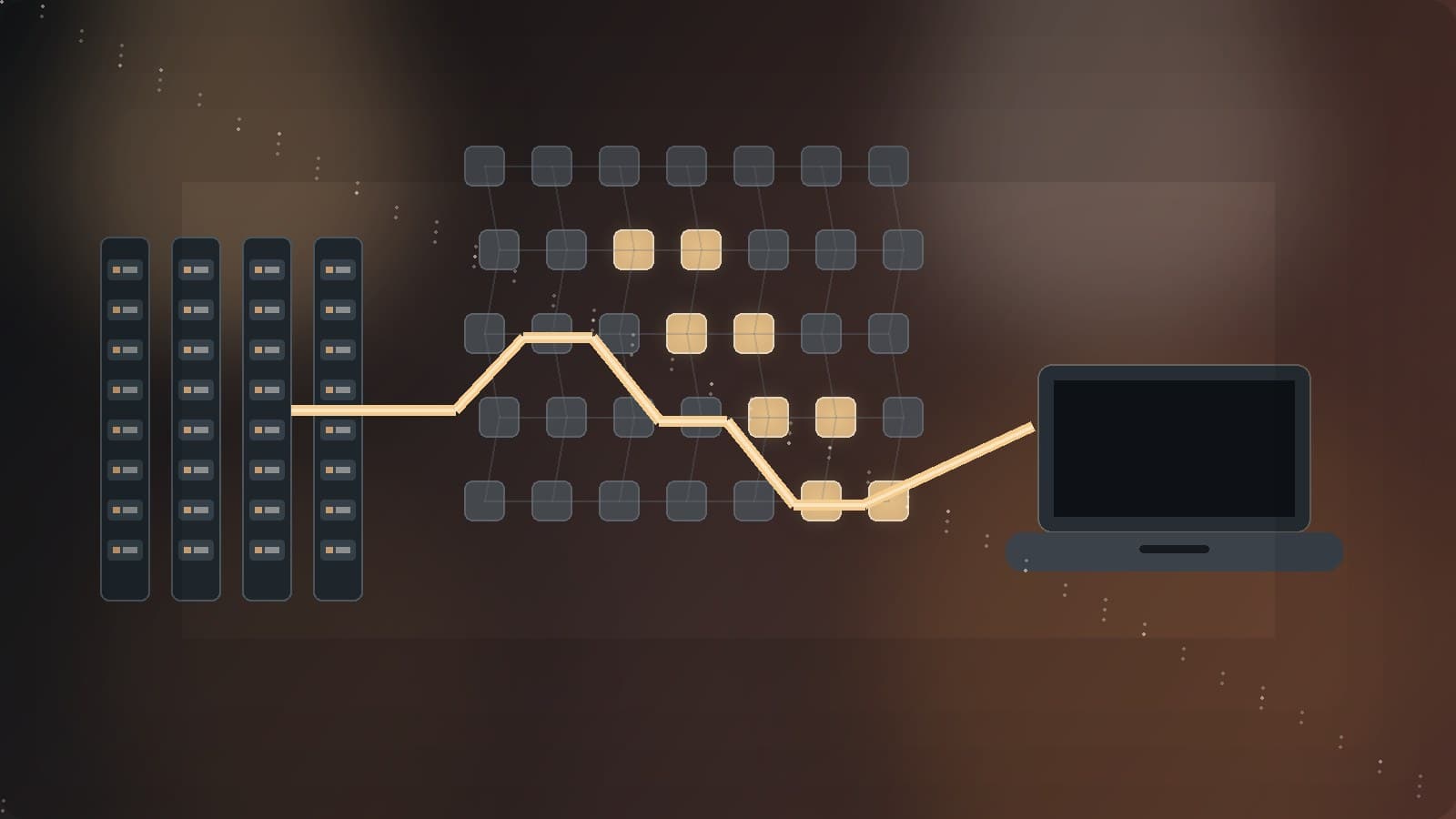

Mistral AI used NVIDIA GTC 2026 to announce a deeper role in Nvidia's model stack: it has joined the Nemotron Coalition as a founding member and is co-developing the base model behind Nemotron 4. The model was trained on NVIDIA DGX Cloud, will be fully open-sourced, and uses a Mixture-of-Experts design with 675 billion total parameters but only 41 billion active on each query.
That last number is the whole story.
The industry still likes to quote total parameter count because it sounds like raw horsepower. Buyers care about the active path. If only 41B parameters light up per request, the serving bill looks radically different from a dense 675B-class model. That is how you move a frontier-class system out of "lab trophy" territory and into something companies can actually price, deploy, and support.
The coalition news matters less than the routing math
"Mistral joins Nvidia" is fine as a headline. The useful detail is that Nemotron 4 appears to be designed around sparse activation from day one.
Mixture-of-Experts changes the economics because the model does not drag its full weight through every token. You keep the larger knowledge surface and specialization benefits of a 675B parameter model, but inference only pays for the 41B slice the router selects on that request. That makes lower-latency serving possible on much cheaper hardware tiers than the topline parameter count would suggest.
For teams deciding whether frontier inference belongs in a managed API, a private rack, or an on-prem edge deployment, active parameters are closer to the number that belongs in the spreadsheet.
This is why "from data centers down to laptops" is not throwaway copy
Nvidia's pitch is that Nemotron 4 scales from cloud infrastructure down to local machines. Most model announcements say some version of that. Usually it collapses under weight, memory, or power constraints once you get past the keynote slide.
Sparse MoE is one of the few architectures that gives the claim a plausible operating model. If the active footprint stays near 41B per query, the serving stack can target a wider range of accelerators and memory budgets. The data center still matters for training and high-concurrency deployment. The laptop claim matters because it hints at a real continuity path: prototype in the cloud, tune on enterprise infrastructure, then push narrower versions or quantized variants closer to the employee.
That is a much more interesting story than "AI on device." It means the same open model family can span central IT, field machines, and developer laptops without forcing a vendor rewrite at each layer.
Open source is the part that changes the buying conversation
If Nemotron 4 ships fully open, Mistral and Nvidia are not just releasing another benchmark contender. They are handing enterprises and service firms a new negotiating position.
Open weights with frontier-adjacent behavior change the build-vs-buy math in three ways:
First, they reduce the penalty for self-hosting. A team can test whether its workload really needs a closed API premium before locking into somebody else's margin structure.
Second, they widen the middle market for customization. You do not need to be a hyperscaler to fine-tune routing, retrieval, or guardrails around an open model if the inference budget stays near the active path instead of the full model size.
Third, they put pressure on every proprietary vendor selling "frontier performance" as a black box. Once buyers believe 41B-active sparse models can reach comparable usefulness, the conversation shifts from who has the biggest number to who has the cleanest deployment and the lowest real token cost.
The Nvidia hardware angle is doing more than supplying training credits
The training run on DGX Cloud and Nvidia's claim of up to 10x faster inference versus previous-generation H200 hardware give this partnership a second layer. Nvidia is not just hosting Mistral. It is using Mistral's model-building credibility to push a story about what Blackwell-era inference can unlock when sparse architectures are built for the stack.
That matters because many enterprise AI projects stall between proof of concept and production rollout. The blocker is rarely model quality alone. It is the gap between "this works in a demo" and "this fits the latency, cost, and deployment constraints of the business." A model family designed to scale across Nvidia infrastructure tiers, while staying open, attacks that gap directly.
Watch the active path, not the parameter brag
Nemotron 4's 675B number will get the screenshots. The 41B active path is the figure procurement teams should circle. If Mistral and Nvidia can deliver an open model with that routing profile, fast inference on Blackwell-class hardware, and credible down-market deployment options, they are not just launching another giant model. They are making frontier inference look a lot less like a rent-only market.
Turn this idea into a pilot
Which workflow should go first?
Use the readiness check to compare impact, effort, risk, owner, and next step before requesting a review.
- 3-5 minutes
- Deterministic score
- No sensitive data
Practical AI Workflow Notes
Want more practical AI operations ideas?
Get short notes on applying AI inside real small-business workflows — from document handling and customer follow-up to internal reporting, compliance, and automation guardrails.
Related Posts