
Two things happened today that, viewed together, tell an IT buyer exactly where the pressure is mounting.
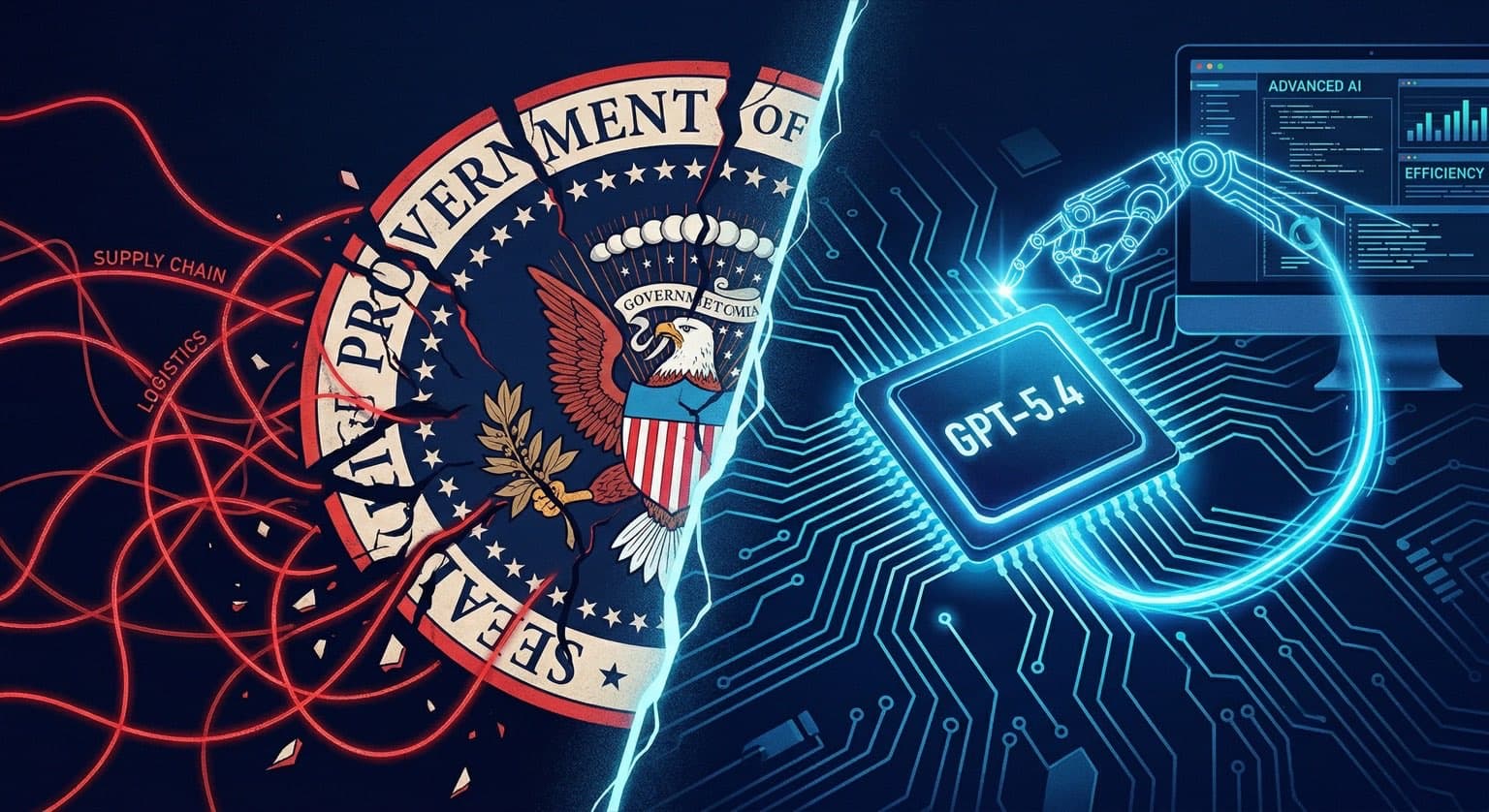
OpenAI released GPT-5.4 — its most capable model, with native computer use, 1M context, and API pricing at $2.50/$15.00 per million tokens (input/output). And the Pentagon's Anthropic "supply chain risk" designation finished rippling through every major cloud vendor, forcing Google, Microsoft, and Amazon to publish public reassurances that Claude isn't going away — for non-defense customers, anyway.
Neither event is standalone. Together they describe a vendor landscape under active geopolitical stress and a capability curve that moves faster than annual budget cycles can track.
The supply-chain event: what the DOD designation actually says
On March 5, Defense Secretary Pete Hegseth designated Anthropic a "supply chain risk to national security" — a label previously reserved for companies with Chinese government ties. The trigger: Anthropic refused to grant the DOD unrestricted access to its models under a $200M contract signed last July. Negotiations collapsed, Trump instructed federal agencies to stop using Claude, and Hegseth set a six-month wind-down clock for existing DOD integrations.
Anthropic's CEO Dario Amodei has said the company has "no choice" but to challenge the designation in court.
The blast radius: Any organization that runs Claude through AWS Bedrock, Google Cloud Vertex AI, or Azure has seen its AI vendor involuntarily inserted into a federal legal dispute. The technology still works — all three hyperscalers confirmed commercial access continues — but the contractual and reputational ground shifted overnight.
Operator exposure map (for a 20-50 person IT buyer)
If your company uses Claude, here is where the actual risk sits, in order of severity:
Tier 1 — Direct API customers: If you call api.anthropic.com directly and hold an Anthropic master service agreement, you now have a counterparty in active litigation with the federal government. Review your data processing addendum. Check whether your contracts include force majeure language that covers regulatory action. This is not theoretical.
Tier 2 — Cloud-routed customers (Bedrock, Vertex, Azure): Google, Microsoft, and Amazon have all confirmed Claude remains available for non-defense work. Your access isn't interrupted, but you're one court ruling away from a hyperscaler having to act. Document which workflows depend on Claude specifically (not just "an LLM"), and confirm you have an alternative model mapped — even if you never use it.
Tier 3 — SaaS products built on Claude: This is the most underaudited exposure. If a tool you pay for — a writing assistant, a coding copilot, a customer support bot — is itself built on Claude, you may not know it. Ask your vendor directly. If they hedge, that's your answer.
What to document right now: Model name + version used in each workflow, which hyperscaler routes the call, whether the workflow is customer-facing or internal, and estimated cost per month. Two hours of inventory now is worth far more than a scramble six months from now if the court case goes sideways.
GPT-5.4: the upgrade that actually changes agent economics
OpenAI dropped GPT-5.4 today across ChatGPT (as "GPT-5.4 Thinking"), the API, and Codex. The numbers that matter for operators:
- 83% — share of professional-level tasks where GPT-5.4 matches or outperforms human experts across 44 occupations and nine industries, per OpenAI's internal benchmarks
- 18% fewer errors than GPT-5.2, with individual factual claims 33% less likely to be false
- 1M token context — enough to feed an entire codebase, a contract stack, or a month of customer transcripts in a single call
- $2.50/$15.00 per million tokens (input/output) for the standard API — the same ballpark as GPT-5.2 despite the capability jump
- GPT-5.4 Pro: $30/$180 per million tokens — only worth it for the most computationally heavy reasoning chains
The capability that rewrites agent design is native computer use. GPT-5.4 is OpenAI's first general-purpose model that can operate a desktop environment — not as a bolt-on, but baked into the base model. Codex workflows can now span applications without needing a separate computer-use wrapper.
GPT-5.3 Instant (released March 3) is still the default for everyday ChatGPT users and will remain free under the gpt-5.3-chat-latest API alias. GPT-5.2 Instant retires June 3, 2026 — three months from now. If you have evals or prompts pinned to 5.2 behavior, start your regression window now.
Signal: Xiaomi miclaw enters closed beta in China
Xiaomi announced a limited closed beta for miclaw today — a smartphone AI agent built on its in-house MiMo large language model. The system runs an inference-execution loop (analyze → select tool → execute → verify → repeat), integrates with Mi Home smart devices, and supports MCP (Model Context Protocol) for developer extensions.
For non-Xiaomi shops: miclaw is the clearest evidence yet that on-device agent infrastructure is being built natively into consumer hardware at scale, in China, with a platform-agnostic protocol (MCP). The competitive pressure on Apple Intelligence, Samsung, and Google's Pixel AI features just got measurably more concrete. For anyone building mobile-adjacent AI workflows, the assumption that phone-based agents are "still a year or two out" is now wrong — at least in one of the world's two largest smartphone markets.
The through-line
Three things collided today: a geopolitical attack on the AI vendor stack, a capability jump that resets what agents can actually do, and hardware manufacturers racing to embed inference at the device level. For an IT buyer, the practical read is this — the era of treating AI vendors like stable SaaS providers is over. Anthropic's situation is extreme, but the underlying dynamic (governments, contracts, and model deprecations all moving faster than procurement cycles) is permanent.
Build with that assumption baked in: vendor-agnostic where you can, documented dependencies everywhere, and a parallel-model evaluation running for anything customer-critical.
GPT-5.4's computer-use capability is the most consequential technical development in today's batch — it closes the gap between "LLM that helps" and "agent that acts," and it does so at API pricing most mid-market teams can actually absorb.
AI Pilot Readiness Checklist
Turn the idea into a pilot you can defend.
AI agent articles are easy to bookmark and hard to operationalize. Use the readiness questions as a shared way to decide whether a workflow is specific enough, safe enough, and measurable enough to pilot. If they surface a strong candidate, BaristaLabs can review it with you and help shape a first version that fits your systems, approval process, and risk tolerance.
Please do not submit PHI, customer records, credentials, or confidential workflow exports.
Practical AI Workflow Notes
Want more practical AI operations ideas?
Get short notes on applying AI inside real small-business workflows — from document handling and customer follow-up to internal reporting, compliance, and automation guardrails.