


On July 31, 2026, AWS announced the Agentic Catalog Experience in Amazon Quick. The AI-powered workflow lets data curators define a catalog context boundary, discover relevant assets, and create Catalog-Generated Datasets and Topics that inherit selected upstream metadata. AWS describes the AWS Glue Data Catalog connection as available in preview. Its post names Glue and Databricks Unity Catalog as the supported catalogs today, with more catalog support planned.
An analytics team should connect an existing catalog now only as a controlled pilot, and only when the upstream catalog is already maintained. The connection can remove duplicate setup, but the team still owns catalog authority, the data query path, manual metadata refresh, local edits, and answer validation. This article follows those dependencies in order so that you can decide whether the current boundary fits your analytics work.
Quick depends on an authoritative upstream catalog
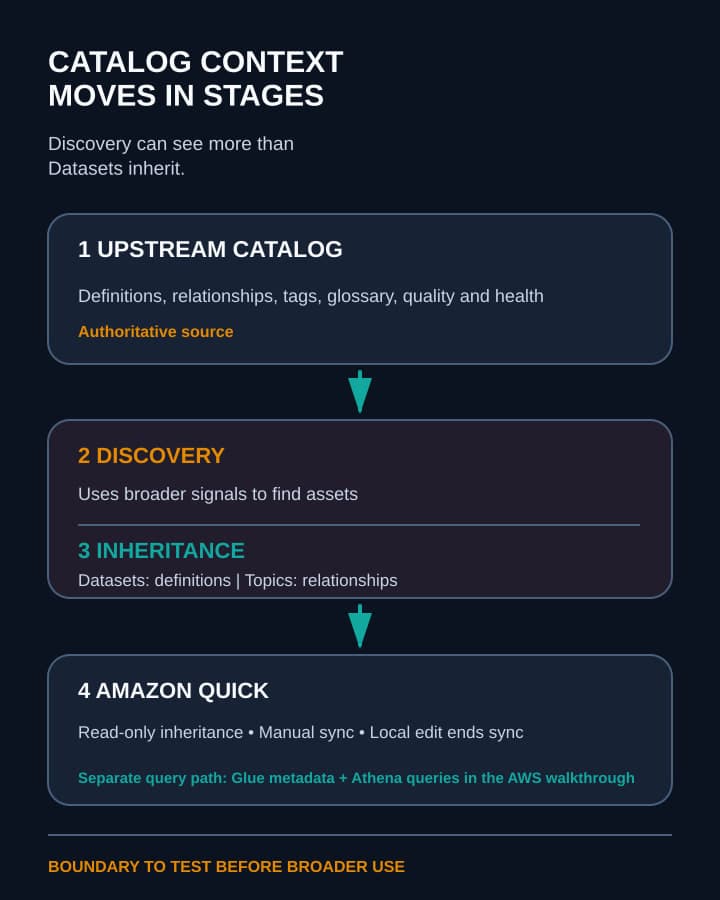
AWS describes Amazon Quick as a consumer of catalog metadata. The upstream catalog remains the source of truth, and inherited semantics stay read-only in Catalog-Generated Datasets. Quick can carry selected definitions and relationships forward; it does not decide which definitions should be canonical or repair weak upstream metadata.
The supported connection also sets a practical limit. AWS documents an IAM Role ARN for AWS Glue Data Catalog authentication. For Databricks Unity Catalog, it documents OAuth 2.0 or a Personal Access Token. The announcement does not establish universal regional or license availability, so teams should confirm access in their own AWS environment before they plan a pilot.
Within Quick, a curator can scope the Quick Agent to a specific catalog connection. The agent uses that context to find tables and relationships, then creates Datasets and Topics after the curator selects or confirms the assets. That confirmation is an important owner decision because it defines which part of a larger catalog becomes available for downstream analytics.
Discovery uses more metadata than Datasets and Topics inherit
During discovery, the Quick Agent can use business descriptions, tags, Gold/Silver/Bronze classifications, quality scores, table health scores, and glossary terms. These signals help it find and rank relevant tables in a large catalog. They describe the search surface; they are not a list of everything copied into a Catalog-Generated Dataset.
Dataset inheritance is narrower. AWS lists table business and technical descriptions; column descriptions and display names; data types and nullability; and glossary terms and synonyms. Topics receive relationship metadata, including primary and foreign keys, relationship definitions and cardinality, and star or snowflake models. A quality score or classification that helped the agent discover a table should not be treated as inherited Dataset metadata unless the product shows that metadata on the created asset.
This distinction matters when a team expects its catalog policy to appear unchanged inside Quick. Discovery can use a signal without transferring it. Created relationships also need local validation against known joins and questions before anyone treats the resulting Topic as dependable.

The metadata connection and query connection do different jobs
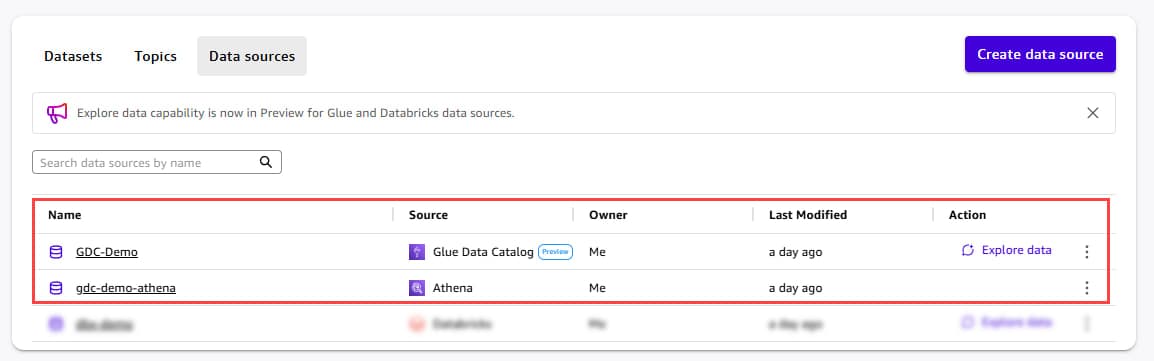
The AWS Glue walkthrough requires two connections. The Glue Data Catalog connection supplies table, column, and relationship metadata. A separate Amazon Athena connection supplies the query path to the underlying data in Amazon S3. Connecting the catalog alone does not give Quick the documented path it uses to run those queries.
Catalog-Generated Datasets use Direct Query by default, so AWS says the workflow does not copy or move the data. Quick consumes the selected semantics while queries continue through the linked data source. This two-connection design is documented for the Glue walkthrough; the announcement does not establish the same query setup for every current or future catalog.
This boundary also separates semantic consumption from data engineering. Our analysis of Databricks Genie Code covers an agent that builds and maintains data work. The Amazon Quick catalog feature begins after useful data assets and catalog metadata already exist.
Manual sync leaves metadata freshness with the team
Authors refresh inherited metadata on demand with a sync button. AWS says scheduled automatic sync is on the roadmap, so teams should not design current operations around an automatic schedule. The documented sync concerns inherited metadata; it does not replace the separate processes that refresh source data or maintain the upstream catalog.
A pilot therefore needs a named author who knows when upstream definitions or relationships change and when Quick must be refreshed. That author should sync after a controlled upstream change, then check the affected Dataset, Topic, and known answers. Without this step, Quick can keep valid read-only metadata that is simply older than the catalog it came from.
A local edit ends inherited semantic sync
Read-only inheritance preserves a clear authority until an author edits a Catalog-Generated Dataset. AWS says Quick warns that the edit creates a custom Dataset and that semantic sync no longer applies. The custom Dataset is now a local fork, even if most of its content still resembles the upstream asset.
That fork can be useful when Quick needs a local change, but the maintenance owner changes with it. The team must decide whether a needed correction belongs in the upstream catalog, where future sync can carry it forward, or in a custom Dataset that it will maintain separately. A workflow that requires frequent local edits and continued upstream semantic sync does not match the documented behavior.
Catalog transfer does not define or maintain the metric
Our earlier article on owning canonical metric definitions before an analytics agent answers covers who defines each metric, maintains its reference material and freshness rules, and sets review thresholds. This article starts after a catalog connection exists. It covers which metadata transfers, how that metadata is refreshed, where a local edit creates a fork, and which separate connection queries the data.
A controlled pilot should exercise every handoff
Start with one supported catalog connection and one stable schema whose owners, joins, and expected answers are already known. Keep the scope small enough that a curator can inspect every selected table and relationship. For Glue, include the separate Athena connection and confirm that the metadata source and query source point to the intended assets.
First, compare discovery with inheritance. Record which tags, classifications, quality signals, and glossary terms influenced asset selection, then inspect what appears in the created Datasets and Topic. This shows whether the narrower inherited scope contains enough context for the questions your users need to ask.
Next, change one upstream description or relationship in a controlled test. Confirm that Quick retains the earlier inherited value before manual sync, then sync and inspect the affected assets again. On an expendable Dataset, make a local edit, accept the custom Dataset warning, and test a later upstream metadata change. The purpose is to verify that operators can see and manage both states: synchronized catalog representations and custom Datasets that have left semantic sync.
Finally, run a small set of known questions before and after those changes. Compare the selected tables, joins, query results, and explanations with answers your analytics team has already approved. Broader AI workflow controls can help set the review level for answers that will inform financial, customer, or operational decisions.
AWS's walkthrough uses a seven-table finance schema and creates six joins. AWS also says the workflow can reduce setup from weeks to minutes. Those details show the publisher's example and framing; they are not independent proof of accuracy, freshness, adoption, time saved, or business outcomes in another environment.
Proceed beyond the pilot when the narrower metadata scope is sufficient, someone owns manual sync, custom forks remain visible, and known questions pass local review. Defer broader use when the team needs unsupported catalog connections, scheduled sync today, inheritance of discovery-only signals, or frequent local edits that must remain synchronized upstream.
Amazon Quick can reduce repeated catalog setup when those boundaries fit the work. It cannot take ownership of the source definitions, refresh decisions, query connection, custom forks, or the evidence required to trust an answer. If you need help testing those handoffs against a real analytics workflow, talk with BaristaLabs about a bounded Amazon Quick pilot.
Sources
Analytics connection review
Test one catalog handoff before broader use
BaristaLabs helps analytics teams trace catalog authority, inherited semantics, query connections, refresh responsibility, edit forks, and known-answer checks around one controlled pilot.
Useful for teams evaluating Amazon Quick against an existing Glue Data Catalog or Databricks Unity Catalog.
Turn this idea into a pilot
Which workflow should go first?
Use the readiness check to compare impact, effort, risk, owner, and next step before requesting a review.
- 3-5 minutes
- Deterministic score
- No sensitive data
Practical AI Workflow Notes
Want more practical AI operations ideas?
Get short notes on applying AI inside real small-business workflows — from document handling and customer follow-up to internal reporting, compliance, and automation guardrails.