


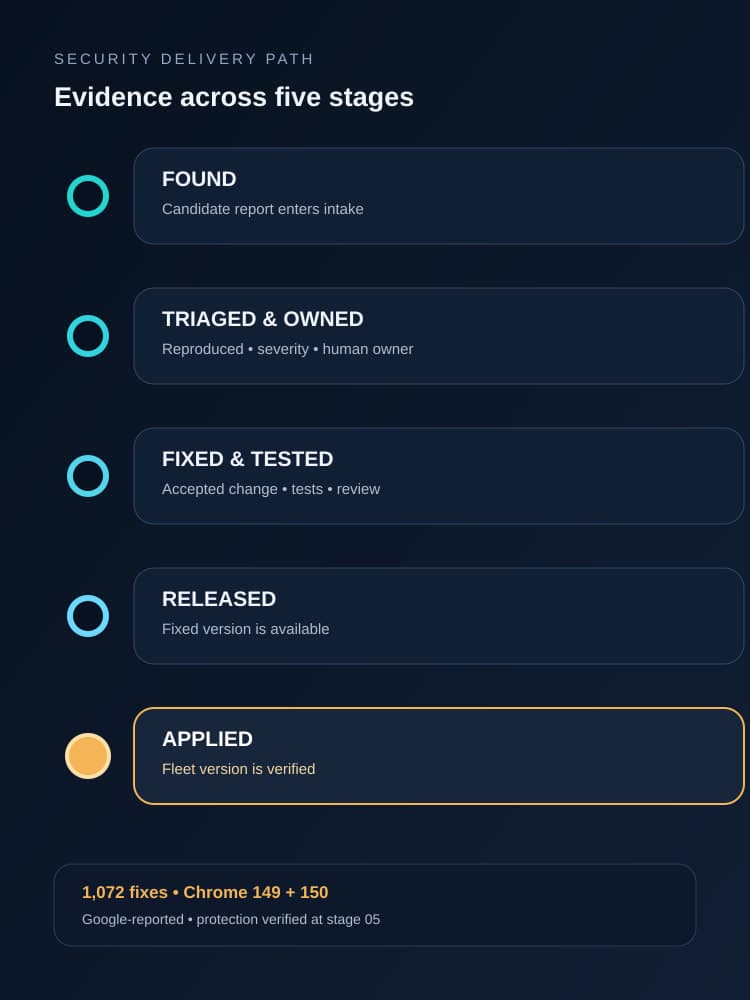
On July 30, 2026, the Chrome Security Team reported a large increase in AI-assisted security throughput. Chrome says it fixed 1,072 security bugs in Chrome 149 and 150, more than it fixed across the prior 23 release milestones combined. That count measures the number of fixes in those two milestones. It does not show how many reports were rejected, how much review each fix required, whether a fix caused a regression or was reverted, or how many endpoints applied the protected version.
The completion boundary comes later. A fixed bug protects users only after Chrome releases the fix and the browser applies the update. By following Chrome's five-stage lifecycle, operators can identify which times and evidence they must retain before they claim that an AI-assisted security process improved protection.
Chrome's five stages end at the applied update
A vulnerability is a software bug with a security effect. An exploit is code or a technique that uses a vulnerability to read private data, gain control, or perform another malicious action. Chrome defines five ordered stages for a security bug: found, triaged, fixed, released in a Chrome update, and applied after Chrome restarts. Triage is the intake process that filters invalid reports, reproduces a bug, sets its severity, and assigns an owner.
Each stage depends on the one before it. Discovery creates a report. Triage determines whether the report deserves work and who owns it. A reviewed fix must still enter a release, and the endpoint must apply that release. Evidence from an earlier stage cannot prove completion at a later one.
Our earlier analysis of the Anthropic and Mozilla Firefox security collaboration focused on discovery, reproducibility, human validation, and time to fix. Chrome's lifecycle continues through release and endpoint application. It therefore changes where an operator should stop the clock.
Faster discovery increases the work at triage
Chrome says an early-2026 Gemini agent harness found vulnerabilities across the Chrome codebase with higher efficiency and fewer false positives. A false positive is a report that appears valid but does not represent a reproducible security bug. Google does not publish the denominator, false-positive rate, benchmark, or comparison method, so the post does not quantify the size of that improvement.
Chrome reports that one finding was a sandbox escape that had remained in the codebase for more than 13 years. A sandbox escape lets code break out of an isolated process. In this case, Chrome says a compromised renderer could have tricked the browser into reading local files.
Chrome says the discovery system can use models with public weights and proprietary models. It combines Chrome's Git history, past Common Vulnerabilities and Exposures (CVE) records, and SECURITY.md files that describe threat boundaries. A separate critic agent checks another agent's work, and Chrome repeats scans because model results can vary between runs.
Chrome also says these scans read source code at rest on locked-down machines without general internet access. Network requests are intercepted and allowlisted, and subagents cannot change the local system or read files outside designated source directories. Chrome presents this work as a complement to fuzzing and external security research, not as a replacement for either.
The new volume then enters triage. Chrome describes four operations. The system filters spam, duplicates, and reports that do not meet intake rules. It reproduces a proof of concept on the affected operating system and browser versions, adds technical details such as stack traces, sets metadata and severity, and routes the issue to a component and human owner. Developers can change the assigned severity.
Chrome says a security report historically took 5 to 30 or more minutes to triage. Google estimates that the current automation saves hundreds of developer hours each month, while stating that the estimate is hard to measure precisely. The mechanism is clearer than the estimate: an accepted report must leave triage with reproduction evidence, an affected scope, a severity, and a named human owner. Faster discovery can only help if that intake work keeps pace. Our analysis of the shared vulnerability-report intake problem covers the coordination burden that appears when finding volume outruns review.
Candidate fixes still need tests, review, and a release
Chrome says its fixing agent prepares multiple candidate fixes. A separate critic evaluates which candidate is the best fit, and the two agents work in a review loop that checks whether the code works and follows local code rules. Test-writing agents then check supported platforms and configurations before a developer reviews the proposed fix.
This process separates code generation from approval. The post keeps developer review explicit, and it describes candidate fixes rather than autonomous acceptance. The distinction matters when a team measures output: generated patches, accepted fixes, and released fixes are different events.
Chrome reports that 1,072 security bugs were fixed in Chrome 149 and 150. The post does not publish an independent denominator, the severity mix, the revert or regression rate, or the human effort per fix. The count is publisher-reported evidence of fix throughput. It cannot establish false-positive cost, review cost, or applied protection on its own.
After an accepted change lands, release work starts. Chrome says security fixes can be merged from the main development tree into the active Stable release branch based on severity. Chrome monitors that branch for new crashes and regressions.
Chrome calls the interval between public source visibility and user protection the patch gap. An N-day attack exploits a vulnerability after a public fix reveals it but before the affected user has applied the update. Chrome says a fix committed to the main tree typically takes weeks to reach Stable. Google is moving Chrome to two-week major milestones with weekly security updates, and it is piloting two security releases per week. Those changes shorten the release part of the patch gap. Endpoint application still requires separate evidence.
The patch gap ends when the endpoint applies the update
Chrome says it downloads update binaries in the background and stages them on disk. The browser applies the staged update at its next restart. Later in the same post, Google says triage, fixing, testing, and release take 1 to 2 days, while the wait for a restart can add materially to N-day exploitation risk. The source does not reconcile that 1-to-2-day statement with its separate claim that fixes committed to the main tree typically take weeks to reach Stable, or explain the bug classes and delivery paths behind each figure. Neither figure should become a general service target.
A merged change proves that code was accepted. A security release proves that a fixed version is available. A recorded restart after the update was staged, or a verified fleet version, provides evidence that the affected endpoint applied it. Without that final evidence, the team knows the fix exists but does not know whether the endpoint is protected.
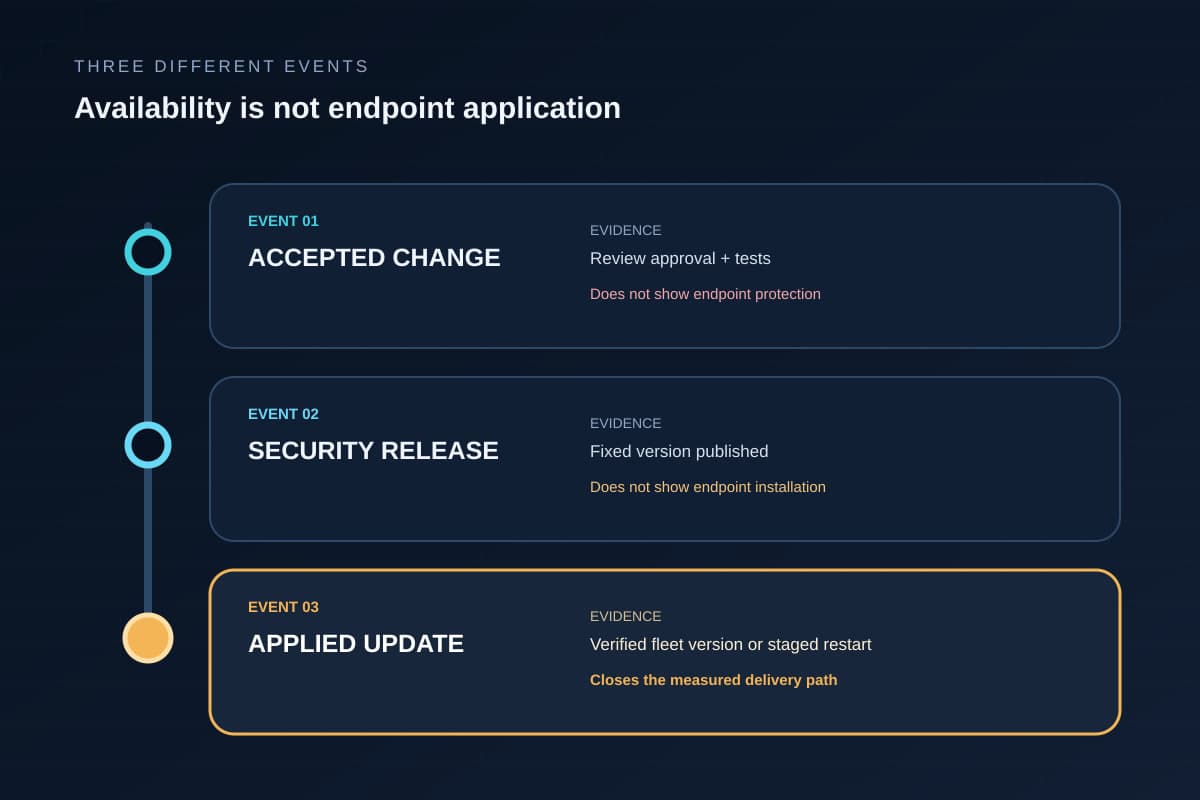
Chrome is researching dynamic patching that would replace background Renderer and GPU processes in sequence, without a full browser restart in most cases. This is future development, not a universal current behavior. Chrome also says version 150 on macOS can restart automatically when an update is pending and the application has no open windows but remains active in the background. That narrow state does not support a general claim that Chrome now restarts automatically on every platform.
For managed fleets, Google recommends the RelaunchNotification policy, Extended Stable for environments that require update vetting, and Chrome Enterprise Core or Premium dashboards for fleet version visibility. These are Google recommendations. They are not BaristaLabs test results.
Keep the five times that connect discovery to protection
For a local review, start with one high-severity finding and confirm that every stage can be observed. Then compare accepted findings from the same severity class across fixed before-and-after windows. Keep the severity rule, window length, and denominator consistent.
Scroll sideways to see all 3 columns.
| Stage | Time to retain | Evidence to keep |
|---|---|---|
| Found | When the report was first recorded | Original report, discovery source, and affected code or version identified at intake |
| Triaged and owned | When the report was reproduced, accepted, and assigned | Duplicate and intake decisions, reproduction evidence, affected operating systems and browser versions, severity, component, and human owner |
| Fixed and tested | When the reviewed fix and required tests were accepted | Accepted change, test results, and developer approval |
| Released | When the first fixed Stable version was published | Fixed version, release record, and CVE or release note when available |
| Applied | When the affected fleet was verified on the required version | Restart record after the update was staged or fleet version inventory, affected endpoint denominator, and endpoints that missed the required version |
Keep rejected, duplicate, and irreproducible reports separate from the accepted path, but retain them for the same window. Also retain fixes that were reverted or caused regressions, and endpoints that missed the required version. Those records show costs and coverage that a fixed-bug count cannot show.
Report stage medians or percentiles only when there are enough observations, and state the denominator and comparison window. Do not mix severity classes to create a larger sample. The useful comparison is the elapsed time between each adjacent stage and the full time from finding to verified application.
Automate the stage where accepted findings still wait
Expand discovery automation only when the next constrained stage has capacity and the team can verify endpoint application. If accepted reports wait for owners, invest in triage and ownership. If reviewed fixes wait for platform tests or a Stable release, invest there. If released versions miss endpoints, improve restart enforcement and fleet version visibility. Faster discovery otherwise enlarges the queue without reducing the time to protection.
BaristaLabs can help trace one AI-assisted finding from intake through endpoint application. Our AI consulting work measures where elapsed time and review work accumulate, so the next investment goes to the stage that still delays protection. If you want to inspect that path with us, review the security delivery path.
Sources
Security workflow review
Find the stage that is actually delaying protection
BaristaLabs can trace one finding from intake through endpoint application, measure where elapsed time and review work accumulate, and identify the next useful automation target.
Best fit for teams adding AI to vulnerability discovery, triage, remediation, testing, release, or endpoint operations.
Turn this idea into a pilot
Which workflow should go first?
Use the readiness check to compare impact, effort, risk, owner, and next step before requesting a review.
- 3-5 minutes
- Deterministic score
- No sensitive data
Practical AI Workflow Notes
Want more practical AI operations ideas?
Get short notes on applying AI inside real small-business workflows — from document handling and customer follow-up to internal reporting, compliance, and automation guardrails.