


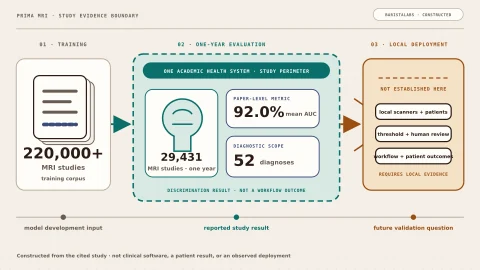
Prima is a University of Michigan AI model for brain MRI studies. In Nature Biomedical Engineering, the researchers report a mean diagnostic area under the receiver operating characteristic curve (AUC) of 92.0% across 52 radiologic diagnoses. The one-year evaluation included 29,431 MRI studies at one academic health system, after training on more than 220,000 MRI studies.
The result measures model discrimination under one study design. The cited sources do not establish better patient outcomes or autonomous diagnosis. A deployment review must still test local patients, scanners, thresholds, and human review before Prima changes an urgent-care workflow.
The release metric and the paper metric answer different questions
The Michigan Medicine release, as reproduced by ScienceDaily, says Prima reached 97.5% accuracy. That page does not identify the paper-defined task, denominator, or decision threshold behind the figure. This makes 97.5% unsuitable as a summary of performance across 52 diagnoses.
The final paper abstract gives a different study-level result: mean diagnostic AUC of 92.0%. AUC measures how well a model separates positive and negative cases across possible classification thresholds. It is not the percentage of diagnoses that were correct at one selected threshold.
The mean also combines performance across 52 diagnoses. It does not show the result for each condition or the false alarms and missed cases that a clinical team would see after it selects a threshold. Those per-diagnosis results matter most for urgent conditions, where the cost of a missed case can differ sharply from the cost of an extra review.
The accessible final primary text does not tie 97.5% to an exact task and denominator. For that reason, this article does not use the figure in the title, excerpt, or search metadata, and it does not present the figure as general diagnostic accuracy.
Prima produces model outputs for diagnosis, priority, and referral
Nature describes Prima as an AI foundation model for neuroimaging. A foundation model learns reusable features from a broad training corpus so that teams can adapt those features to several tasks. Prima uses a hierarchical vision architecture to process clinical MRI studies and learn features at different levels of the imaging data.
The Michigan Medicine release calls Prima a vision-language model, which means that it can process image and text data together. The release says the system combines MRI data with the patient’s clinical history and the reason for the scan. This context gives the model more information than a narrow detector trained to find one lesion in one image sequence.
The paper abstract reports three types of output: differential diagnoses, radiologist worklist priority, and clinical referral recommendations. A differential diagnosis lists possible explanations for the imaging findings. A priority output can move a study earlier in a radiologist’s queue. A referral recommendation can point toward a relevant specialty.
These outputs could support a clinical workflow, but each output needs its own acceptance test. A diagnosis score, a worklist rank, and a referral recommendation have different errors and different consequences. The cited abstract does not report that Prima replaced a radiologist, sent autonomous alerts in routine care, or improved patient outcomes.
The study has boundaries that matter outside Michigan Medicine
The evaluation took place within one academic health system. The abstract reports performance across diverse patient groups and MRI systems inside that study. It does not establish the same performance at another health system with different scanners, protocols, referral patterns, disease prevalence, or documentation practices.
A mean AUC can support comparison across models, but it does not set a safe operating threshold. A clinical team still needs the rate of true cases detected and the rate of false alarms at the threshold used for each diagnosis. It also needs subgroup results with enough cases to detect important differences instead of relying only on an overall fairness statement.
Nature’s data-availability statement places another limit on independent review. It says the model parameters are for investigational use and that the raw patient MRI data are not public. Data sharing is subject to institutional agreements, patient-privacy duties, and non-commercial academic or investigational use. Other teams can inspect the code and test the model on data they can lawfully use, but they cannot reproduce the full study from an open copy of the training corpus.
The clinical outcome boundary is separate. Diagnostic discrimination can justify further testing. It cannot show by itself that patients receive faster treatment, that urgent cases are never delayed, or that a new queue produces fewer harmful errors. Those questions require workflow and outcome evidence.
A local evaluation must connect the metric to the workflow
A technical or clinical leader can use the paper as a starting point for a local validation plan. The plan should answer these questions before any model output changes care:
- Define the target diagnosis, the positive case, and the denominator. Report AUC for comparison, then report sensitivity, which is the share of true cases detected, and precision, which is the share of model flags that are true, at the proposed threshold.
- Test the patient population, scanner vendors, field strengths, imaging protocols, and referral patterns that the local workflow receives. Review results for important demographic and clinical subgroups.
- Compare Prima with the current process. Measure the same cases against the radiologist workflow, queue order, turnaround time, false alarms, and missed urgent cases.
- Run a prospective local test in silent mode first. Record what Prima would have ranked or recommended without changing the live worklist, and define stop criteria before the test starts.
- Keep radiologist review and failure handling explicit. Name who reviews each output, what happens when required data are missing, how the team handles a model timeout, and how staff can reject or override a recommendation.
- Evaluate workflow and patient outcomes separately from model performance. AUC, queue time, time to clinical review, treatment timing, and patient outcomes answer different questions and need different study designs.
The precision and recall guide explains why a selected threshold moves errors between missed cases and false alarms. The related guide, A confidence score is not an approval policy, explains why a model score can support routing without granting authority to act.
The Nature paper gives Prima a credible reason for further local validation. A deployment decision still depends on whether a fixed threshold improves a specific, reviewed workflow for local patients without unacceptable misses or false alarms.
Sources
- Yiwei Lyu et al., “Learning neuroimaging models from health system-scale data”, Nature Biomedical Engineering, published February 6, 2026.
- Nature publisher abstract and data-availability statement.
- Michigan Medicine release reproduced by ScienceDaily, dated February 10, 2026. This source is used for attributed descriptions and release context, not as the study-level performance summary.
Model evaluation
Turn model evidence into a local validation plan
BaristaLabs helps technical teams define the target metric, comparison baseline, human review point, failure thresholds, and stop criteria before a model changes a live workflow.
Best fit when a paper shows promising model performance, but the team still needs a source-bounded test for its own data and workflow.
Practical AI Workflow Notes
Want more practical AI operations ideas?
Get short notes on applying AI inside real small-business workflows — from document handling and customer follow-up to internal reporting, compliance, and automation guardrails.