

Something wild happened in the software industry last week: it decided it doesn't want to be the software industry anymore.
The New York Times ran a piece on Friday titled "Software? No Way. We're an A.I. Company Now!" -- and it captures a mass identity crisis that is already affecting the tools your business relies on every day.
Here is the short version: traditional software stocks just experienced their biggest plunge in over 30 years. J.P. Morgan estimates that roughly $2 trillion in market cap has been wiped out from peak valuations. The S&P North American Expanded Technology Software Index dropped about 20% in the past month alone. Salesforce and ServiceNow -- names you probably recognize from your own vendor stack -- have seen shares fall 40% or more over the past year.
The response from the industry? A frantic scramble to slap "AI" on everything.
The Great Rebrand
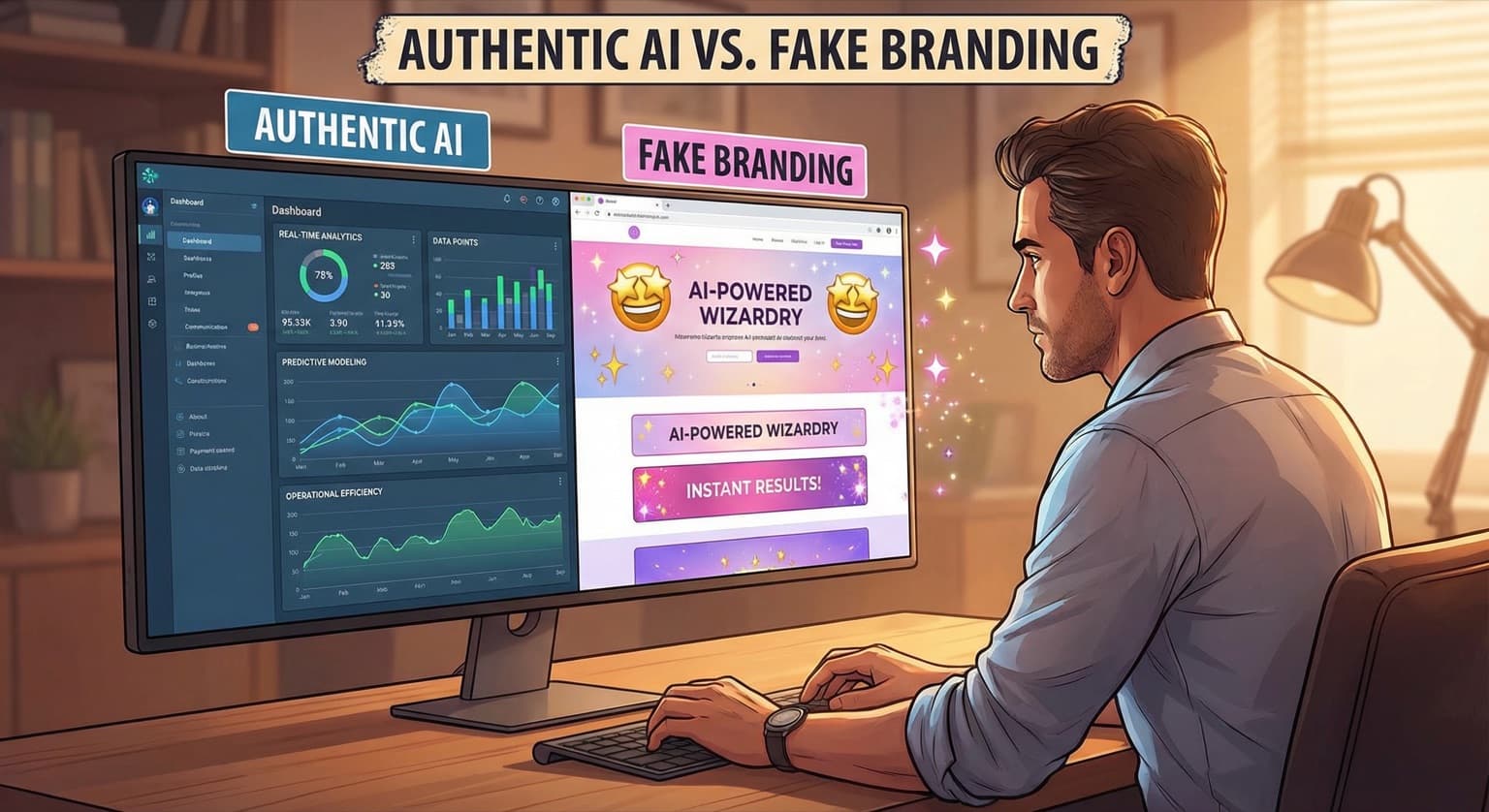
If you have been paying attention, the signs are everywhere. Company websites are swapping ".com" for ".ai" domains. Sparkle emojis and magic wand icons are popping up across product dashboards. VC investors report that virtually every software startup pitch now leads with an AI angle, whether the product actually uses AI or not.
We recently covered how SaaStr rebranded itself to "SaaStr AI" -- a pretty striking signal when the world's largest SaaS community decides the "Software as a Service" label is no longer worth keeping. But SaaStr is just one data point in a much broader wave.
The NYT story highlights Intercom CEO Eoghan McCabe, who saw this coming before most. His reasoning was blunt: if AI chatbots can handle customer queries directly, companies won't need help desk software in the traditional sense. So he didn't just rebrand Intercom -- he rebuilt it around AI from the ground up. That distinction matters, and we will come back to it.
Why This Matters for Your Business
You might be thinking: stock prices and corporate rebrands are Wall Street problems. Why should a small business owner care?
Because the tools you pay for every month are caught in this upheaval. When your CRM vendor, your email marketing platform, or your accounting software suddenly pivots to calling itself an "AI company," one of two things is happening:
- They are genuinely rebuilding their product around AI -- which could mean better features, smarter automation, and real time savings for you.
- They are panicking about their stock price and dressing up the same product with new buzzwords -- which means you are paying for marketing, not innovation.
The $2 trillion wipeout also raises questions about vendor stability. As Mark Cuban recently pointed out, the traditional software model is under real pressure. Companies that fail to adapt may cut corners, raise prices, or disappear entirely. If your business depends on a vendor that is struggling to find its footing, you need to know about it now -- not when the service goes down.
Red Flags: The AI Costume Party
Not every AI rebrand is genuine. Here is what to watch for:
The overnight transformation. If a vendor that has been selling the same product for years suddenly calls itself an "AI-first company" without launching meaningfully new features, be skeptical. Real AI integration takes engineering effort and time.
Sparkle without substance. Adding an AI chat widget to a sidebar or auto-generating email subject lines is not the same as rebuilding a product around AI. Look for changes to core workflows, not decorative add-ons.
Vague claims. Phrases like "AI-powered," "intelligent automation," and "smart insights" are everywhere. Ask specifically: what model powers this? What data does it train on? Can you show me a before-and-after of the workflow? If they can not answer clearly, the AI label is probably cosmetic.
Pricing jumps with no new value. Some vendors are using the AI rebrand as cover to raise prices. If your monthly bill went up but the product feels the same, that is a red flag.
Green Flags: Real AI Integration
On the other hand, some companies are doing the hard work. Here is what genuine AI integration looks like:
Workflow changes, not just features. When Intercom rebuilt around AI, it didn't just add a chatbot -- it rethought how customer support works. Look for vendors that are changing how you interact with the product, not just adding a tab.
Transparent AI use. Good vendors will tell you exactly what their AI does, what data it uses, and where humans are still in the loop. Opacity is a warning sign.
Measurable outcomes. Real AI capability shows up in your metrics. Faster response times. Fewer manual steps. Better predictions. If you can not measure the difference, the "AI" might not be doing much. We have seen this play out in areas like A/B testing being replaced by AI optimization -- the gains are concrete and visible.
Five Questions to Ask Your Vendors
Next time a software vendor pitches you on their AI capabilities, ask these:
- "What specifically changed in the product in the last 12 months?" You want concrete feature releases, not a new logo.
- "What AI model or technology powers this?" They don't need to reveal trade secrets, but they should be able to explain the basics.
- "Can I see it work on my actual data?" A demo with canned data proves nothing. Real AI should handle your messy, real-world information.
- "What happens if the AI is wrong?" Good AI products have guardrails and fallbacks. If there is no answer here, the product is not ready.
- "How does this change what I am paying?" Understand whether AI features are included or an upsell -- and whether the value justifies any price increase.
The Bottom Line
The software industry's identity crisis is real, and it is not going away anytime soon. For small businesses, this is both a risk and an opportunity. The risk is getting stuck with vendors that are all hat and no cattle -- lots of AI branding with no real capability underneath. The opportunity is finding tools that genuinely use AI to save you time, cut costs, and compete with bigger players.
The key is being a smart buyer. Don't take the "AI" label at face value. Ask hard questions. Look for measurable results. And if you are evaluating new tools, check out our guide to the top AI tools for small businesses in 2026 for recommendations that have been vetted for real-world use.
Need help evaluating your current software stack or figuring out which AI tools are worth the investment? Get in touch -- we help small businesses cut through the noise and make smart technology decisions.
Back-Office Automation ROI Worksheet
Choose the first automation with evidence, not vibes.
AI tools can make almost any workflow look automatable. The ROI worksheet helps you pick the one most likely to pay back quickly. If one workflow rises to the top, BaristaLabs can help decide whether a lightweight tool, integration, or custom pilot is the best next step.
Use broad workflow categories in the form; save specifics for a scoped conversation.
Turn this idea into a pilot
Which workflow should go first?
Use the readiness check to compare impact, effort, risk, owner, and next step before requesting a review.
- 3-5 minutes
- Deterministic score
- No sensitive data
Practical AI Workflow Notes
Want more practical AI operations ideas?
Get short notes on applying AI inside real small-business workflows — from document handling and customer follow-up to internal reporting, compliance, and automation guardrails.