The Death of A/B Testing: Why Scarcity No Longer Rules the Web
A/B testing assumes you can only afford one website. AI changes the math. Stop splitting your traffic and start multiplying your presence.

Sean McLellan
Lead Architect & Founder

A/B testing has a dirty secret: your "B" variant is actively costing you money.
For decades, we've accepted this trade-off. We split our traffic, show half of our visitors a version we suspect might be inferior, and wait for statistical significance. We do this because we operate under a fundamental constraint: scarcity.
Building a website used to be expensive. Designing, coding, and maintaining a high-quality digital experience required significant human effort and capital. Because we could only afford to build and maintain one "real" website, we had to ensure it was the best possible version for the average user. A/B testing was the tool we used to find that local maximum.
But that constraint is gone.

The Economics of Abundance
AI has driven the marginal cost of creating software and content effectively to zero. As a16z notes in "The Economic Case for Generative AI", "Generative AI promises to bring the marginal cost of creation to zero."
When the cost of building a website drops to near-zero, the logic of A/B testing collapses. Why choose between Headline A and Headline B when you can generate a unique landing page for every single visitor? Why optimize for the median user when you can serve the entire distribution?
Instead of splitting your traffic to find the "winner," you should be multiplying your presence.
The Traffic You "Lose" Was Never Yours
In the old model, visitors who bounced were often considered "lost conversions"—people who didn't like what you offered. But in reality, many of them were simply unserved customers. They had preferences, needs, or contexts that your single, median-optimized site couldn't satisfy.
By forcing everyone into the same funnel, you're inevitably alienating the edges of your bell curve. A/B testing just helps you alienate slightly fewer people.
AI allows you to expand your total addressable audience by dynamically generating experiences that resonate with specific segments. As OfferFit argues, reinforcement learning (RL) and AI decisioning are replacing static A/B testing by continuously adapting to user behavior in real-time.
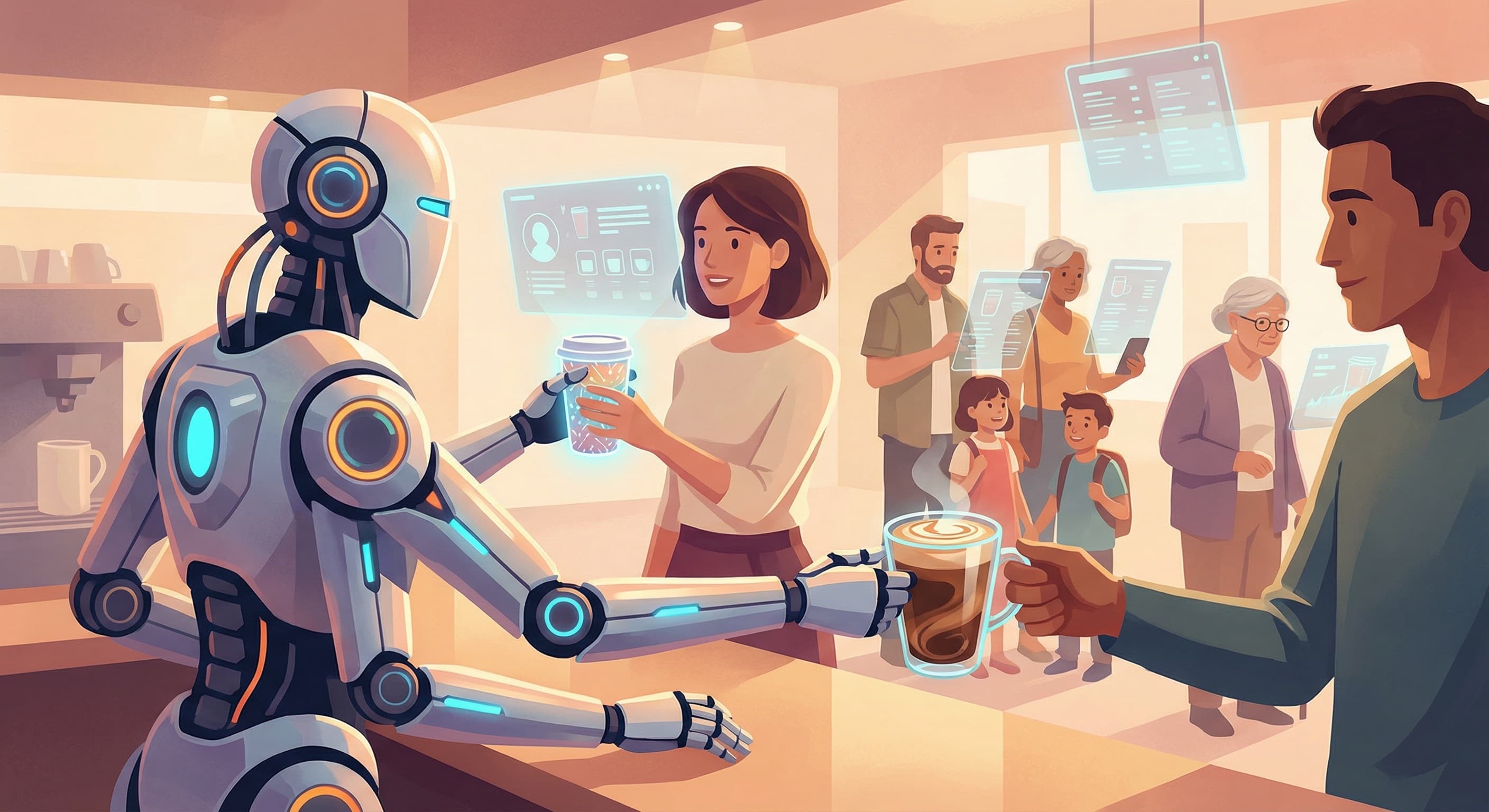
The Long Tail of Web Presence
Imagine a guitar shop. In the physical world, the shopkeeper changes their pitch based on who walks in. For a beginner, they talk about ease of play and durability. For a professional, they discuss tonewoods and pickup winding.
On the web, we've historically been forced to give the same pitch to everyone. But with AI, we can build the digital equivalent of that adaptable shopkeeper. We can launch:
- A site optimized for beginners (simplified jargon, focus on learning).
- A site for collectors (high-res galleries, provenance details).
- A site for gigging musicians (specs, durability, road-readiness).
Each site is a "real" site, fully maintained and optimized by AI agents. The guitar shop doesn't just have a "B" variant; it has an entire fleet of specialized storefronts.
Practical Questions
You might be thinking, "This sounds chaotic." And yes, it requires a shift in how we manage web properties.
- SEO Cannibalization: Won't multiple sites compete? Not if they target distinct intents and keywords. Subdomains or distinct brands can target specific long-tail queries without diluting the main domain.
- Management Complexity: How do you update 50 sites? You don't. AI agents do. You define the core brand truth and the inventory; the AI handles the presentation layers.
- Consistency: Centralized content systems (headless CMS) ensure that pricing and inventory are always accurate across all variants.
- Measurement: You stop measuring "conversion rate" on a single URL and start measuring total conversions across your entire portfolio.
Closing: Stop Splitting, Start Multiplying
A/B testing was a brilliant solution to a problem that no longer exists. It was an optimization technique for a world of scarcity.
That world is behind us. The scarcity constraint has been lifted.

If you're still A/B testing a single landing page, you're fighting a war with muskets while your competitors are deploying drone swarms. Stop trying to find the one "perfect" version of your site. It doesn't exist.
Instead, build them all. Let the market sort it out. And watch your "lost" traffic turn into your most loyal customers.
Turn this idea into a pilot
Which workflow should go first?
Use the readiness check to compare impact, effort, risk, owner, and next step before requesting a review.
- 3-5 minutes
- Deterministic score
- No sensitive data
Practical AI Workflow Notes
Want more practical AI operations ideas?
Get short notes on applying AI inside real small-business workflows — from document handling and customer follow-up to internal reporting, compliance, and automation guardrails.