Silicon-Carbon Batteries: The Quiet Revolution Powering Your Next Device
Silicon-carbon batteries store 10x more energy than graphite—and they're already shipping in phones. EVs are next.

Sean McLellan
Lead Architect & Founder
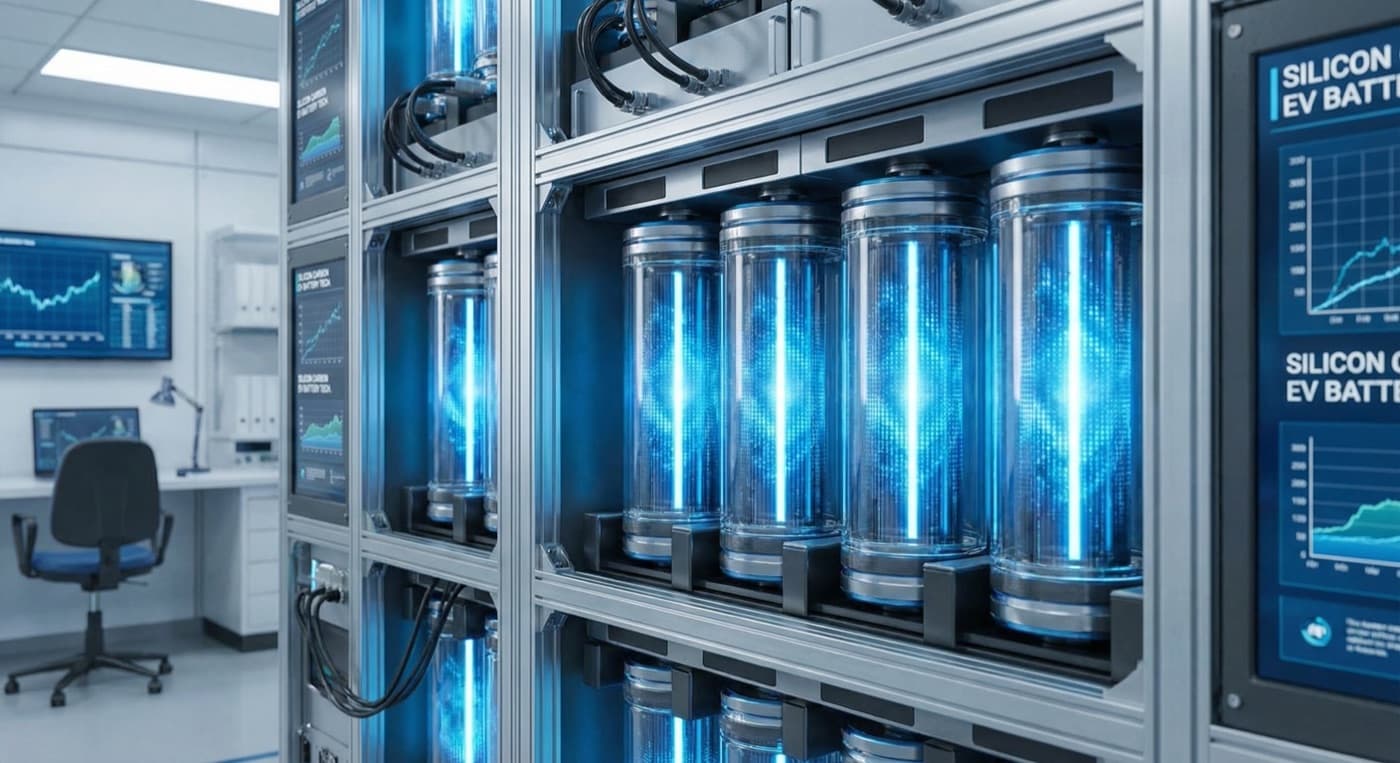
While the world holds its breath for solid-state batteries, a quieter revolution is already in our pockets. Silicon-Carbon anode technology has moved from the lab to the production line, offering a critical stepping stone in the quest for higher energy density.
For years, graphite has been the dependable workhorse of the battery world. But as our devices demand more power and our EVs demand more range, graphite's limitations have become a bottleneck. Enter silicon.
The Silicon Promise: 10x Potential
The physics are simple but compelling: a silicon anode can store approximately 10 times more lithium ions than a traditional graphite anode. If graphite is a parking lot, silicon is a multi-story garage.
However, this massive capacity comes with a massive catch. When silicon absorbs lithium ions during charging, it swells—expanding by up to 300%. In early prototypes, this expansion caused the battery internals to crack and fail after just a few cycles. It was a brilliant battery that only worked a handful of times.
The Solution: The Carbon Matrix
The breakthrough came not by replacing silicon, but by caging it. Manufacturers have developed a carbon matrix—a microscopic scaffolding that holds the silicon particles in place.
Think of it like a honeycomb. The carbon structure provides room for the silicon to expand without destroying the battery's overall architecture. It stabilizes the Solid Electrolyte Interphase (SEI) layer and maintains electrical conductivity even as the silicon swells and shrinks.
The result? A battery that offers:
- Higher Energy Density: Up to 20% more capacity in the same physical size.
- Faster Charging: Improved ion transport kinetics.
- Lighter Weight: Essential for everything from drones to sports cars.
Already In Your Pocket
This isn't vaporware. If you've looked at the Honor Magic V3, the OnePlus 13, or the latest Xiaomi flagships, you've seen this tech in action. These devices leverage silicon-carbon batteries to maintain slim profiles while packing in 5,000mAh+ capacities that were impossible with pure graphite.
So why haven't Apple and Samsung made the switch?
The answer lies in scale and safety. The supply chain for high-purity silicon anodes is still maturing. For a company shipping hundreds of millions of iPhones, a 1% defect rate is a catastrophe. Apple and Samsung are reportedly waiting for the technology to pass rigorous long-term safety validation, particularly regarding thermal stability as energy density climbs.
The EV Tipping Point: 2026
While smartphones are the early adopters, electric vehicles are the main event. 2026 marks the year we expect to see the first large-scale deployment of silicon-carbon anodes in production EVs.
Mercedes-Benz (with Sila Nanotechnologies) and Porsche (with Group14 Technologies) are leading the charge. For the EV market, this technology promises to push ranges past the 500-mile mark without increasing battery weight—a critical factor for efficiency and handling.
A Crucial Stepping Stone
It's important to view silicon-carbon not as the final destination, but as the vital bridge to the future. It sits comfortably between traditional Lithium-Ion (stable, cheap, lower density) and Solid-State (ultra-high density, expensive, still maturing).
For the next 3-5 years, silicon-carbon will likely be the premium standard, enabling lighter phones and longer-range cars while solid-state manufacturing costs come down.
At Barista Labs, we track these hardware shifts because they dictate the software possibilities of tomorrow. More power density means more on-device AI compute, longer-lasting autonomous agents, and form factors we haven't even imagined yet.
The battery revolution isn't coming. It's already here.
Turn this idea into a pilot
Which workflow should go first?
Use the readiness check to compare impact, effort, risk, owner, and next step before requesting a review.
- 3-5 minutes
- Deterministic score
- No sensitive data
Practical AI Workflow Notes
Want more practical AI operations ideas?
Get short notes on applying AI inside real small-business workflows — from document handling and customer follow-up to internal reporting, compliance, and automation guardrails.