
Linux is dropping Assisted-by: what AI disclosure needs
The Linux kernel is removing its Assisted-by tag because only about 10% of 7.3 commits carried it and a missing tag said nothing. Here's what an AI disclosure rule needs instead.

Sean McLellan
Lead Architect & Founder

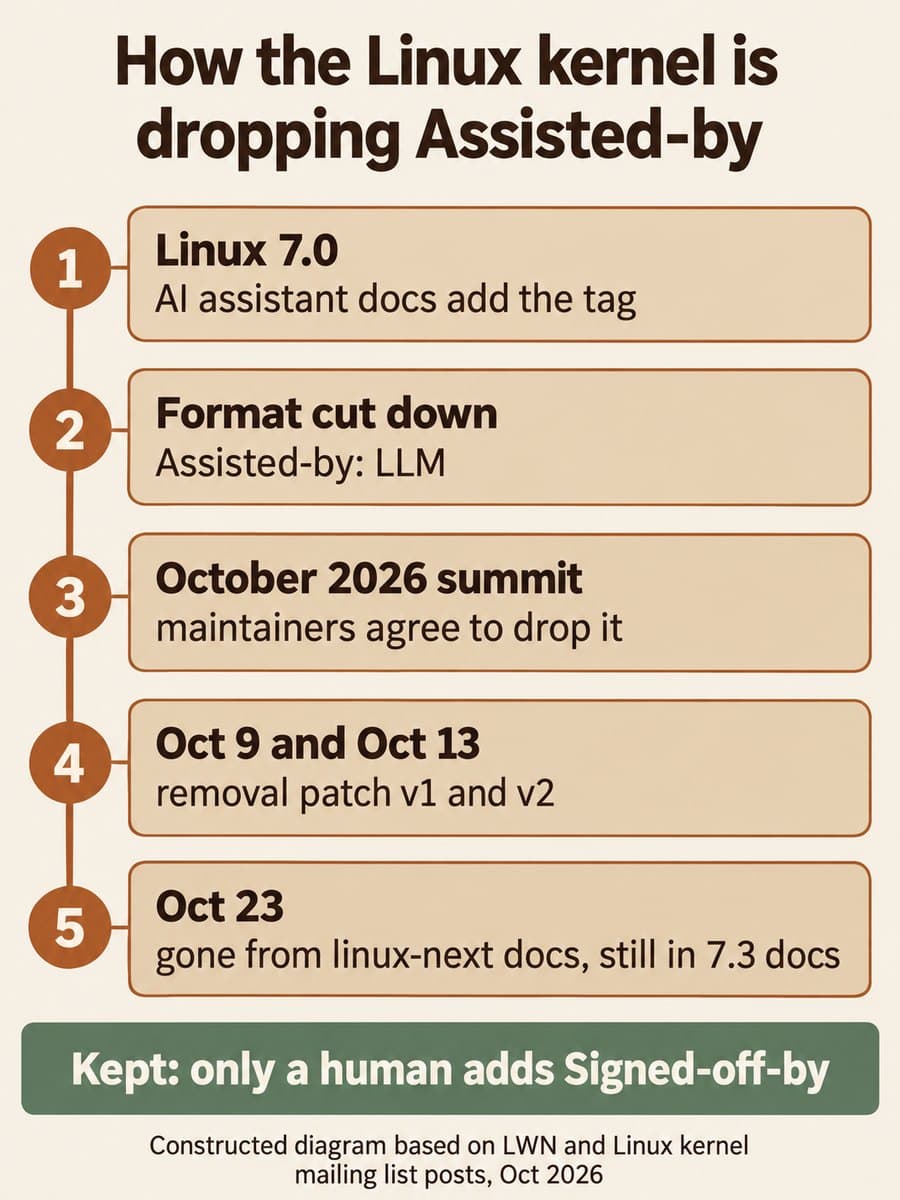
On October 9, 2026, Sasha Levin posted a patch to remove the Assisted-by tag from the Linux kernel's contribution rules, a day after the kernel Maintainers Summit agreed to drop it. The reason is simple. In the 7.3 cycle through -rc7, only about 10% of non-merge commits carried the tag, even though maintainers say AI use is far more widespread. A missing tag told reviewers nothing.
If your team asks for an AI disclosure trailer, the kernel just ran the experiment for you. An optional label that nobody checks doesn't measure AI use. It measures who bothers to comply. Before you copy anyone's trailer format, decide whether you'll enforce the rule in CI or replace it with a few sentences of prose that reviewers actually read.
What happened to Assisted-by in the Linux kernel?
The kernel isn't done removing it yet, so the precise wording is "being removed." Here is the record as of October 23, 2026.
Scroll sideways to see all 3 columns.
| Date | What happened | Source |
|---|---|---|
| Linux 7.0 | The kernel's AI coding assistants document adds an Assisted-by tag | LWN |
| Later | The format is cut down to Assisted-by: LLM [TOOL1] [TOOL2] | Patch v2, mainline docs |
| July 2026 | A proposal to drop the tag is turned down | Patch v2 |
| October 8 | The Maintainers Summit in Prague discusses LLMs, and the room agrees to drop the tag | LWN |
| October 9 | Levin posts v1 of the removal patch | LWN copy of v1 |
| October 13 | v2 carries Reviewed-by tags from Kees Cook and Greg Kroah-Hartman and an Acked-by from Lorenzo Stoakes | Patch v2 |
| October 21 | Christian Brauner adds his Reviewed-by | LKML |
| October 23 | The attribution section is gone from the linux-next docs and still present in the mainline 7.3 docs | Both doc pages |
The patch removes the attribution section from coding-assistants.rst, the "Using Assisted-by" section from submitting-patches.rst and its translations, and the tag handling in checkpatch.pl. LWN's account of the Summit comes with a caveat from its author, Jonathan Corbet, that it is "entirely my interpretation" of an invitation-only discussion. The patch text and the mailing-list replies are the primary record.
Why didn't the Assisted-by tag work?
The tag failed as a signal, not as a format. LWN counted 18,533 non-merge changesets in the 7.3 cycle through -rc7, and 1,884 of them, essentially 10%, carried the tag. At the same Summit, LWN reports Dave Airlie's estimate that about 90% of contributors use LLMs.
The v2 patch spells out the consequence: "the tag does not provide the signal it was kept for: its absence says nothing about how a patch was made." It also states the choice: "The choice was between finding a way to enforce the requirement and dropping it, and there was a strong, though not unanimous, consensus in the room to drop it."
Some maintainers said so in public. Greg Kroah-Hartman wrote on October 13: "I've now changed my mind, it didn't work out at all and maintainers are really annoyed by it so let's just drop it and focus on the content of the patch itself." Kees Cook's reply to v1 was shorter: "it has become as redundant as specifying what editor I use."
Not everyone agrees. Laurent Pinchart wrote that he was "not happy removing the tag without adding another mechanism for required disclosure," as The Register reported. Steven Rostedt argued on the list that changes like this "should not rely on LWN articles" and said he would like a stronger Vibe-coded-with: tag. The dissent matters because it names the open question: if not a tag, then what?
What the kernel is keeping
Dropping the tag is not dropping disclosure or accountability. Three things stay:
- The DCO rule. The kernel's guidance still says AI agents must not add
Signed-off-bytags, because only a human can legally certify the Developer Certificate of Origin. - Submitter responsibility. The person who sends the patch owns it, whatever tools produced it.
- Prose disclosure. Per the v2 patch, information about tool use belongs in the patch cover letter, and the separate
generated-content.rstguidance that asks for transparency is unchanged.
That's the part worth copying. The kernel moved disclosure out of a machine-readable line nobody checked and into the text a reviewer reads before the diff.
What does an AI disclosure rule need instead?
This section is BaristaLabs' interpretation, not the kernel's. We think a disclosure rule has to pass three tests.
- Someone reads it. Name the reader and what they do differently. A reviewer who looks harder at generated tests is a reader. A dashboard nobody opens is not.
- Silence means something. If a missing label could mean "no AI" or "didn't bother," the label carries no information. That was the kernel's problem.
- It sits where review already happens. Commit trailers suit audits and
git logqueries. PR descriptions and cover letters suit reviewers.

Those tests lead to two workable options, with a hard line shared by both.
Scroll sideways to see all 4 columns.
| Option | What you ask for | How you know it's honest | Good fit |
|---|---|---|---|
| Enforce it | A yes/no AI answer on every PR, plus a trailer when the answer is yes | CI fails when the answer is missing, and trailers are detected and labeled | Teams that need an audit trail of AI-assisted changes |
| Ask for prose | A short note in the PR description or cover letter: which tools, used where | The reviewer reads it with the diff and can ask follow-up questions | Teams that care more about review quality than counting |
| Both | Only a human adds Signed-off-by or approves the merge | Branch protection and DCO checks | Everyone |
The option to avoid is the one the kernel just retired: an optional trailer with no check.
How to enforce an AI disclosure rule with free tools
You don't need to build a checker. Open-source projects have already published working pieces you can adapt.
- CHAOSS disclosure. The CHAOSS project's disclosure tool scans a commit range for
Co-Authored-ByandAssisted-Bytrailers, known AI bot committer emails, and agent branch names such ascodex/orclaude/.disclosure scan --range=BASE..HEADexits 0 when it finds no AI signals and 1 when it does, so it works as a CI step. Its GitHub Action labels PRs, and itstextcommand can read a PR description, including checkbox answers. - Nextcloud's AI policy workflow. Nextcloud's
ai-policy.ymllabels a PR "AI assisted" when it finds anAssisted-bytrailer and fails the check when a coding agent adds aSigned-off-byline. - HyperSpy's trailer check. HyperSpy's
ci-check-ai-trailers.pyfails CI when a commit names an AI tool inCo-authored-byand tells the contributor to useAssisted-byinstead.
None of these can see AI use that nobody disclosed. Detection catches trailers, bot emails, and branch names, not intent. That's why our recommendation is to make the answer required: a PR template with a yes/no checkbox, and a CI step that fails when neither box is checked. Then a missing answer is a failed check, not silence.
If enforcing feels heavier than the information is worth, take the kernel's path and ask for prose. A two-line note such as "Used an AI assistant to draft the parser tests. Reviewed and rewrote the edge cases by hand." tells a reviewer more than a trailer string.
Start with one repo
Pick the repo where AI-assisted changes matter most. Then:
- Write down who reads the disclosure and what they do with it.
- Choose enforce or prose. Don't ship a third, optional option.
- If you enforce, add the PR checkbox and a CI step. If you choose prose, add two prompts to the PR template.
- Keep
Signed-off-byand merge approval human, and say so inCONTRIBUTING.md.
For the trailer format itself, see our refreshed guide to the Assisted-by git trailer. The AGENTOWNERS contribution policy covers which AI-authored changes get in at all, and AI code review lanes covers who reviews them. If you want help wiring this into your CI and PR templates, our process automation team does this work.
Sources and scope
This post relies on Sasha Levin's removal patch (v1 on LWN, v2 via an LKML mirror), the replies linked above, LWN's Maintainers Summit report, the kernel's mainline and linux-next documentation, and the public repositories of CHAOSS, Nextcloud, and HyperSpy, all checked on October 23, 2026. Mailing-list messages were read through the lkml.iu.edu mirrors. The removal had not reached a mainline release as of that date, and the patch could still change. The three-test framework and the recommendations are BaristaLabs' interpretation.
AI disclosure in your repos
Make your AI disclosure rule mean something
Bring one repo and your current contribution rules. BaristaLabs can help you choose between an enforced answer and a prose note, wire the PR template and CI check, and keep sign-off human.
Start with the repo where AI-assisted changes matter most.
Turn this idea into a pilot
Which workflow should go first?
Use the readiness check to compare impact, effort, risk, owner, and next step before requesting a review.
- 3-5 minutes
- Deterministic score
- No sensitive data
Practical AI Workflow Notes
Want more practical AI operations ideas?
Get short notes on applying AI inside real small-business workflows — from document handling and customer follow-up to internal reporting, compliance, and automation guardrails.