
The landscape of generative audio is shifting rapidly towards efficiency. Just as we have seen with Sandia's neuromorphic computing breakthrough pushing the boundaries of hardware efficiency, software optimization is catching up. Today, a new contender has emerged that promises to democratize high-quality voice synthesis: Kani-TTS-2.
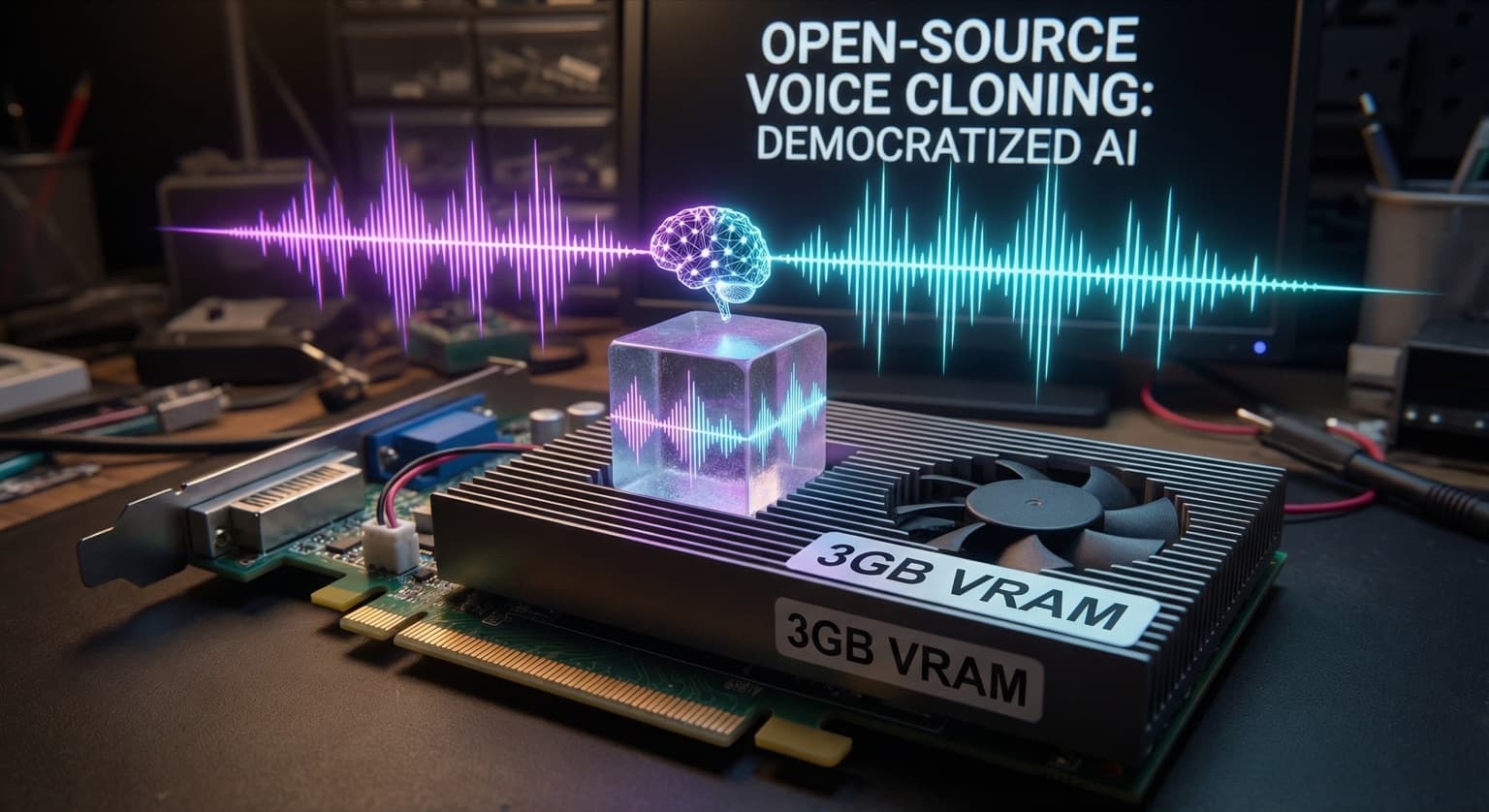
Released by the team at nineninesix.ai, Kani-TTS-2 is a 400 million parameter open-source text-to-speech model that runs comfortably on consumer hardware with as little as 3GB of VRAM. This is a significant milestone for local AI development, making powerful voice cloning accessible to developers and hobbyists without requiring enterprise-grade GPUs.
Why Kani-TTS-2 Matters
For a long time, high-quality TTS was bifurcated. You either had fast, robotic-sounding models or slow, heavy models like Tortoise-TTS that required substantial compute. Cloud APIs like ElevenLabs set the gold standard for quality but introduced latency, cost, and privacy concerns.
Kani-TTS-2 bridges this gap. By optimizing the architecture to run on 3GB VRAM, it opens the door for:
- Local Voice Assistants: Running entirely offline on a mid-range laptop or even edge devices.
- Indie Game Development: Creating dynamic NPC voices without per-character API costs.
- Privacy-First Applications: Processing sensitive text-to-speech data without it ever leaving the user's machine.
This aligns perfectly with the trend of efficient, specialized models we discussed in our guide to top AI tools for small business in 2026, where cost-effective local inference is becoming a key competitive advantage.
Key Features
The model is not just about efficiency; it packs a punch in terms of capabilities:
- Voice Cloning: It supports zero-shot and few-shot voice cloning. You can provide a short reference audio clip, and the model will synthesize speech in that voice.
- Audio as Language: Kani-TTS-2 treats audio generation similarly to how LLMs treat text, predicting audio tokens autoregressively. This approach, while computationally intensive in the past, has been optimized here for speed.
- Open Source: The model weights and, crucially, the pre-training code have been released. This allows the community to fine-tune the model on specific languages, accents, or character styles.

Technical Deep Dive
Under the hood, Kani-TTS-2 leverages a decoder-only transformer architecture. It uses a high-fidelity neural audio codec to compress audio into discrete tokens. The model then learns to predict these tokens from the input text.
What makes this release particularly interesting is the efficiency optimization. Running a 400M parameter model on 3GB VRAM implies aggressive quantization or highly optimized attention mechanisms. For developers, this means you can run Kani-TTS-2 alongside a small LLM (like a 7B parameter model) on a single consumer GPU (e.g., an NVIDIA RTX 3060 or 4060), creating a fully local, voice-enabled AI agent.
Getting Started
You can try the model right now on Hugging Face Spaces: Kani-TTS-2 Demo.
For developers looking to integrate it, the code is available on GitHub. Installation is straightforward for those familiar with Python and PyTorch environments.
git clone https://github.com/nineninesix-ai/kani-tts-2-pretrain
cd kani-tts-2-pretrain
pip install -r requirements.txt
As the ecosystem of open-source AI tools expands, the barrier to entry for building sophisticated AI applications continues to lower. Kani-TTS-2 is a prime example of how community-driven innovation is matching—and in some specific efficiency metrics, exceeding—proprietary solutions.
Need Help Building with Local AI?
Integrating local AI models like Kani-TTS-2 into your production workflow can be challenging. Whether you are building a voice-enabled customer service bot or an interactive media experience, optimizing these models for real-time performance requires expertise.
At BaristaLabs, we specialize in helping businesses leverage the latest in open-source AI to build secure, cost-effective, and high-performance solutions.
Contact us today to discuss your AI strategy.
AI Pilot Readiness Checklist
Turn the idea into a pilot you can defend.
AI agent articles are easy to bookmark and hard to operationalize. Use the readiness questions as a shared way to decide whether a workflow is specific enough, safe enough, and measurable enough to pilot. If they surface a strong candidate, BaristaLabs can review it with you and help shape a first version that fits your systems, approval process, and risk tolerance.
Please do not submit PHI, customer records, credentials, or confidential workflow exports.
Practical AI Workflow Notes
Want more practical AI operations ideas?
Get short notes on applying AI inside real small-business workflows — from document handling and customer follow-up to internal reporting, compliance, and automation guardrails.