

The race for infinite context just got a new frontrunner, and it's not from Mountain View or San Francisco.
DeepSeek, the Chinese AI lab that has been consistently undercutting US models on price while matching them on performance, officially began testing a massive upgrade to its flagship model today. The headline? A 1 million token context window.
For developers and small business owners, this is not just a technical spec bump. It is a fundamental shift in how we build AI applications and process business data. Moving from the previous 128k limit to 1 million tokens means jumping from processing a novel to processing an entire library—or in business terms, from analyzing a single contract to auditing five years of legal agreements in one go.
The 1M Token Breakthrough
While Google's Gemini 1.5 Pro popularized the idea of million-token context windows last year, access has often been expensive or rate-limited. DeepSeek's entry into the "mega-context" club changes the calculus because of their aggressive pricing strategy.
The upgrade, which began rolling out to select users earlier this week and entered broader testing today (February 14), allows the model to hold vast amounts of information in its active memory.
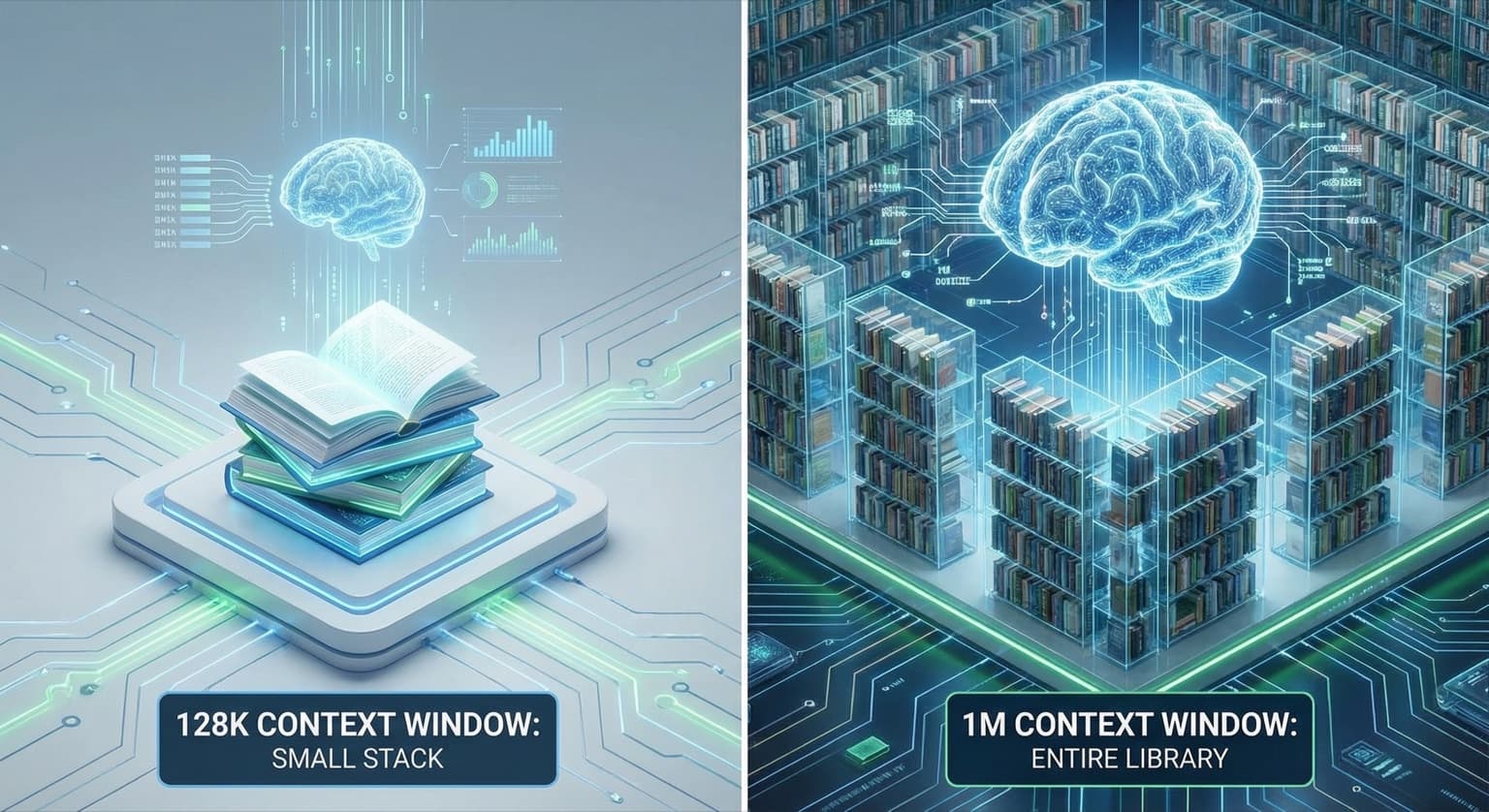
What Can You Fit in 1 Million Tokens?
To put this number in perspective:
- ~750,000 words of text (roughly 10-12 average-sized business books).
- Over 50,000 lines of code, allowing the model to "read" an entire medium-sized software repository.
- Years of financial records, enabling deep historical analysis without data truncation.
- Thousands of pages of legal discovery, making it a powerful tool for law firms and compliance officers.
Crucially, the update also pushes the model's knowledge cutoff to May 2025, ensuring it is aware of relatively recent events and technical frameworks.
Do We Still Need RAG?
For the past two years, the standard way to handle large datasets was Retrieval Augmented Generation (RAG). You would chunk your data, store it in a vector database, and retrieve only the relevant snippets for the AI to answer a question.
With 1 million tokens, that architecture becomes optional for many use cases.
Instead of building a complex RAG pipeline to "chat with your PDF," you can simply upload the entire document—or fifty documents—and let the model reason across the full text. This approach, often called "long-context prompting," has distinct advantages:
- Global Understanding: RAG often misses the forest for the trees. It retrieves specific keywords but might miss broad themes or connections that span the entire dataset. A long-context model reads everything and can synthesize global insights.
- Simplified Stack: No vector database, no embedding model, no chunking strategy. Just prompt and response.
- Accuracy: Early tests suggest that for reasoning tasks requiring information from multiple parts of a document, long-context models outperform RAG systems.
However, RAG is not dead. For datasets larger than 1M tokens (e.g., an entire corporate wiki or a massive customer support archive), retrieval is still necessary. But for the "middle ground"—projects, books, codebases—the 1M window is the new default.
The Developer Angle: Codebase Analysis
For technical founders and developers, this update is particularly exciting.

Imagine onboarding a new developer. Instead of them spending weeks reading documentation, they can feed the entire repo into DeepSeek and ask: "Explain how the authentication flow interacts with the billing service, and point out any potential race conditions."
Because the model has the full code in context, it can trace variable definitions across files, understand complex inheritance structures, and spot bugs that a snippet-based RAG system would miss.
This aligns with the broader trend we're seeing from Chinese labs this week, including the release of GLM-5 and MiniMax M2.5, which are pushing the boundaries of what's possible with open and affordable models.
Impact on Small Business
For small business owners, this upgrade unlocks enterprise-grade analysis at a fraction of the cost.
- Legal Review: Upload a 50-page lease agreement and ask for a summary of liabilities and unusual clauses.
- Financial Auditing: Feed in a year's worth of messy ledger entries and ask the model to categorize expenses and flag anomalies.
- Content Repurposing: Upload a dozen past blog posts and ask the model to write a new one that matches your exact tone and style (like we discuss in our Seed 2.0 Pro analysis).
The barrier to entry for these workflows is no longer technical complexity—it's just knowing that the capability exists.
Conclusion
DeepSeek's move to 1 million tokens is another signal that AI capabilities are commoditizing faster than anyone expected. High-end features that were once the exclusive domain of expensive US-based enterprise models are now available to everyone.
Whether you are a developer looking to simplify your stack or a business owner wanting to make sense of your data, the "context barrier" has effectively been lifted. The question is no longer can the AI read your data, but what will you ask it to discover?
If you're looking to integrate high-context AI into your business workflows, we can help. Contact us to discuss how to leverage these new capabilities for your specific needs.
Back-Office Automation ROI Worksheet
Choose the first automation with evidence, not vibes.
AI tools can make almost any workflow look automatable. The ROI worksheet helps you pick the one most likely to pay back quickly. If one workflow rises to the top, BaristaLabs can help decide whether a lightweight tool, integration, or custom pilot is the best next step.
Use broad workflow categories in the form; save specifics for a scoped conversation.
Turn this idea into a pilot
Which workflow should go first?
Use the readiness check to compare impact, effort, risk, owner, and next step before requesting a review.
- 3-5 minutes
- Deterministic score
- No sensitive data
Practical AI Workflow Notes
Want more practical AI operations ideas?
Get short notes on applying AI inside real small-business workflows — from document handling and customer follow-up to internal reporting, compliance, and automation guardrails.