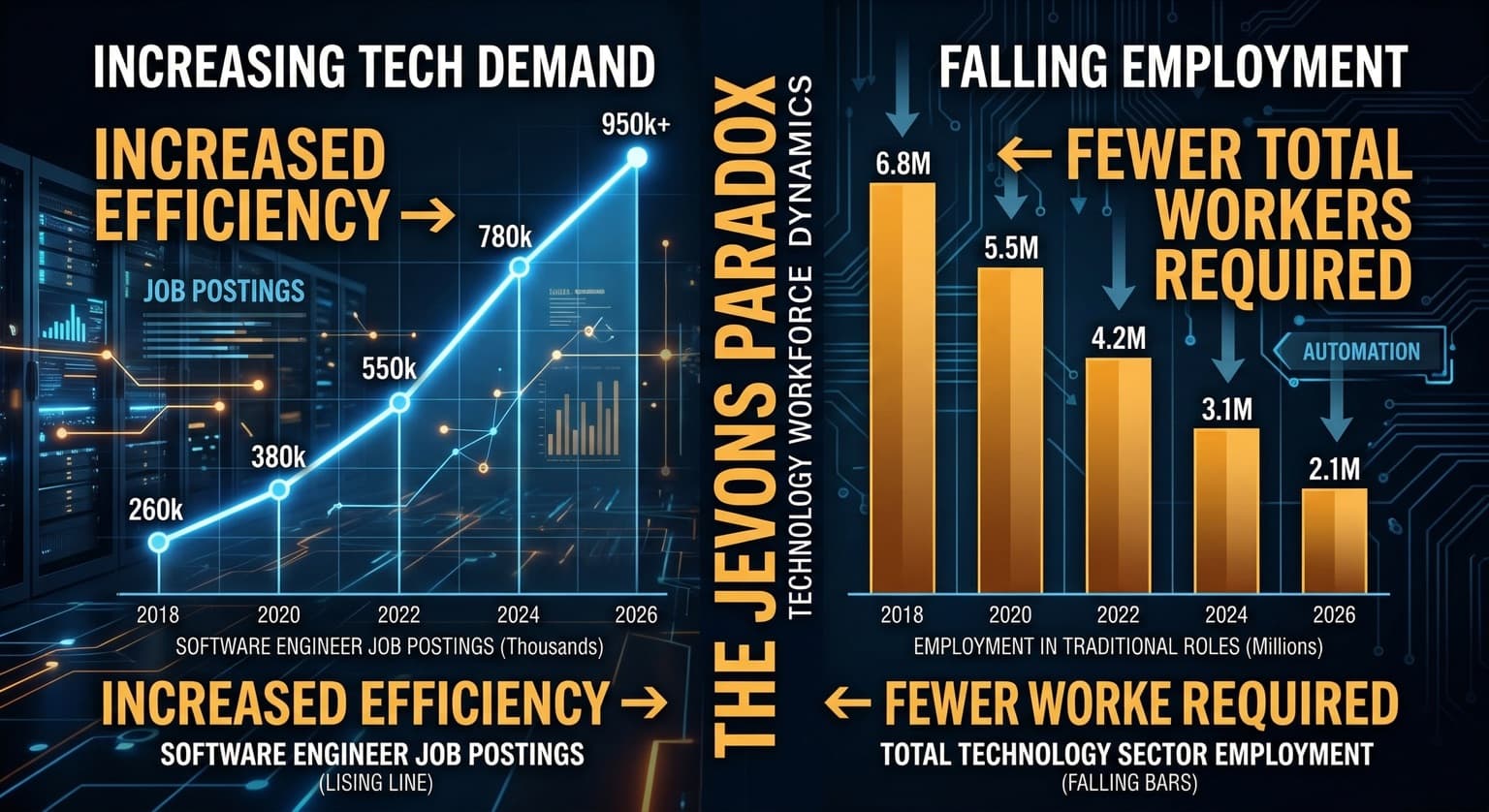

Two numbers landed this week that seem like they can't coexist.
Software engineer job postings are up 11% year-over-year, according to Indeed data published by Citadel Securities. At the same time, computer programmer employment has fallen 27% since 2023 — its lowest level since 1980 per Bureau of Labor Statistics figures.
Both are real. Both are right. And if you're an ops lead or IT buyer trying to figure out what to staff and what to contract out in 2026, the tension between them is exactly the thing worth pulling on.
The Two Numbers That Don't Contradict Each Other
The confusion comes from conflating two job categories that the labor market has already started treating as distinct.
Programmer — the role that translates a spec into working code — is contracting. That work is increasingly absorbed by AI coding tools: GitHub Copilot, Cursor, Claude Code, Codex. A developer running one of these stacks ships two to four times the output of someone coding unassisted. You don't need as many bodies for that function.
Software engineer — the role that decides what gets built, how systems talk to each other, where the risk lives, and why the spec was wrong in the first place — is expanding. GitHub reports code pushes up 35% year-over-year. New iOS app submissions are up 50%. New websites up 40%. Every company that previously couldn't afford custom software now can, and someone has to architect it, own it, and keep it running.
AI made the unit economics of software production collapse. That triggered the Jevons Paradox: when a resource gets dramatically cheaper, total consumption rises rather than falls. The 19th-century economist William Jevons observed this with coal efficiency; Citadel just documented it with code.
What Citadel Measured, What Anthropic Confirmed
The Citadel data came through a shareholder letter from Ken Griffin, covering Indeed job posting trends across the economy. Software engineering was a standout — one of the only technical fields where postings accelerated through a period when overall job listings were flat or declining.
Anthropic's labor market impact study, published this week, arrives at the same finding from the opposite direction. The researchers introduced a measure they call "observed exposure" — combining theoretical LLM capability with actual real-world usage data, weighting automated uses more heavily than augmentative ones.
Their findings on computer and math occupations: 94% theoretical exposure (tasks where LLMs could plausibly handle the work), but only roughly 33% observed exposure (tasks where AI is actually being used to automate, not just assist).
That 61-point gap is the Jevons Paradox in numerical form. AI can theoretically reach most of what a programmer does. It is actually replacing about a third of it. The remaining two-thirds — and the system design work above it — is growing in total volume faster than automation is eating the underlying tasks.
Anthropic also found that workers in the most exposed occupations are more likely to be older, more educated, and higher-paid. The displacement isn't hitting junior developers as a class. It's hitting the narrow sub-role of translating requirements into code, regardless of seniority.
The 61-Point Exposure Gap
Most AI labor market analysis runs on a binary: AI will or won't take this job. Anthropic's framework is more granular. It tracks what's theoretically feasible, then overlays what's actually happening in real Claude conversations with real workers. The gap between those two lines is where practical risk — and opportunity — lives.
For context on other fields:
- Legal occupations: ~90% theoretical exposure, significantly lower observed
- Management: ~60%+ theoretical, much lower observed
- Office and administrative: ~90% theoretical, closing faster than most fields
Computer and math is the field where the gap is most discussed and, per Citadel's hiring data, most visibly bifurcating. The gap isn't closing evenly — it's closing on execution-heavy roles while expanding on architecture and ownership roles.
Budget Lines and the Hiring Decision in Front of You Now
For an ops lead or IT buyer at a 20–50 person firm, the practical read:
Don't hire for pure code output. If your next headcount request is "we need someone to write the tickets the backlog generates," that role is already priced wrong. A mid-level engineer with Cursor Pro ($40/month) and Claude Code (~$100/month in API at moderate usage) ships what previously required 1.5–2 FTE on execution tasks alone. The math on a contractor engagement changes materially once you account for tooling.
Do hire for system ownership. Architecture decisions, vendor evaluations, integration design, security posture — none of that is in the 33% being actively automated. Anthropic's data confirms it. These functions are growing in demand and require a human who is accountable when things go sideways.
Map the task split before your next headcount review. For each open req or renewal, classify tasks as execution (code a known spec) versus judgment (determine whether this should be built and how). That ratio tells you where AI tooling creates leverage and where additional headcount still pencils out.
The engineer isn't dying. The code monkey is. And the firms that update their job descriptions to match that reality are competing against a 27%-smaller labor pool for the roles that actually move product.
Sources: Anthropic Research, "Labor market impacts of AI: A new measure and early evidence" (March 2026) · Citadel Securities shareholder letter, Indeed data via Ken Griffin · BLS occupational employment data · GitHub Octoverse 2025
AI Pilot Readiness Checklist
Turn the idea into a pilot you can defend.
AI agent articles are easy to bookmark and hard to operationalize. Use the readiness questions as a shared way to decide whether a workflow is specific enough, safe enough, and measurable enough to pilot. If they surface a strong candidate, BaristaLabs can review it with you and help shape a first version that fits your systems, approval process, and risk tolerance.
Please do not submit PHI, customer records, credentials, or confidential workflow exports.
Practical AI Workflow Notes
Want more practical AI operations ideas?
Get short notes on applying AI inside real small-business workflows — from document handling and customer follow-up to internal reporting, compliance, and automation guardrails.