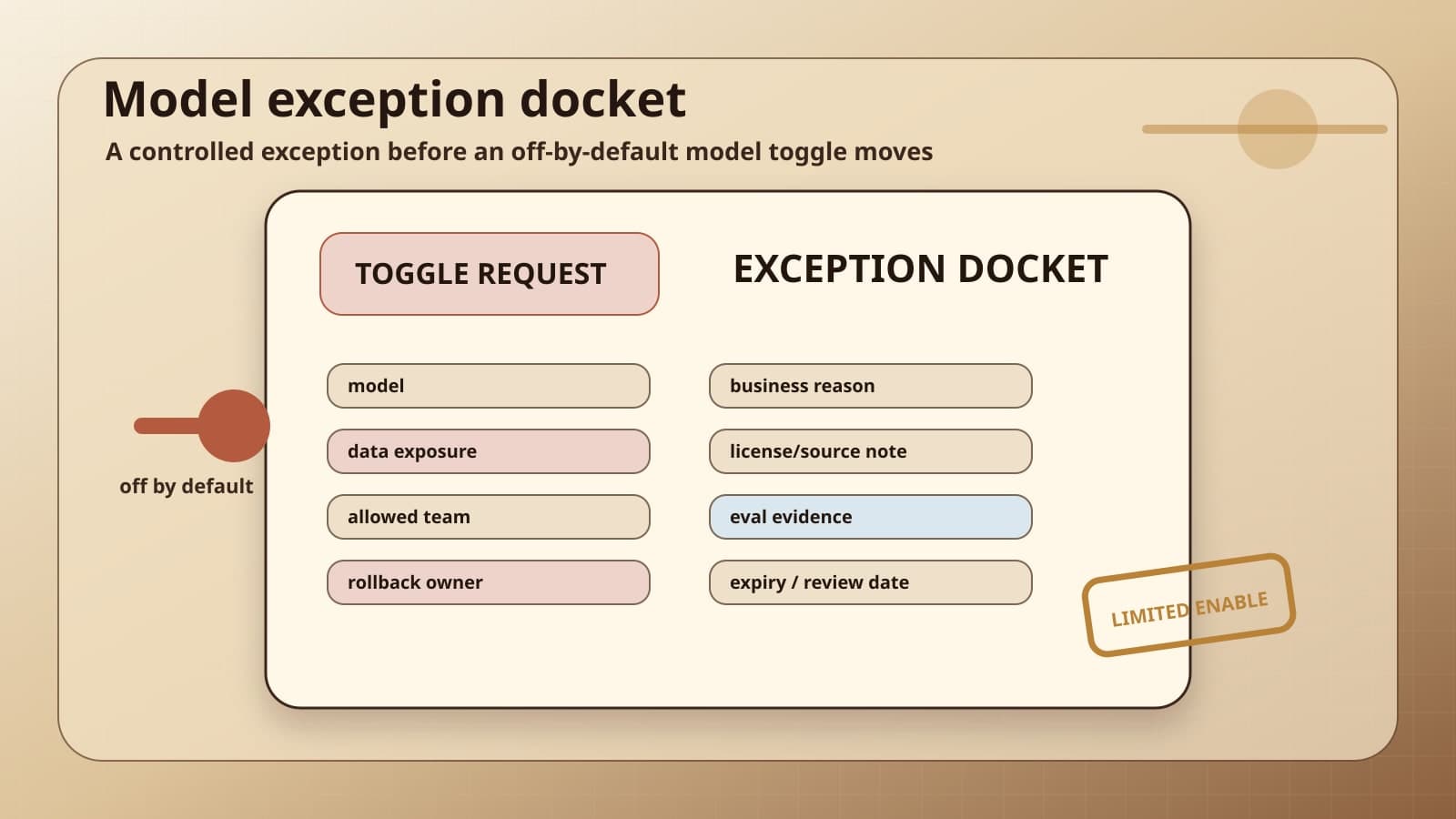

The quiet part of GitHub's Kimi K2.7 Code rollout is not the model name. It is the switch.
For individual Copilot users, the new model reads like another choice in a growing picker: try this one for coding work, compare the feel, see whether the lower-cost option is good enough for the job. For Copilot Business and Enterprise, the same row arrives with a different posture. It is available, but it is not normal. GitHub ships it off by default, and a plan administrator has to enable the policy before anyone in the organization can select it.
That is the useful signal for operators. GitHub did not merely add another model. It created a moment where availability and approval split apart.
On July 1, GitHub announced Kimi K2.7 Code as generally available in Copilot, calling it an open-weight model and the first open-weight selectable option in the Copilot model picker. The first rollout went to Copilot Pro, Pro+, and Max, with named client requirements: VS Code 1.127.0 or later, Visual Studio 17.14.6 or later, and JetBrains 1.9.1-251 or later. GitHub also stated that the model is hosted by GitHub on Microsoft Azure and billed at provider list pricing under usage-based billing.
Then the enterprise part arrived. On July 7, GitHub made Kimi K2.7 available to Copilot Business and Copilot Enterprise. The release note says the policy is off by default. It says plan administrators must enable the Kimi K2.7 Code policy in Copilot settings before anyone in the organization can select it. It also recommends that administrators review open-weight models against their own security, compliance, and data-governance requirements before enabling them.
That recommendation is easy to read as boilerplate. It should not be. It is the line that turns a model-picker launch into an operations task.
Why this is not just another model choice
Open-weight models usually enter companies through a side door. A developer runs one locally. A research team tests one in a sandbox. A platform team hosts one behind an internal endpoint. In those cases, the evaluation naturally starts with infrastructure: where will it run, what license applies, which data can touch it, who pays for the hardware, and who maintains the serving stack?
Copilot changes the shape of the question. Kimi K2.7 Code appears inside a tool many teams already trust, pay for, and administer. It is not an experimental binary someone downloaded to a workstation. It is a selectable model inside the same corporate surface that already carries code suggestions, chat, CLI work, and agentic sessions.
That convenience is the reason the policy gate matters. The model can feel ordinary because the interface is ordinary. The administrative work should not become ordinary until someone writes down why this model deserves the exception.
The same week, GitHub gave admins more of the machinery around that decision. Enterprise managed-settings.json became generally available, letting Enterprise Cloud customers configure AI standards in a .github-private repository for Copilot clients such as VS Code and Copilot CLI. GitHub says the settings are fetched when a user authenticates and refreshed hourly. Enterprise admins can also default new conversations to auto model selection through that managed settings file, while users may still switch per conversation. And Copilot CLI and SDK now support session-level AI credit limits, including --max-ai-credits for noninteractive runs, with the caveat that the cap is soft because in-flight responses finish before stopping.
Read together, those releases point in one direction: model choice is becoming policy material. Not philosophy. Not Slack debate. Policy material.
The GitHub Copilot enterprise-controls guide places that temporary model exception beside the enterprise baseline, effective population, product surfaces, verification evidence, owner, expiry, and next review trigger.
Write the exception before you normalize it
Most teams already have some version of a model approval conversation. It happens in a meeting, a security thread, a procurement note, or a quick "looks fine" from someone senior enough that no one pushes back. The problem is not that the conversation is absent. The problem is that it does not leave behind an object a second team can audit.
That matters here because the default state is already meaningful. GitHub set the enterprise policy to off. If you turn it on, you are not merely accepting a new option. You are changing the default for a managed developer environment.
So don't call the artifact an approval forever. Call it an exception docket. The word is useful because it resists permanence. An exception has a requester, a reason, a scope, evidence, and an expiry. It can widen later, but it has to earn that motion.
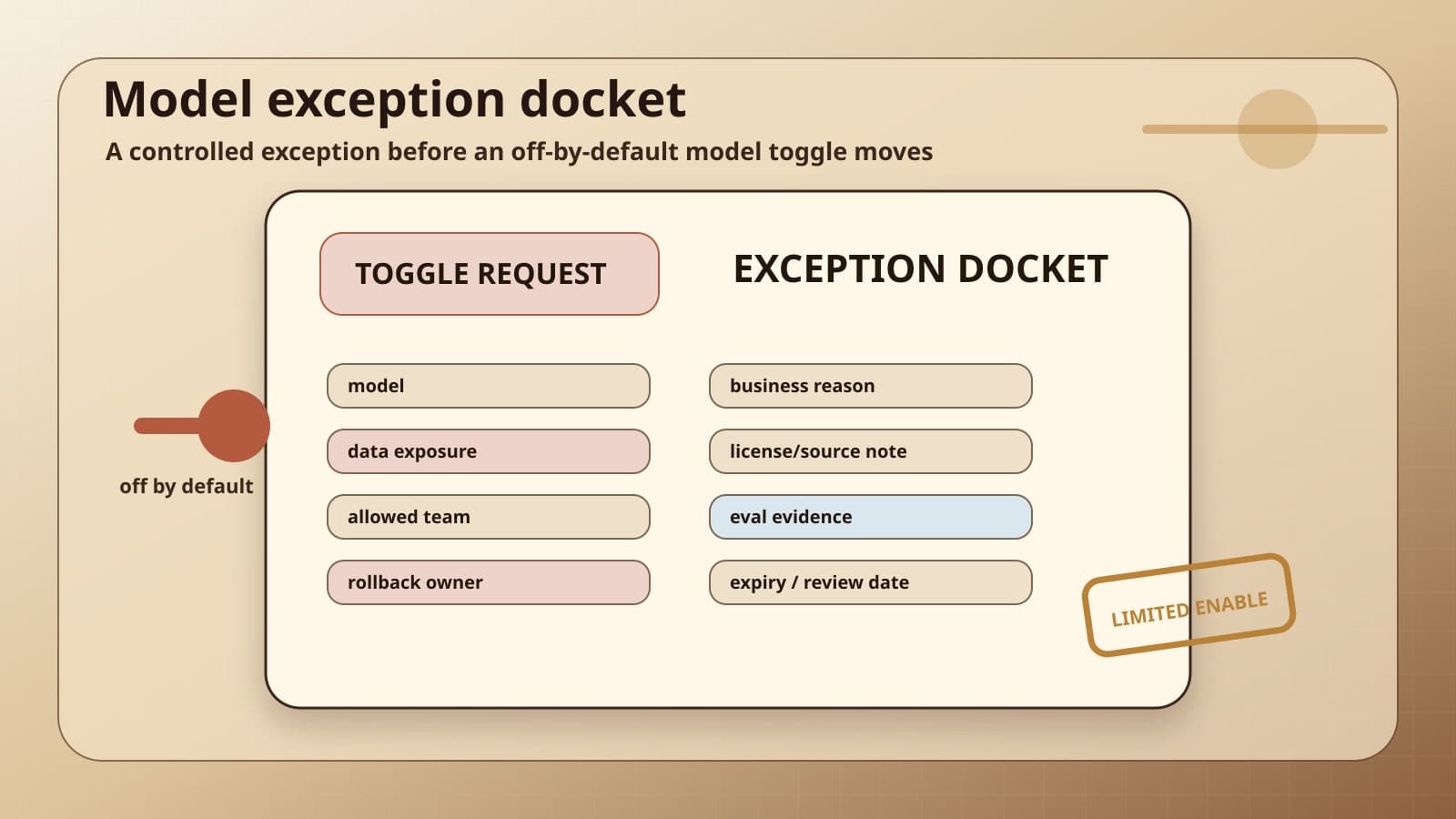
The model exception docket
Before a new Copilot model becomes normal
Model exception docket
Use this docket when a model is available in your enterprise tool but still needs an explicit exception before a team can rely on it.
- 01
Exception request
Required
Pins down: Who wants Kimi K2.7 Code enabled, for which team, repo set, and delivery window.
Why it matters: Availability is global. The business reason to allow it should be local.
- 02
Model provenance
Required
Pins down: Open-weight Kimi K2.7 Code, served by GitHub on Microsoft Azure inside Copilot.
Why it matters: Open weights describe the model family. They do not answer where your code is processed in this product.
- 03
Default policy state
Required
Pins down: Off for Copilot Business and Enterprise until a plan administrator enables the policy.
Why it matters: The starting state is a control. Preserve the reason for changing it.
- 04
Data boundary
Required
Pins down: Which source code, customer context, secrets-adjacent files, and regulated work are allowed or blocked.
Why it matters: GitHub tells admins to review data governance. This is the line where that review becomes inspectable.
- 05
Task boundary
Required
Pins down: The job classes this exception covers: test scaffolds, internal tools, low-risk refactors, or something narrower.
Why it matters: A model-picker option is broad. A permissioned exception should not be.
- 06
Client readiness
Required
Pins down: VS Code, Visual Studio, JetBrains, or CLI versions checked against the team's real machines.
Why it matters: A rollout that starts with editor mismatch becomes a support problem before it becomes a governance win.
- 07
Cost pressure
Required
Pins down: Usage-based billing expectation, credit/session cap, and owner for reviewing usage.
Why it matters: Lower-cost still needs a ceiling when the work can run in an agent loop.
- 08
Test evidence
Required
Pins down: Three real tasks, expected outcome, observed failure, and whether the exception remains limited.
Why it matters: Community enthusiasm is not an eval. Your repos are the eval.
- 09
Expiry and closure
Required
Pins down: The date the exception is reviewed, widened, narrowed, or closed, plus the rollback trigger.
Why it matters: Exceptions rot when they do not have a closing motion.
Done means the exception can expire. Not that the model row stays on forever.
This is smaller than a model catalog. In our piece on the model facts register, the problem was keeping model facts current after a model-picking meeting ends. Here, the question is narrower and more urgent: should this team be allowed to use this newly available option now?
It is also different from the Copilot Actions run card. That card governs a workflow that can spend organization credits while it runs. The exception docket sits earlier. It decides whether a model belongs in the team's allowed set before the work starts.
The first pilot should be boring
The easiest way to mishandle this rollout is to make the first pilot heroic. Someone points Kimi K2.7 Code at a hairy migration, gets an impressive result, and the story becomes "look what the new model can do." That is useful for a demo and dangerous for a policy.
A better first pilot is boring enough to judge. Pick three tasks from repos the team understands: one test scaffold, one internal tool refactor, one documentation-adjacent code cleanup. Record expected behavior before the model touches anything. Record what changed. Record where the result required human repair. If the model performs well, the docket can widen. If it does not, the exception remains narrow without turning into a cultural argument about whether open-weight models are good or bad.
The cost line deserves the same discipline. GitHub's session limits do not replace budgets, and GitHub says they are soft caps, but they are exactly the kind of guardrail that belongs in the docket. If a model is attractive because it is lower cost, prove that attraction with a limit and a usage review. Cheaper per request is not a spending policy.
Finally, give the exception a closing motion. Thirty days is enough for a first pass. At the review, one of four things happens: close it because the model was not useful, keep it limited to the pilot scope, widen it to more teams with stronger evidence, or turn it off because a data, quality, or cost condition tripped. Any of those outcomes is better than the common fifth option: the toggle stays on because nobody remembered the review was supposed to happen.
Make model choice inspectable
This is the same operating principle behind our AI workflow controls and data security work: make the decision inspectable before the tool becomes ambient. A managed tool can make a new model feel safe because the interface is familiar. Familiar is not the same as reviewed.
If your team already keeps an AI app settings baseline, this docket sits beside it. The baseline says which AI apps and settings exist across the fleet. The docket says which newly available model gets a temporary pass, for which work, with which evidence, and until what date.
GitHub did the product work: it put Kimi K2.7 Code into Copilot Business and Enterprise, then left the policy off. Your job is the narrower, messier one. Decide whether the first team asking for it has earned an exception. If the answer is yes, write the docket before the switch becomes background noise. Build a model exception docket.
Before the exception becomes normal
Write one model exception docket
Bring the Copilot model your team wants to enable. We'll define the requester, data boundary, task boundary, client-readiness check, cost guard, test evidence, and expiry date before the toggle becomes a standing permission.
Best fit when a new AI model is available in a managed tool but has not earned normal access yet.
Turn this idea into a pilot
Which workflow should go first?
Use the readiness check to compare impact, effort, risk, owner, and next step before requesting a review.
- 3-5 minutes
- Deterministic score
- No sensitive data
Practical AI Workflow Notes
Want more practical AI operations ideas?
Get short notes on applying AI inside real small-business workflows — from document handling and customer follow-up to internal reporting, compliance, and automation guardrails.