


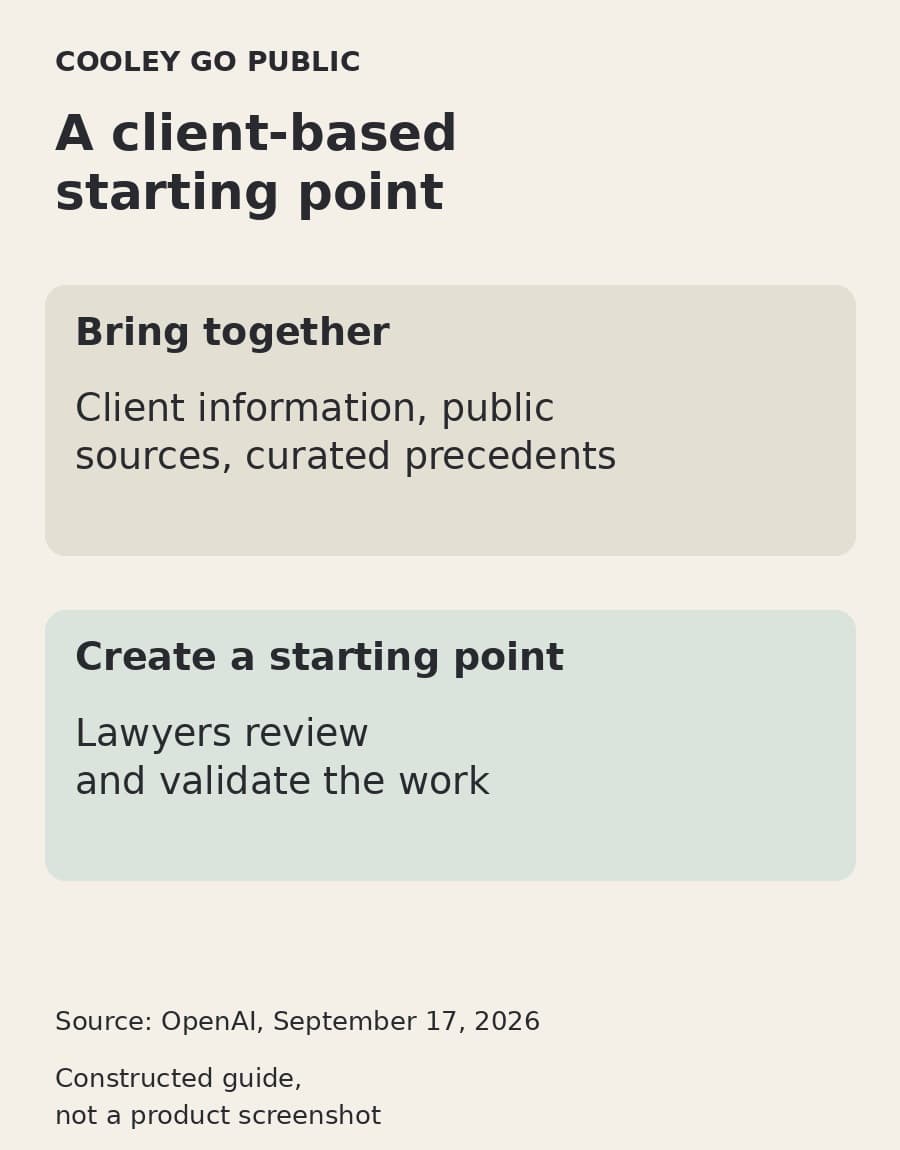
Cooley has described a different starting point for AI-assisted IPO preparation: build around the client's information, then bring in relevant public sources and selected precedents. Its GO Public offering uses ChatGPT Work to produce a tailored starting point for lawyers to review.
The September 17 customer account published by OpenAI matters beyond capital markets. Professional-service teams often begin with something they delivered before. AI can make that adaptation faster, but it can also carry yesterday's assumptions into today's work. Cooley's account suggests a more useful question: what should the first draft be based on?
From a comparable company to the actual client
According to the account, Cooley's teams previously often began with a precedent from a comparable company and adapted it to the client's circumstances. GO Public instead brings together information supplied by the client, relevant public sources, and carefully curated precedents.
Precedents remain part of the work. The change is their role: they help shape an answer grounded in the client's circumstances rather than supplying the initial answer that everyone must correct.
That distinction is useful in consulting, proposal writing, and other document-heavy services. A prior deliverable can provide structure and language. It cannot establish the new client's facts. When an AI system receives a polished example before it receives complete requirements, fluent adaptation may conceal how much remains unknown.
Cooley's description does not publish the exact order of its prompts or retrieval steps. The broader lesson is BaristaLabs' interpretation of its stated approach: make the current client's evidence the basis for the work, and use comparable material for a defined supporting purpose.
The workflow includes the firm's judgment
GO Public is a proprietary Cooley offering, not a general-purpose IPO button in ChatGPT. Cooley says legal engineers, innovation counsel, and practitioners worked together to translate its capital-markets experience into an agentic system.
An agentic harness is the software around the model that organizes its work. In this account, it defines which steps agents can perform automatically, where lawyers must review or validate the work, and how the pieces come together.
That is more specific than asking a model to write like an experienced professional. The firm has to decide which material belongs in the workflow, what the system may do with it, and which judgments require a practitioner. Those decisions become part of the service rather than instructions each employee must invent from scratch.
OpenAI also announced Astra for Law on September 17, describing a legal AI foundation and inviting inquiries about early access. That announcement provides wider context, but it does not make Cooley's proprietary workflow available to other firms or establish that its implementation can be copied from public documentation.
Evaluate the starting point, not just the writing
For another professional-service team, the practical experiment is to compare how drafts are assembled. Use one completed engagement whose material is cleared for this purpose. Ask the responsible expert to identify the facts, constraints, and unresolved questions that a useful first draft needed to preserve.
One version can begin with the team's usual prior deliverable. Another can begin with the current engagement's approved information, using a selected example only for structure and relevant language. Keep the expected output and reviewer consistent. This is a suggested test, not a description of a test Cooley reports having run.
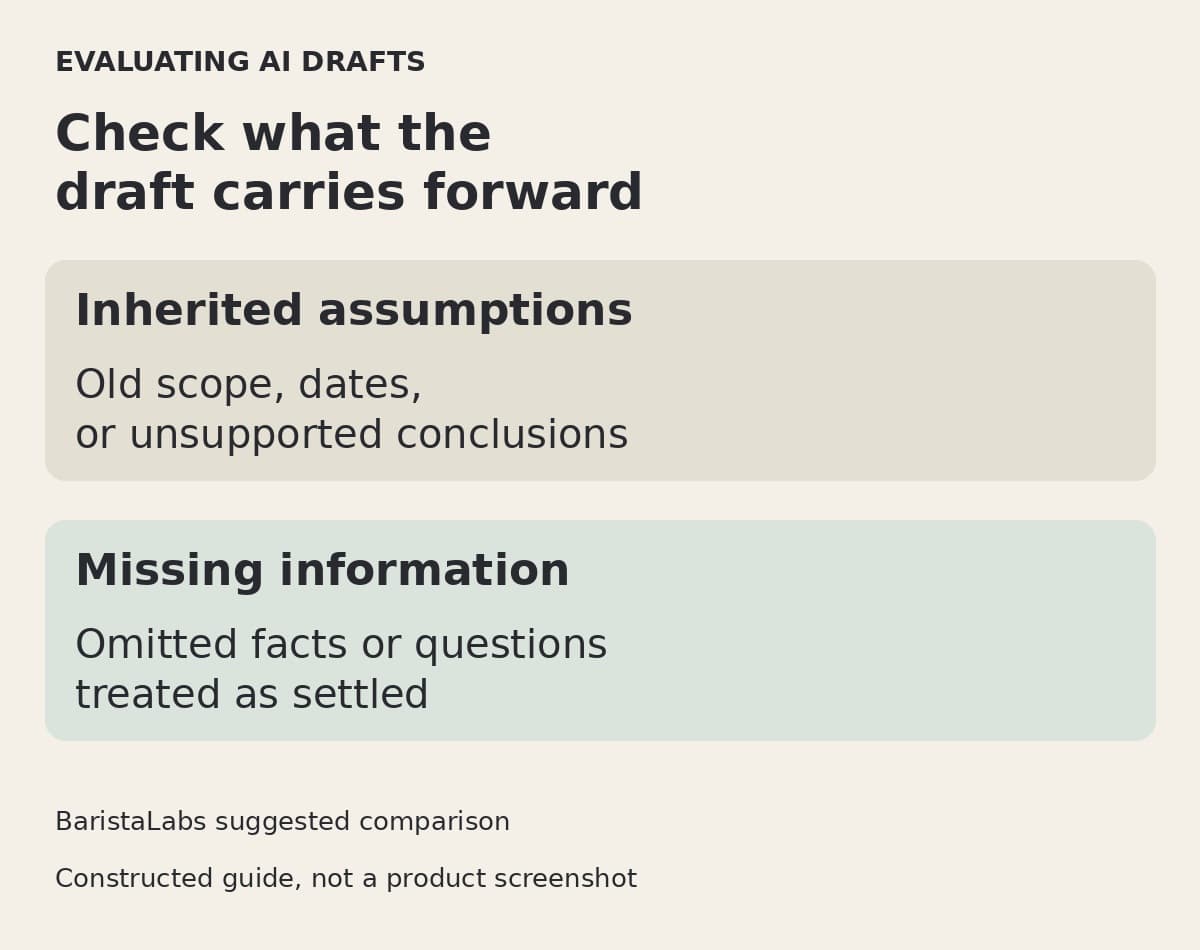
The reviewer should look for inherited assumptions: a service the client did not request, an old deadline, a conclusion supported by the previous engagement but not this one. Also note information the draft omitted or presented as settled when the source left it open. An attractive draft that requires those corrections may be less useful than a rougher draft that preserves the right facts.
Do not score only drafting time. Record the work needed to trace important statements to their sources and make the document ready for its intended use. That gives the team evidence about whether a different starting point actually improves its process.
What the customer story leaves unanswered
OpenAI's account includes Cooley representatives' descriptions of faster preparation and more attention to judgment. It does not provide an independently measured reduction in IPO preparation time, a controlled comparison of draft quality, or public pricing for GO Public. There is no basis here to promise a particular saving to another firm.
Nor does assembling client information settle its use permissions. A team needs approval for the material and the environment in which it will be processed. Our legal-AI permissions guide explains how to test access before connecting matter documents. Qualified practitioners still decide whether legal work is usable; a workflow that routes drafts for review does not transfer that responsibility to the model.
The useful development is the way Cooley describes embedding its expertise: client information, selected sources, curated prior work, and defined practitioner review. For teams considering a similar change, the next decision is which part of their existing drafting process should supply evidence and which part should supply an example. That is a narrower, more testable decision than whether AI can replace the whole service.
AI-assisted drafting
Compare how your first draft gets made
BaristaLabs can help map a document workflow, define the source material it needs, and design a comparison that includes expert review effort.
Bring a workflow description and examples cleared for sharing, not confidential client files.
Turn this idea into a pilot
Which workflow should go first?
Use the readiness check to compare impact, effort, risk, owner, and next step before requesting a review.
- 3-5 minutes
- Deterministic score
- No sensitive data
Practical AI Workflow Notes
Want more practical AI operations ideas?
Get short notes on applying AI inside real small-business workflows — from document handling and customer follow-up to internal reporting, compliance, and automation guardrails.