The AI Adoption Inflection Point Is Here. Claude's Numbers Make That Hard to Ignore.
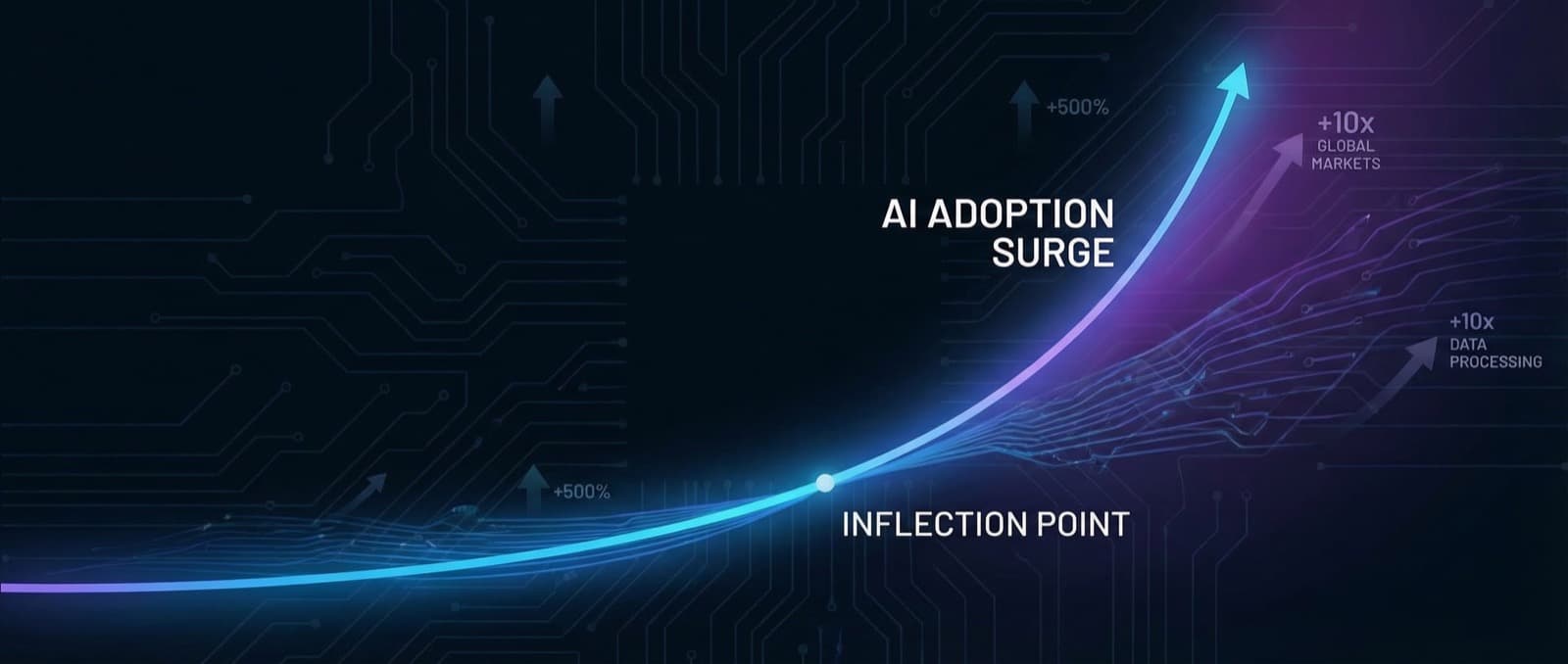
Claude's daily active users are climbing fast, Claude Code reportedly hit a $2.5B ARR run-rate, and Anthropic's revenue keeps compounding. That is not hype. It is a sign that businesses are already changing how work gets done.

Sean McLellan
Lead Architect & Founder
If you run a small business and you are still treating AI like a thing to "look into later," that window is closing.
Not because of vibes. Not because a founder said something dramatic on a podcast. Because the usage and revenue numbers around Claude and Anthropic are starting to look like a real adoption curve.
The big signal is daily behavior. Similarweb shared data showing Claude's daily active users have been climbing sharply since early 2025. That matters more than one-time signups or app downloads. Daily usage means people are not just trying AI tools. They are working with them over and over, which is exactly how new operating habits form.
Then there is the money.
According to reporting and source material summarized by Aakash Gupta, Claude Code went from a $500 million ARR run-rate in September 2025 to $2.5 billion by February 2026. That is a 5x jump in five months for a product that, until recently, many non-technical business owners had probably never heard of.
Anthropic's overall revenue picture is even more aggressive. The company reportedly went from roughly $100 million in 2023 to $1 billion in 2024 to $9 billion to $10 billion in 2025, with several billion dollars more in January 2026 alone. Just as important, around 70% to 75% of that revenue is said to come from API and enterprise usage, not consumer subscriptions.
That last number is the part a lot of SMB owners miss.
When most people think about AI adoption, they picture consumers paying $20 a month for a chatbot. That is not what these numbers suggest. They suggest businesses are buying AI behind the scenes and embedding it into support workflows, internal operations, software products, reporting, document handling, research, and coding.
In other words, a huge chunk of the adoption wave is not visible unless you know where to look.
Why this matters to SMBs right now
The obvious response is, "Sure, but those are enterprise numbers. What does that have to do with my business?"
A lot, actually.
Large-company adoption usually shows up in SMB markets with a lag, but that lag is getting shorter. Fast-growing AI infrastructure does not stay trapped inside Fortune 500 companies for long. It gets productized into software your competitors use, bundled into tools your team already pays for, and turned into workflows that suddenly feel normal.
That is what Claude's DAU surge is telling you. Businesses are not waiting for a perfect future-state AI stack. They are using these tools now.
Some are using them directly through chat interfaces. Some are using them through coding tools like Claude Code. Some are using them through API-based automations inside CRMs, help desks, internal dashboards, and document workflows. The front door varies. The pattern is the same: AI is moving from experiment to habit.
For SMBs, the risk is not "AI will replace my business tomorrow." The real risk is more boring and more immediate.
Your competitors will answer leads faster.
They will summarize calls and proposals faster.
They will produce first drafts faster.
They will clean up data, prepare client deliverables, and ship internal tools faster.
They will turn one good operator into a much more leveraged operator.
That kind of advantage rarely looks flashy on day one. It shows up as tighter response times, lower admin drag, shorter project cycles, and fewer balls dropped. Then six months later, one company feels sharper than another and nobody can quite explain why.
AI is increasingly the reason why.
Claude Code is the leading indicator most SMBs should pay attention to
The Claude Code number is especially important because it points to something bigger than "people like chatting with AI."
A coding assistant hitting a reported $2.5 billion ARR run-rate means businesses are paying serious money to change how technical work gets done. And "technical work" does not just mean software startups.
It means agencies building client sites faster. It means internal automations that used to sit on a backlog now getting built. It means marketing teams spinning up landing pages without waiting weeks. It means operations teams turning ugly spreadsheet processes into lightweight tools. It means a business owner with one capable technical person suddenly getting much more output from that person.
That is the important translation.
You do not need to be a venture-backed software company for AI coding tools to matter. If your business depends on websites, integrations, automations, internal systems, reporting, or customer workflow improvements, better coding leverage eventually becomes business leverage.
That is why this is an SMB story, not just an AI industry story.
Dario's trillion-dollar compute comment says the quiet part out loud
In his interview with Dwarkesh Patel, Anthropic CEO Dario Amodei said: "Even though a part of my brain wonders if it's going to keep growing 10x, I can't buy $1 trillion of compute in 2027."
That quote lands because it sounds almost absurd. But it also tells you what kind of demand curve the people closest to the market think they may be dealing with.
Founders do not talk about compute bottlenecks at that scale unless the growth feels very real from inside the building.
You do not have to believe every projection. You do not have to assume Anthropic wins the whole market. But you should pay attention when one of the top model providers is effectively saying demand may outstrip the industry's ability to supply infrastructure.
That is not the language of a fading hype cycle.
What small businesses should do next
Do not overreact. But do not sit still.
If you are an SMB owner, this is the moment to move from passive interest to active experimentation.
A good first move is not "deploy AI everywhere." That is how teams create mess.
A good first move is to pick one workflow with high repetition and clear downside if it stays manual. Usually that means one of these:
- lead follow-up and qualification
- customer support triage
- proposal or report drafting
- meeting notes and follow-up tasks
- document intake and summarization
- internal research or knowledge retrieval
Then give yourself 30 days to test whether AI can make that workflow materially faster, more consistent, or easier to delegate.
The point is not to become an AI company. The point is to become a company that uses better tools before your slower competitors do.
That is what these Claude and Anthropic numbers really mean.
They mean the market is already moving.
The companies building with AI every day are creating the future operating standard in plain sight. Everyone else is still calling it early.
It is not early anymore.
If you want help finding the right first AI workflow for your business, or building something more practical than a chatbot demo, contact Barista Labs. We help small businesses put AI to work where it actually moves the business.
Sources
- Aakash Gupta, summary thread on Claude, Claude Code, and Anthropic growth: https://x.com/aakashgupta/status/2031603600728928340
- Similarweb chart showing Claude DAU growth: https://x.com/Similarweb/status/2031404311201144856
- Dwarkesh Patel interview with Dario Amodei: https://www.dwarkesh.com/p/dario-amodei-3
AI Pilot Readiness Checklist
Turn the idea into a pilot you can defend.
AI agent articles are easy to bookmark and hard to operationalize. Use the readiness questions as a shared way to decide whether a workflow is specific enough, safe enough, and measurable enough to pilot. If they surface a strong candidate, BaristaLabs can review it with you and help shape a first version that fits your systems, approval process, and risk tolerance.
Please do not submit PHI, customer records, credentials, or confidential workflow exports.
Practical AI Workflow Notes
Want more practical AI operations ideas?
Get short notes on applying AI inside real small-business workflows — from document handling and customer follow-up to internal reporting, compliance, and automation guardrails.