Field note: why BaristaLabs treats AI work like receipts, not magic
A field note on the BaristaLabs operating pattern behind agent receipts, approval queues, launch packets, verification, rollback, and evidence-first AI workflow launches.

Sean McLellan
Lead Architect & Founder

The demo usually looks better than the meeting that follows it.
Someone types a rough customer request into a prototype. The system finds the account, drafts a reply, updates a note, maybe prepares a page change. For a few minutes, it feels like the hard part is over.
Then the room gets quieter.
What did it read? Which source won when two records disagreed? Did anyone approve the final version, or only the first draft? If it writes to the wrong place, who can unwind it? If the reviewer edits the answer before sending, does the receipt show the edit or only the model's proposal?
That moment is where BaristaLabs does most of its AI work.
The model output matters. Of course it does. But the artifact around the output matters just as much: the receipt, the queue row, the source packet, the reviewer decision, the rollback path, the post-launch check. Without those pieces, a useful demo turns into a story people have to retell from memory.
We do not want AI projects to feel magical after they ship. We want them to feel reconstructable.
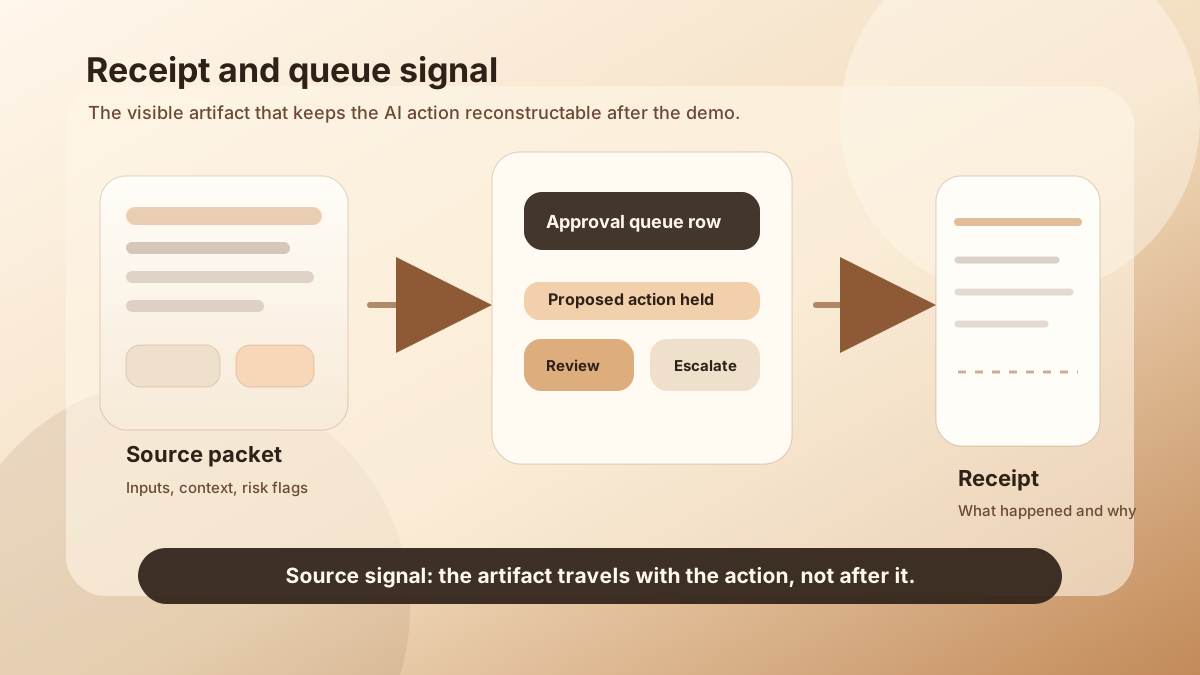
The artifact has to travel with the action
A team can tolerate some uncertainty while a workflow is only drafting. The cost changes once the system reaches a customer, a CRM, a CMS, a billing tool, a support queue, a private document, or a system of record.
At that point, "the AI said so" is not a useful explanation. Neither is a transcript buried in a chat window.
A receipt should answer the questions the team will ask later: what started this run, what sources did it use, what did it propose, which policy rule applied, who reviewed it, what changed, where did the final action land, and how would we correct it?
Our agent receipt template is not a compliance decoration. It is the minimum artifact that lets an operator replay the work without trusting the vibe of the demo.
NIST's AI Risk Management Framework talks about mapping context, measuring behavior, managing risk, and governing the system over time. Those ideas sound abstract until a reviewer needs to decide whether a drafted refund, access change, support answer, or publishing update can proceed. The receipt is where the risk work becomes visible enough to inspect.
OWASP's guidance on excessive agency makes the same point from the other side. The more tools and permissions an AI system has, the more damage a bad instruction, weak boundary, or mistaken action can cause. We treat permission as something the workflow earns in narrow slices, not something the model gets because the demo was impressive.
The queue is where trust gets translated
An approval queue is not a holding pen for nervous teams. It is the product surface where a proposed action becomes a business decision.
The reviewer should not see a lonely AI draft with an approve button beside it. They should see the source record, the proposed change, the policy rule, the risk reason, the missing context if there is any, the destination system, and the receipt that will be left behind.
That is the pattern behind our approval queue guide. Draft, classify, route, hold, escalate, execute, log. The verbs are plain because the work should be plain. If a proposed action cannot survive that sequence, it probably should not get more autonomy yet.
The queue also keeps teams honest about thresholds. A confidence score can help route work, but it is not an approval policy. Some wrong answers are cheap. Some are public, financial, legal, or hard to undo. The queue lets the business decide which mistakes can live in review and which ones cannot reach the customer at all.
Launch packets keep the decision small enough to inspect
Teams often ask for an AI roadmap when they really need a launch packet for one workflow.
The packet is less glamorous. It is also more useful. It names the workflow, the source systems, the data boundary, the allowed actions, the blocked actions, the reviewer evidence, the shadow-week results, the receipt fields, the rollback owner, and the launch decision.
A good packet can still say "not ready." That is part of its job.
Our AI workflow controls checklist pulls those decisions into one place so the meeting does not drift into platform preference or model folklore. The question is not whether AI can help in general. The question is whether this workflow, with these permissions and these controls, is ready for this next level of access.
If the answer is yes, the workflow launches with a narrower boundary and a better receipt. If the answer is no, the team knows what to fix before trying again.
Verification is part of the workflow, not cleanup
This receipt habit shows up in our own publishing loop too.
When a page or article ships, the work is not done because the markdown exists. The reviewer checks the rendered page, mobile layout, metadata, schema, category, image fit, internal links, CTA placement, duplicate modules, and whether the page still says what the draft intended to say.
That may sound unromantic. Good. A public page is a workflow output. It deserves the same kind of evidence trail as a CRM update or customer reply.
The verification step catches the boring failures that make AI work feel unreliable: a good draft in the wrong category, a useful resource with a broken internal link, a CTA repeated so often it starts to feel like a pop-up, an image that looks fine in isolation and awkward in the article, metadata that promises something the page does not deliver.
Those misses are not solved by a better model alone. They are solved by a loop that keeps artifacts, reviewers, and rendered reality close together.
The point is not to slow everything down
Receipts, approval queues, controls, and verification can sound like friction if you picture them as governance paperwork stapled to the end of a build.
That is not the goal.
The goal is to make the first safe version smaller. Pick one workflow. Limit what it can read. Limit what it can do. Show the reviewer the evidence. Log what happened. Keep the rollback path close. Watch the misses. Then expand permission only where the receipts prove the workflow deserves it.
This is how BaristaLabs wants AI projects to feel after the demo: specific enough to inspect, small enough to improve, and honest enough that a future teammate can reconstruct the last run without asking everyone what they remember.
If you already have one workflow that looks useful but still feels a little too magical, start with the receipt. The rest of the system has to earn its way through that record.
Copy the agent receipt template
Make the workflow explainable after the demo
BaristaLabs helps teams turn one promising AI workflow into a controlled system with approval queues, receipt fields, verification checkpoints, and rollback paths.
Best fit when a demo works, but the team still cannot reconstruct what the system saw, proposed, changed, or sent.
Turn this idea into a pilot
Which workflow should go first?
Use the readiness check to compare impact, effort, risk, owner, and next step before requesting a review.
- 3-5 minutes
- Deterministic score
- No sensitive data
Practical AI Workflow Notes
Want more practical AI operations ideas?
Get short notes on applying AI inside real small-business workflows — from document handling and customer follow-up to internal reporting, compliance, and automation guardrails.