
Format H tonight: The under-covered story leads. Everything else ranked by operator impact.
The story every outlet skipped
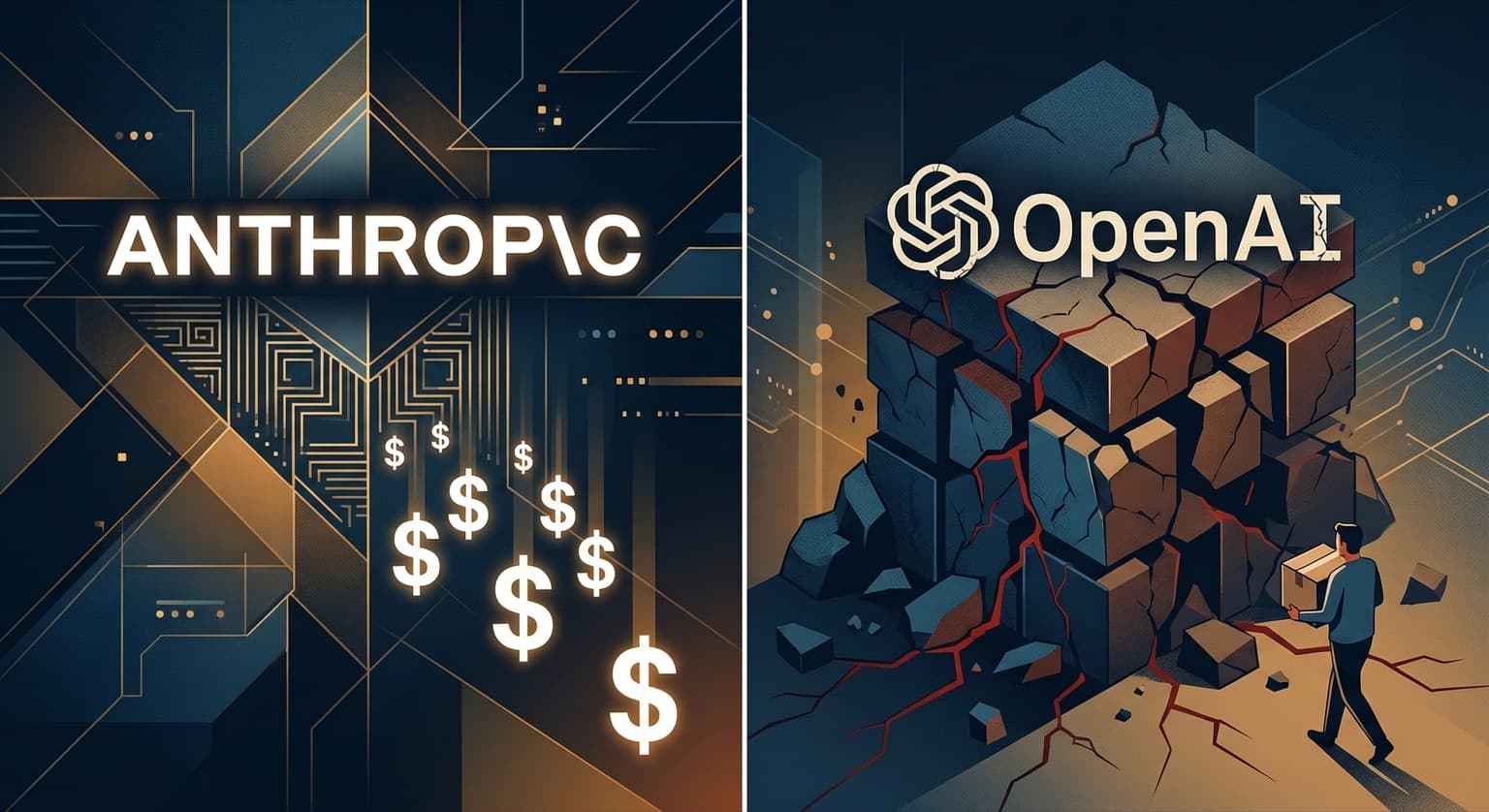
Anthropic has built a 30–60% cost-per-token advantage over OpenAI — and it's not from better prompts. It's silicon strategy. While OpenAI runs almost entirely on Nvidia, Anthropic has diversified across custom silicon, Google TPUs, and AWS Trainium, making its compute stack less brittle and structurally cheaper to scale.
The analysis, published this week, points to Microsoft's internal chip program being "years behind schedule" — which means OpenAI's only real cost lever remains Nvidia pricing. That's not a lever; it's a ceiling. An ops lead evaluating Claude versus GPT-5.4 for a document-processing workflow isn't just picking a model — they're picking a cost trajectory. At 60% lower cost per token, Claude runs a substantially different ROI calculation at volume, especially once you cross 100,000+ API calls per month.
This didn't get buried because it's wrong. It got buried because Caitlin Kalinowski's resignation made better copy.
Ranked by operator impact
1 — GPT-5.4 ships with native computer-use mode
OpenAI launched GPT-5.4 and GPT-5.4 Pro on Friday, available via API, Codex, and ChatGPT paid tiers ($20/month Plus and up). The two headlines: 47% fewer tokens on comparable tasks versus predecessors, and native Computer Use mode that lets the model navigate a user's machine across applications without a separate agent layer.
New Excel and Google Sheets integrations let GPT-5.4 operate inside spreadsheet cells — not just generate formulas, but execute them as an agent. Context window is 1 million tokens in API/Codex, though OpenAI doubles the per-token cost above 272,000 tokens on input. If your workflows stay under that ceiling, the token efficiency gain is real money.
For an ops team running 500K monthly API calls, a 47% token reduction translates directly to invoice reduction — assuming you're already on GPT-5.x and don't switch to Anthropic for the reasons above.
2 — OpenAI's robotics head resigns over Pentagon deal governance
Caitlin Kalinowski — head of robotics and consumer hardware, formerly Meta's Orion AR glasses lead — announced her resignation today citing OpenAI's Department of Defense agreement. Her public statement: "Surveillance of Americans without judicial oversight and lethal autonomy without human authorization are lines that deserved more deliberation than they got."
Her follow-up framing is the sharper signal: "My issue is that the announcement was rushed without the guardrails defined." This isn't an ethics-in-AI abstraction. It's a governance failure at a company that sells "safe AI" as a core product promise.
OpenAI's response confirmed the departure and restated its red lines: no domestic surveillance, no autonomous weapons. The context: Anthropic had previously been in talks with the Pentagon for a similar arrangement, which fell through in late February after Anthropic was designated a supply-chain risk.
For an ops buyer at a 20-50 person company: this affects nothing in your day-to-day. It does affect your board's comfort level if you're in a regulated industry and need to justify your AI vendor stack. OpenAI's mission drift narrative has legs, and legal will eventually ask about it.
3 — Gemini 3.1 Flash Lite is priced at 1/8th the cost of Pro
Google released Gemini 3.1 Flash Lite this week, completing the Gemini 3.1 tier stack (Pro launched in February). Flash Lite is optimized for "time to first token" latency and high-throughput workloads — customer support, live content moderation, UI generation. At 1/8th the per-call cost of 3.1 Pro, it's Google's direct answer to Anthropic's Haiku and OpenAI's mini-class models.
If you're routing routine classification or summarization tasks to a Pro-class model today, this is an immediate repricing opportunity. The question is whether Flash Lite's quality holds on your specific workload. Worth a one-day A/B eval.
4 — OlmoHybrid 7B: 2× data efficiency, fully open weights
AI2 released OlmoHybrid this week — a 7-billion-parameter model combining standard transformer attention with linear recurrent layers. The result: it hits MMLU scores competitive with larger models while requiring half the training data. Fully open, Apache 2.0 license, self-hostable.
For teams running fine-tuned models or building on-premise pipelines, this is worth a look. The hybrid architecture (transformer + linear recurrence) is a real architectural bet, not just another LoRA tweak. At 7B parameters, inference on a single A10 GPU is viable. At 2× data efficiency, fine-tuning on your proprietary data gets cheaper.
5 — Microsoft Phi-4-reasoning-vision-15B: adaptive reasoning on images
Microsoft's Phi-4-reasoning-vision-15B dropped March 4, available on Azure AI Foundry, HuggingFace, and GitHub under a permissive license. The 15B model processes images and text, reasons through math and science problems, interprets charts and documents, and — critically — is designed to not reason when reasoning is wasteful. It skips chain-of-thought for simple visual tasks like captioning and switches to full reasoning for complex document analysis.
That switching behavior is the differentiator. Most reasoning models burn compute on every query. Phi-4 treats reasoning as a budget, not a default.
6 — Anthropic publishes a labor market impact framework
Anthropic released a research paper establishing a new measurement framework for AI's effects on employment — not predictions, but a methodology for detecting economic disruption in labor data that's currently too noisy to read clearly. It's methodologically careful and positioned as groundwork for future empirical work.
The paper's most honest sentence is the implicit one: we don't yet have reliable tools to measure what we're doing to the labor market. For an ops lead hiring or considering headcount decisions based on AI productivity gains, that's worth sitting with.
The unifying thread
Today's news is best read as a vendor governance stress test. OpenAI is losing a key exec over an agreement it made without sufficient internal deliberation. Anthropic is building cost advantages that don't depend on Nvidia. Google is pricing its commodity tier aggressively. And the open-source stack (OlmoHybrid, Phi-4) is closing the gap on proprietary models faster than most procurement teams are tracking.
The ops lead who builds a three-vendor capability (one frontier model, one efficient model, one open-weight option) is more resilient than the one who optimized for a single-vendor discount.
The cost of having no fallback is now visible in a resigned robotics head's LinkedIn post.
AI Pilot Readiness Checklist
Turn the idea into a pilot you can defend.
AI agent articles are easy to bookmark and hard to operationalize. Use the readiness questions as a shared way to decide whether a workflow is specific enough, safe enough, and measurable enough to pilot. If they surface a strong candidate, BaristaLabs can review it with you and help shape a first version that fits your systems, approval process, and risk tolerance.
Please do not submit PHI, customer records, credentials, or confidential workflow exports.
Practical AI Workflow Notes
Want more practical AI operations ideas?
Get short notes on applying AI inside real small-business workflows — from document handling and customer follow-up to internal reporting, compliance, and automation guardrails.