


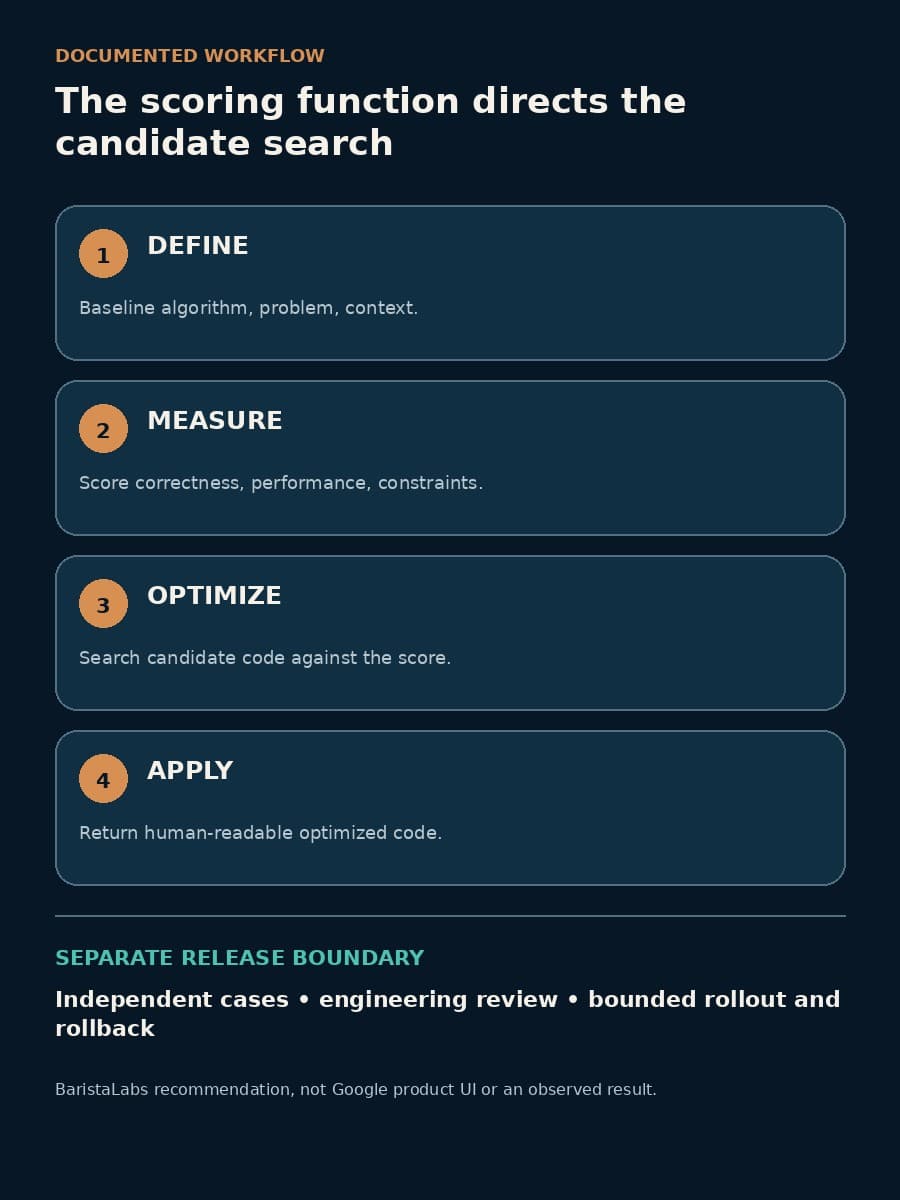
Google Cloud has made AlphaEvolve, its Gemini-based code optimization and discovery agent, generally available on Gemini Enterprise Agent Platform. The system starts with a baseline algorithm, generates candidate code, and searches for versions that improve a scoring function.
That makes the scoring function a consequential piece of production engineering, not a setup detail. If it rewards speed but omits correctness on unusual inputs, the search can produce faster code that the business should not ship. This article explains what AlphaEvolve needs from a team, how to design the objective, and why the final release decision should remain outside the optimization loop.
What does AlphaEvolve actually optimize?
Google describes a four-step workflow: Define, Measure, Optimize, Apply. In the Define step, a team supplies a baseline seed algorithm, the problem definition, and relevant background knowledge. The Measure step establishes a function that can score candidate programs on metrics such as correctness, performance, and operational constraints.
AlphaEvolve then generates and tests candidate code against that function. Google calls the result human-readable optimized code rather than a replacement system built from scratch. The product is aimed at algorithmic problems where many possible implementations can be executed and compared, including logistics, semiconductors, genomics, high-performance computing, and financial services.
The mechanism sets a practical eligibility test. A workflow is a stronger candidate when the current algorithm runs reliably, representative inputs are available, and a machine can score each proposed implementation without waiting for an ambiguous human judgment. “Make this process better” is not yet an optimization problem. “Reduce routing time while preserving every declared feasibility constraint on this fixed case set” can become one.
What belongs in the scoring function?
The score needs to represent the job in dependency order. Start with validity: the candidate must compile or execute, return the required form, and satisfy hard correctness rules. Only a candidate that passes those checks should receive credit for being faster, cheaper, smaller, or more accurate.
Then add the operating trade-offs that matter for the specific workload. Google’s Coolblue example says the retailer optimized a 28-day demand-forecasting pipeline with a metric that combined the first seven days and the full horizon, plus a strict penalty for under-forecasting. Google reports that the resulting pipeline reduced weighted mean absolute percentage error by more than 5% after about 200 iterations. That is a vendor-hosted customer result, not a universal forecast benchmark, but the metric design is instructive: the objective represented two time horizons and an asymmetric business cost rather than one average error.
A useful objective can contain several terms, but each term needs a declared reason and scale. A latency measure collected in milliseconds cannot simply be added to a percentage error without defining how each affects acceptance. Hard safety or correctness conditions should usually remain pass/fail constraints instead of becoming small penalties that a large speed improvement can outweigh.
Also record the measurement environment. Hardware, compiler flags, dependency versions, concurrency, warm-up behavior, input distribution, and candidate time budget can all change which implementation wins. A score without those conditions is not reproducible evidence.
Why is the optimization score not the release gate?
The optimizer sees the cases and rules exposed by its scoring function. Production contains conditions that were omitted, rare, delayed, or difficult to simulate. A candidate can improve the declared objective while consuming more memory under peak load, changing numerical behavior at an untested boundary, becoming harder to maintain, or exploiting a shortcut in the evaluator.
Google’s own customer material preserves this distinction. In the JetBrains example, the quoted engineering lead says engineers still own the benchmark, review, and release decision. AlphaEvolve reduces the search space; it does not own production acceptance.
Keep an independent test set out of candidate selection. It should include normal cases, edge conditions, prior incidents, larger loads, and inputs designed to expose shortcuts. If every release case repeatedly enters the optimization score, it stops being independent and can no longer show whether improvements generalize beyond the search.

Review the code as code, too. Human-readable output supports inspection, but readability does not prove correctness, maintainability, security, licensing suitability, or operational fit. Run the organization’s normal static checks, tests, dependency review, performance profiling, and change approval. The optimizer’s score belongs among that evidence, not above it.
How should reported customer gains be read?
Google’s GA announcement presents substantial customer outcomes. It reports that FM Logistic improved an already optimized routing approach by 10.4%, JetBrains improved IDE performance by more than 15–20%, and Kinaxis improved key forecasting metrics by more than 22% while reducing runtime by more than 90% on benchmark datasets. Google also says Klarna explored nearly 6,000 candidate programs over three weeks for a large machine-learning training pipeline.
These examples show the kinds of measurable search problems early users gave the system. They do not establish an expected return for another workload. The public post does not provide a common baseline, a shared evaluation protocol, complete cost boundaries, or independent replication across those projects.
Use each result as a question generator. What was the baseline? Which cases entered the score? What constraints could disqualify a candidate? How much compute and engineering time did the search consume? Which tests were withheld until release review? Without those answers for the local workload, a percentage from another organization cannot support a purchase or deployment decision.
What should a bounded pilot preserve?
Choose one algorithm where current performance creates a real operating cost and where correctness can be checked automatically. Preserve the baseline source, binary or deployed artifact, benchmark inputs, environment, outputs, runtime, resource use, and known failure cases before starting the search.
Run candidates in an isolated development environment with no production credentials or write access. Fix the candidate budget and record every version that reaches evaluation, not only the winner. A useful pilot should let another engineer reproduce the baseline, the selected candidate, the score, and the reasons rejected candidates failed.
After selection, execute the independent release suite and compare case-level behavior with the baseline. Inspect resource ceilings, concurrency, failure recovery, observability, and rollback behavior. If the optimized implementation advances, use a canary or similarly bounded rollout and retain the prior version until production evidence supports expansion.
These are BaristaLabs recommendations, not requirements published by Google. Google’s public material also does not state universal service pricing, candidate budgets, or the total implementation effort a customer should expect. Confirm commercial availability and product limits directly for the intended account and region.
The score is a search instruction, not a business verdict
AlphaEvolve’s general availability makes large candidate searches accessible to more engineering teams. Its value is strongest when a business can turn a costly algorithmic problem into executable constraints and repeatable measurements.
The boundary is equally important: the scoring function tells the optimizer where to search, while independent evidence tells the organization whether to release. Preserve both. If the same score chooses the candidate and supplies the entire case for production, the pilot has not tested what the search failed to see.
BaristaLabs can review one optimization pilot and help define the baseline, objective, independent checks, ownership, and rollback boundary before candidate code reaches production.
Sources
- Google Cloud: “Solve harder problems with AlphaEvolve, now available to everyone on Google Cloud”, July 9, 2026.
- Google: “We’re rolling out AlphaEvolve widely to solve Google Cloud customers’ hardest problems”, July 9, 2026.
- Google: “The latest AI news we announced in July 2026”, August 4, 2026.
Google controls the product descriptions, availability statements, workflow, and customer claims attributed to its posts. BaristaLabs supplies the eligibility test, score-design interpretation, independent release boundary, and pilot recommendations.
Code-optimization pilot review
Know what the optimizer may change and what still blocks release
BaristaLabs can help scope one measurable optimization problem, its candidate environment, independent checks, ownership, and rollback plan.
Bring a sanitized baseline, test harness, current performance evidence, and operating constraints; do not submit credentials, customer data, or proprietary source code through the contact form.
Turn this idea into a pilot
Which workflow should go first?
Use the readiness check to compare impact, effort, risk, owner, and next step before requesting a review.
- 3-5 minutes
- Deterministic score
- No sensitive data
Practical AI Workflow Notes
Want more practical AI operations ideas?
Get short notes on applying AI inside real small-business workflows — from document handling and customer follow-up to internal reporting, compliance, and automation guardrails.