First-party product engineering proof
RouteDrop EV: making complex product state visible before vehicle handoff
A multi-stop drive becomes a state-management problem before the vehicle moves. RouteDrop EV keeps the plan editable, rehearses ordered behavior, reports the vehicle handoff, and asks separately before live features use more precise location.
This page examines a BaristaLabs product through first-party product pages, help material, privacy documentation, and approved interface screenshots. It is not a client result or a performance report. The BaristaLabs Products page lists RouteDrop EV as coming soon on the App Store.
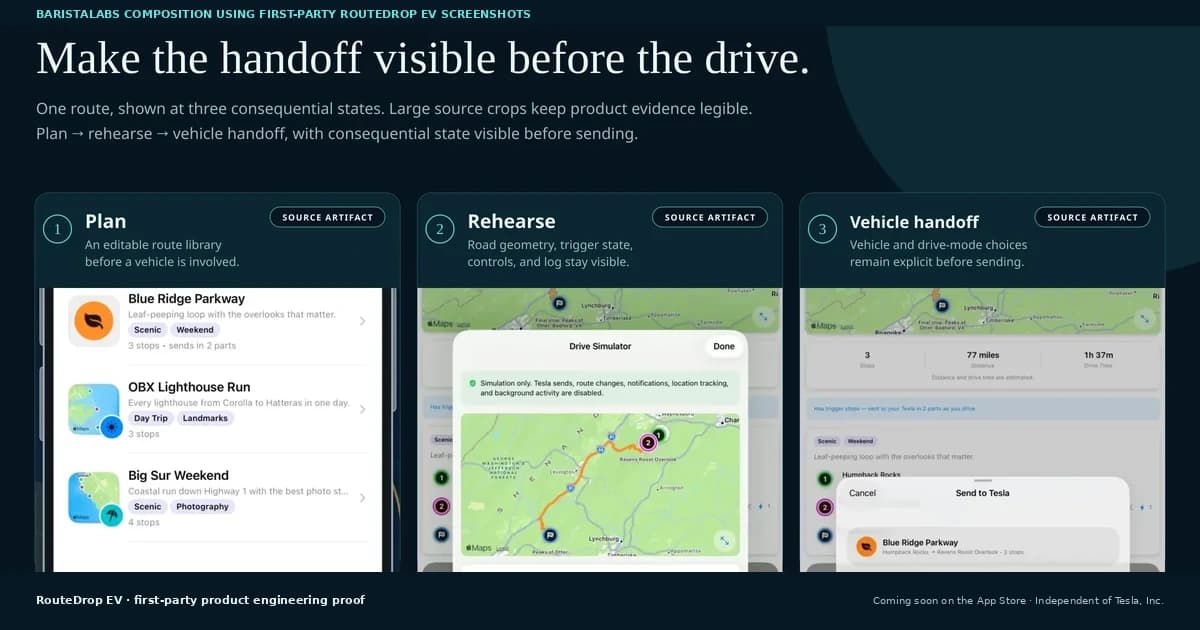
The route becomes a product-state problem before the vehicle moves
Product state is the information the app must preserve and explain. It changes as a person edits a plan, previews behavior, connects another system, or changes a permission. In RouteDrop EV, this state includes route parts, stops, trigger radii, ordered actions, vehicle choice, send mode, progress, confirmation, and location precision.
The engineering question is broader than drawing a route on a map. The product has to keep detailed planning useful without making every edit a server action. It also has to show when a local plan becomes an external command or a live data connection. The evidence below lets a buyer inspect those decisions without turning them into unsupported claims about adoption, speed, safety, or reliability.
The published RouteDrop EV field note explains the product principle across the feature set. This page focuses on the implementation boundaries that a product owner can inspect before choosing a first-release path.
The plan stays editable until an external system needs it
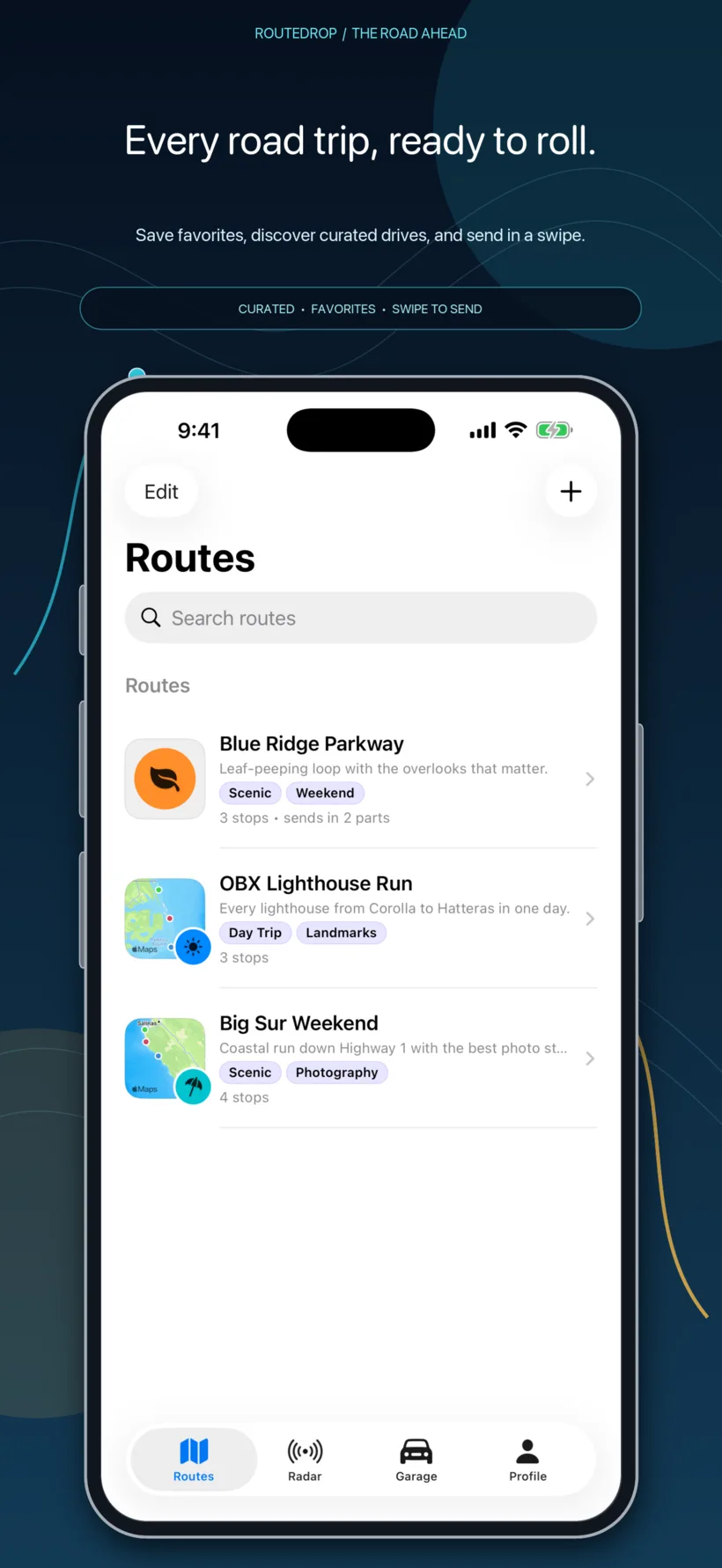
RouteDrop EV starts with a local-first library. Saved routes, Trips, notes, photos, icons, and embedded media work from the device. They privately sync through iCloud. A person can create, import, organize, edit, share as a file, and simulate routes before connecting a Tesla account. The product's privacy policy documents the server-backed actions separately.
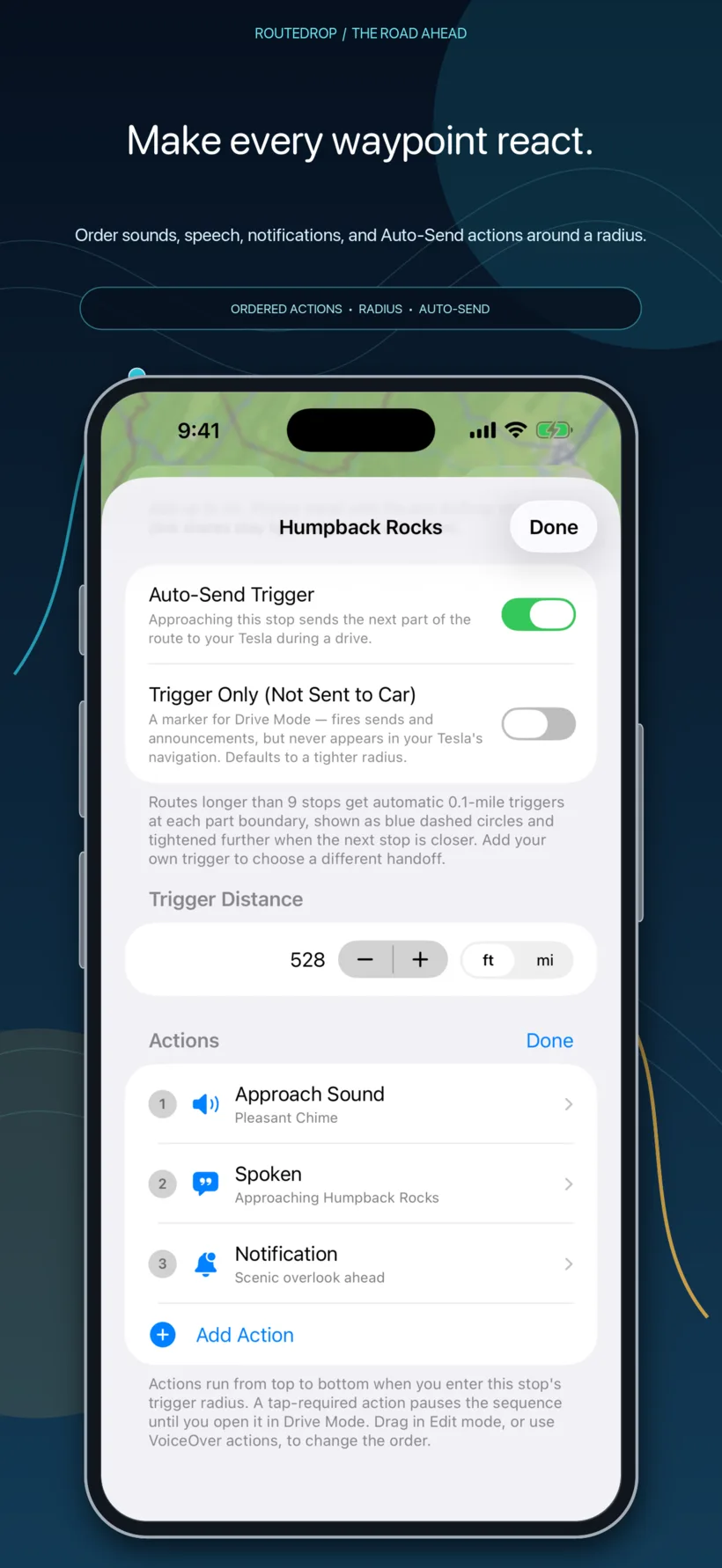
Each stop can also carry a visible trigger radius and an ordered sequence of up to 16 enabled actions. The order matters because one action can present information, wait for a tap, open another app, or hand the drive to another route. RouteDrop EV keeps the sequence editable, and imported actions with side effects arrive paused for review.
Detailed state remains an authored part of the plan. A buyer can inspect that decision in the interface. The app does not reduce the route to a destination list before the user has reviewed each stop.
Rehearsal previews local effects and records external side effects
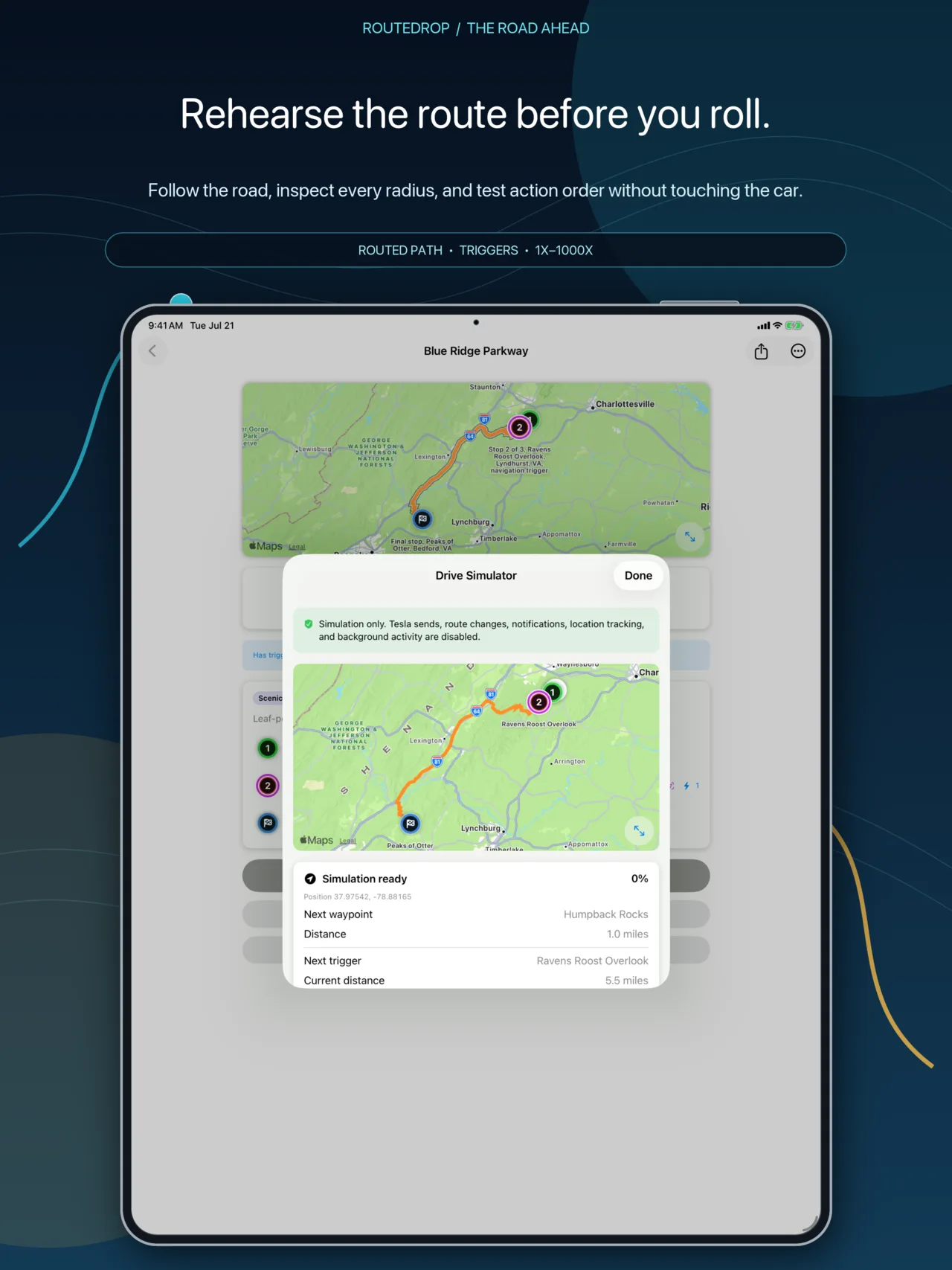
The Drive Simulator follows routed road geometry and enters each trigger circle in route order. It can preview supported local speech, embedded generated audio, and arrival cards. A persistent log records the rehearsal as the simulated drive advances.
The simulator uses another path for actions that can affect an app, service, vehicle, or product state. It logs Tesla sends, notifications, external apps, media controls, Shortcuts, route switches, history, and background work. It does not perform those actions. The user can inspect the intended sequence without turning a rehearsal into a live command.
The evidence establishes one bounded claim. RouteDrop EV provides an inspection surface for route order, trigger behavior, and intended side effects. The source does not establish physical-drive safety, trigger reliability, or correct behavior in every road condition.
The vehicle handoff gives each system a clear job
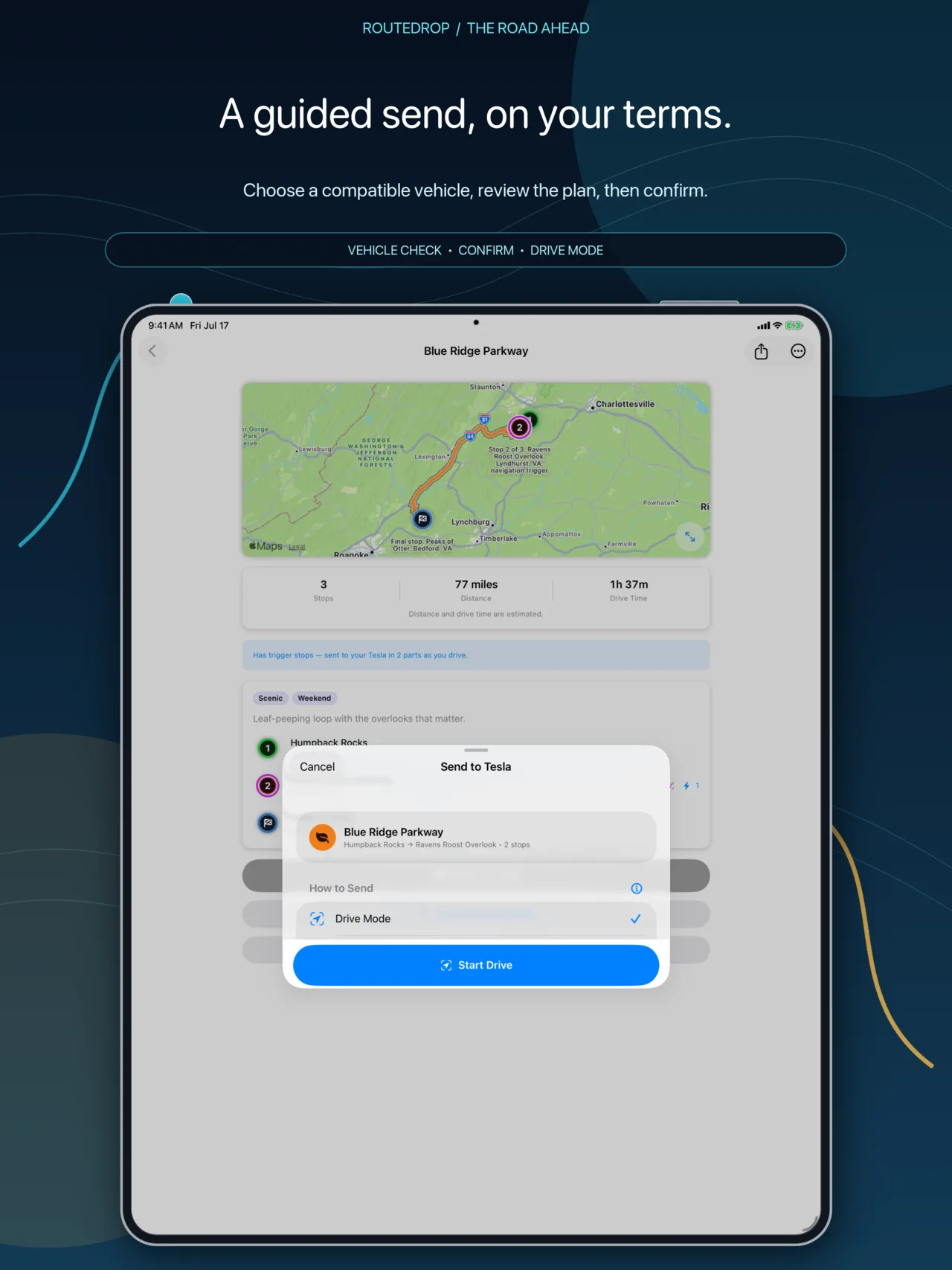
A route send crosses from an editable plan into Tesla's systems. RouteDrop EV exposes the choices and states around that boundary. These include vehicle selection, Tesla sign-in, wake state, pairing when required, compatibility, route preparation, send mode, progress, confirmation, cooldown, and uncertain-delivery fallbacks.
The documented help flow asks the driver to choose the exact car and route part while safely parked. Drive Mode, Round-Trip, and Just Send set different behavior, so the choice appears before the command. Duplicate-send safeguards and a visible cooldown help the user avoid an immediate repeat when delivery state is uncertain.
BaristaLabs' interpretation is that confirmation should stay with the external system that performs the action. RouteDrop EV owns the preparation and delivery state it can report. Tesla owns Tesla confirmation. An uncertain response remains visible as uncertainty instead of being rewritten as success.
Location precision changes only after a separate choice
Route planning does not grant every live feature the same location access. Route Radar is off by default and uses a coarse nearby area plus direction of travel while it is enabled. It does not publish an exact trail.
A Convoy uses a different boundary. A person creates or joins a room with a code. The app then asks for room-specific consent before it relays precise location to that group. The current privacy policy states that positions are relayed in real time. It also states that they are not stored as location history and stop when the person leaves or closes the room.
The product decision is visible at the point where precision changes. A saved route, coarse nearby presence, and invited precise group presence do not inherit one broad permission. This gives a buyer direct evidence of feature-level data boundaries. It does not imply that all RouteDrop data stays on the device.
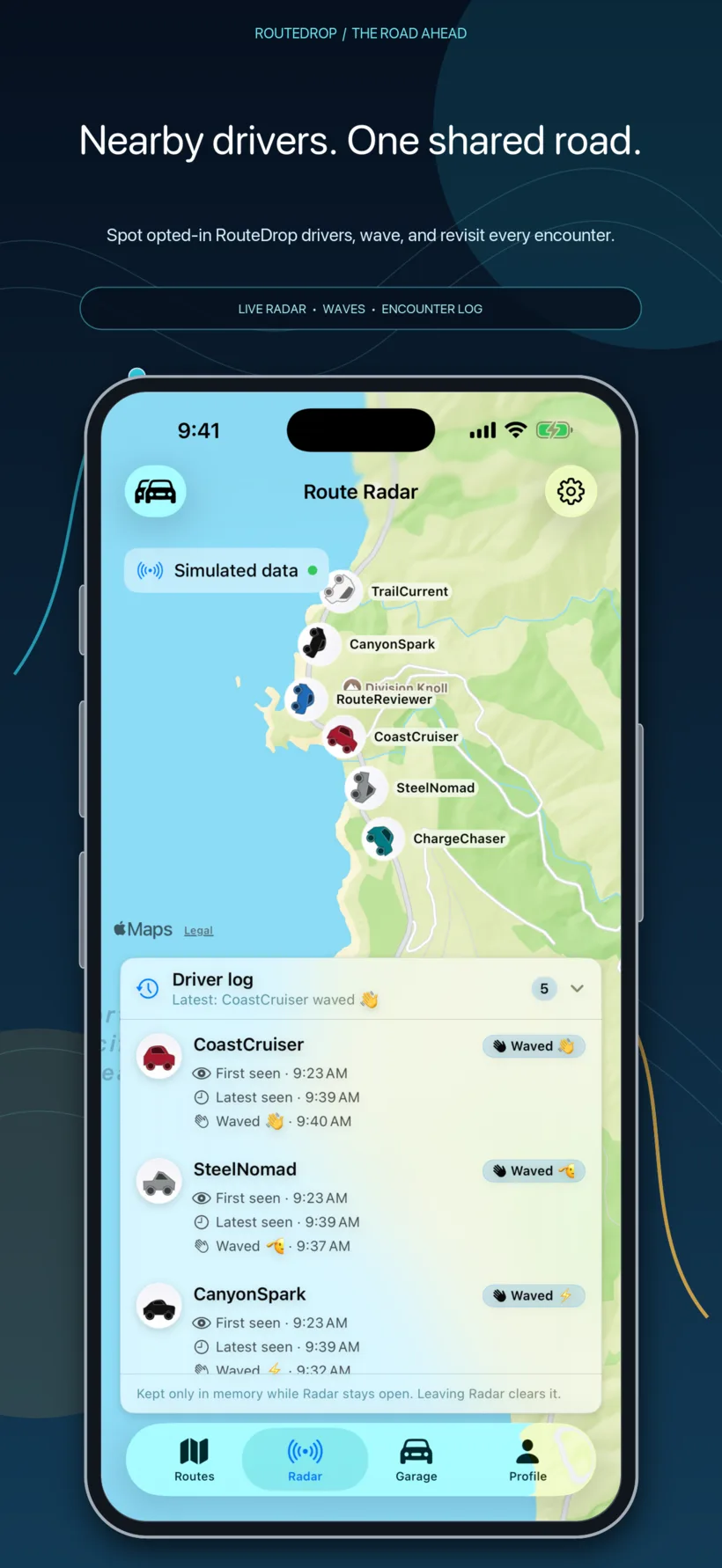
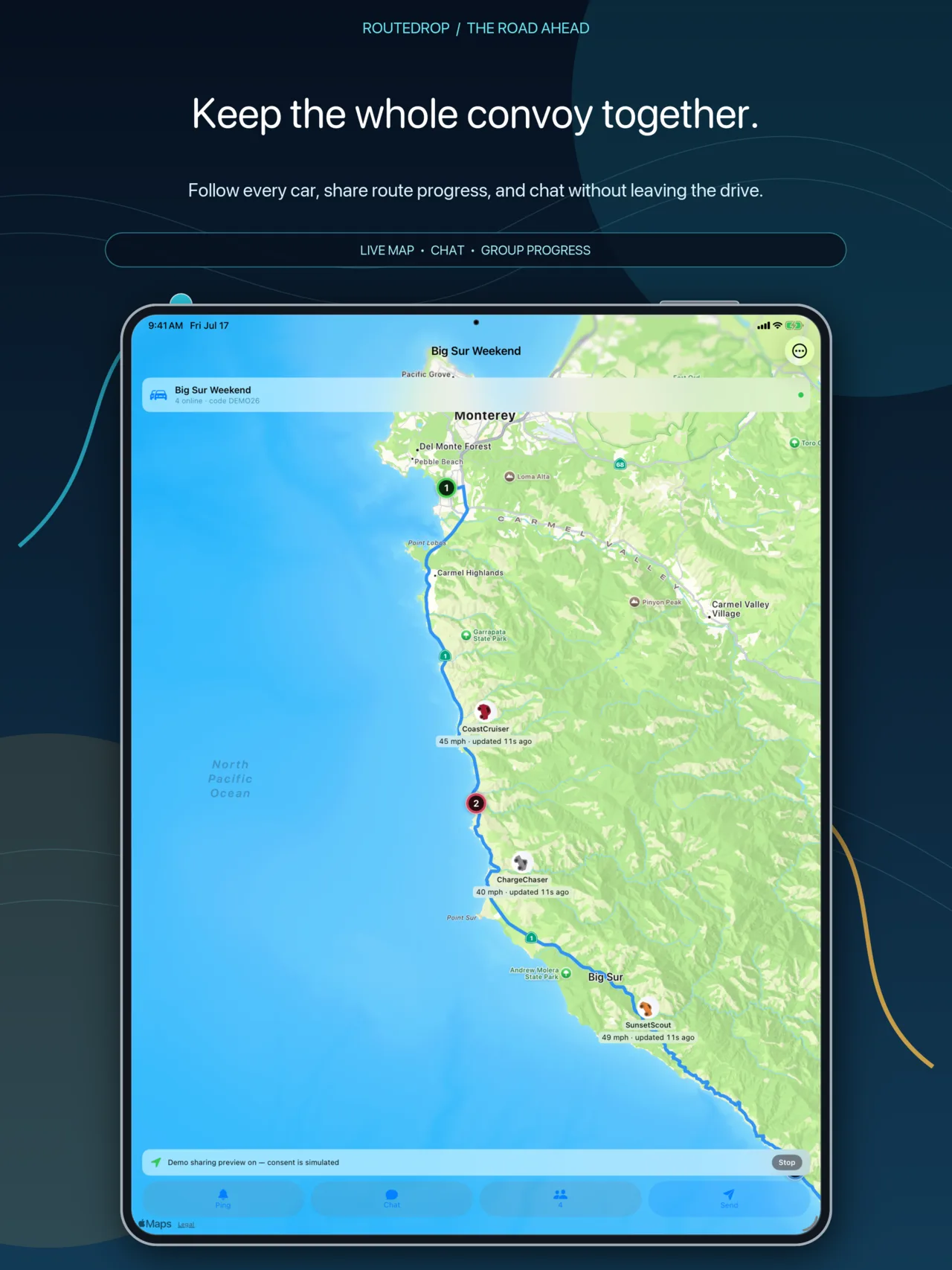
Radar and Convoy are separate source artifacts. The layout compares their feature boundaries; it is not a single RouteDrop EV interface state.
What this first-party evidence supports
The source facts show an editable local-first plan, ordered stop behavior, a road-following simulator, a staged vehicle handoff, coarse Radar presence, and separately consented Convoy precision. Approved first-party screenshots make those interface states available for inspection.
BaristaLabs' interpretation is that a focused product becomes easier to review when consequential state remains visible. A team can see what is still editable, what will create a side effect, which system confirms an external action, and when a feature asks for more precise data.
The evidence has clear limits. It supplies no customer result, adoption count, time-saved measurement, command-success rate, safety result, physical-drive reliability result, App Store availability, or release date. It does not establish how BaristaLabs would apply a data-security review or responsible-AI artifact in a client engagement.
If data access or generated features are the next buyer question, review the BaristaLabs data-security method and responsible-AI method. Those pages describe service methods. They are not RouteDrop EV outcome claims.
A focused first release starts with the boundary
A first release can exclude many platform features. The team must define the editable state and the action that crosses into another system. It must also define the confirmation owner and the point when the data boundary changes.
RouteDrop EV gives buyers a current first-party example of those decisions in a mobile product. Use the product preview to inspect the app itself. If you are evaluating a custom portal, integration, dashboard, mobile app, or AI-enabled system, bring the first-release boundary to Custom Solutions.
RouteDrop EV is coming soon on the App Store. It is an independent Barista Labs product and is not affiliated with, endorsed by, or sponsored by Tesla, Inc.
Sources for this proof
First-party RouteDrop EV sources reviewed on August 21, 2026: product home, feature guide, help, about, and privacy policy. The published BaristaLabs field note supplies the approved screenshot provenance and the earlier product-principle analysis.