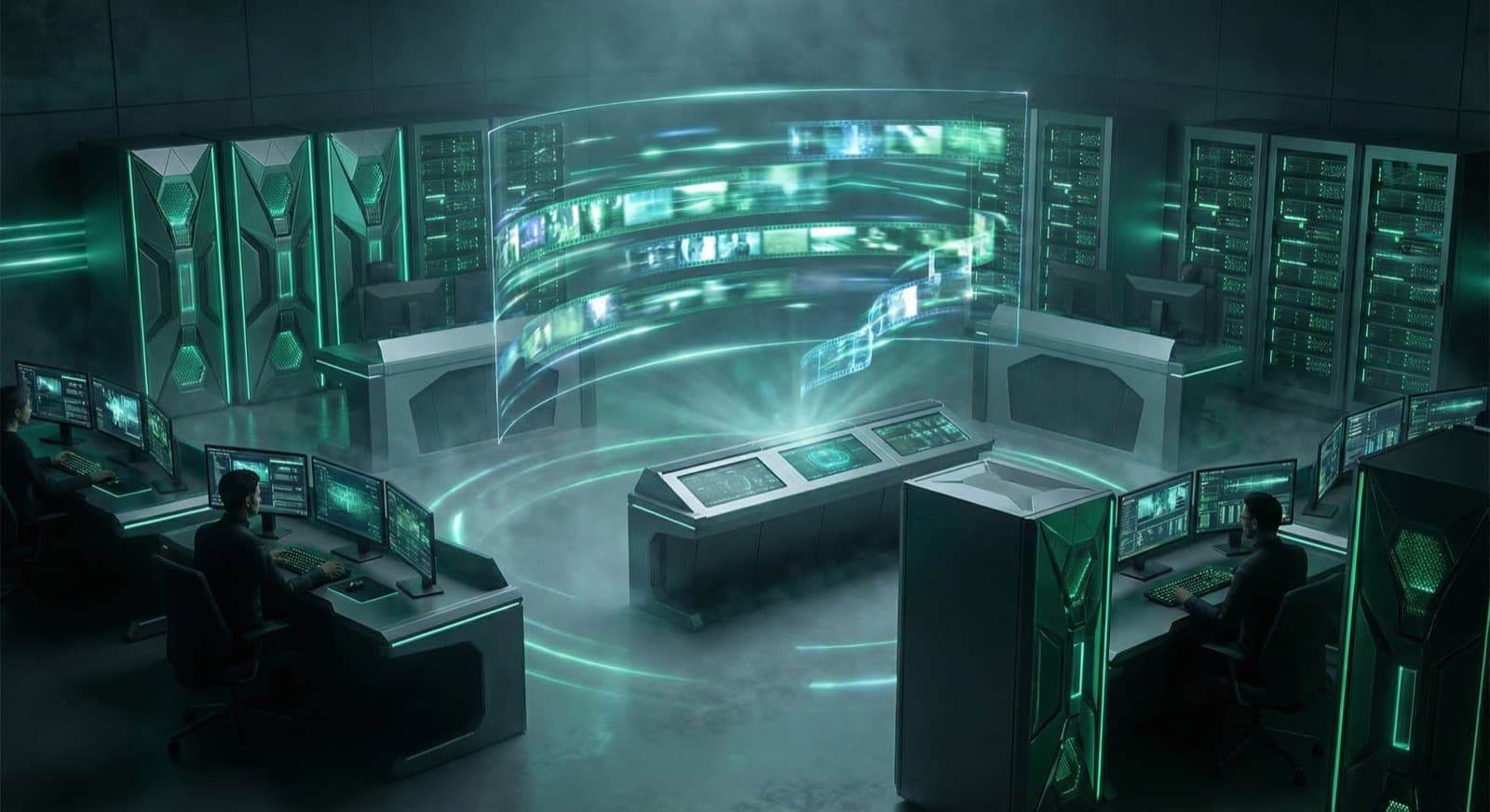

Runway just put a hard number on a transition the video market has been waiting for. In a post shared during NVIDIA GTC 2026, the company said it had trained a new real-time video model with NVIDIA that runs on Vera Rubin, generates HD video instantly, and delivers time-to-first-frame under 100 milliseconds. Runway described it as a research preview, not a public product launch, but the performance claim is strong enough that the product roadmap almost writes itself.
Under 100ms is not "faster generation." It is a category change.
Most AI video systems today still behave like render farms wearing consumer UI. You type a prompt, wait, inspect the clip, revise the prompt, wait again, then hope the next pass did not break character consistency, motion, or scene logic. Even the better tools remain asynchronous at heart. They are useful, sometimes very useful, but they are still built around delayed feedback.
What Runway showed this week points at a different interface entirely: video models that respond quickly enough to feel interactive. Once latency drops below the threshold where humans perceive a long pause, the design space changes. Prompts become controls. Iteration becomes steering. Video generation starts to look less like batch media production and more like a live graphics system.
The number worth respecting is the first frame
Model demos often hide behind aggregate throughput. A company says a system is faster, but "faster" can mean almost anything: shorter total render time, better parallelism, smaller clips, lower resolution, or a cherry-picked benchmark that matters only inside the lab.
Runway's phrasing was more useful than that. It emphasized time-to-first-frame.
That is the right metric for interactivity because the first frame determines whether the system feels immediate or delayed. Once the first image appears, the user can start reacting. In practice, that is the line between a tool that supports live creative flow and a tool that keeps interrupting it. Under 100ms is in the territory where the machine can plausibly sit inside a human feedback loop instead of forcing the human to work around the machine.
This is why the GTC demo matters even though it is only a research preview. The market has been talking about "real-time generative video" loosely for a while, often meaning "short wait times" or "streaming playback after generation begins." Runway attached a concrete latency target to the claim, and it did so in HD on NVIDIA's next-generation Rubin stack. That raises the bar for what counts as real-time.
Vera Rubin is doing more than making a benchmark slide look good
The infrastructure piece is not decoration here. It is the entire point.
NVIDIA introduced the Rubin platform in January 2026 as its next major AI system architecture, built around the Vera CPU and Rubin GPU, with the company claiming major gains in inference efficiency and lower token cost versus Blackwell. Runway was one of the named ecosystem partners at launch. The GTC demo now gives that partnership a much clearer shape: not just "Runway will use Rubin someday," but "Runway is already using Vera Rubin to push video generation into interactive latency."
That matters because video generation is a nastier inference problem than most text or image tasks. It requires coherence across frames, enough spatial quality to avoid looking cheap, and enough temporal stability that motion does not fall apart under user control. Running that stack fast enough for immediate feedback has been one of the cleanest stress tests for new AI hardware.
If Rubin can sustain this kind of workload at HD with sub-100ms first-frame latency, the signal is bigger than one flashy demo. It suggests NVIDIA's next wave of infrastructure is not just about larger training runs or cheaper token output. It is about supporting new classes of media software that only become viable when latency collapses.
The obvious use cases are not the most interesting ones
The easiest applications to imagine are the familiar creative ones: directors roughing in camera motion live, ad teams iterating on storyboard beats during a meeting, game studios prototyping cinematics without waiting on traditional render cycles, or live event teams generating background visuals that respond to music and stage cues.
Those are real opportunities, but they are also the conservative read.
The more interesting use cases appear when you stop thinking about "video generation" as a content export tool and start thinking about it as a runtime. A real-time video model can become an interface layer for virtual production, interactive entertainment, simulation, telepresence, personalized education, dynamic ecommerce environments, or AI-native design tools that respond visually while a user is still talking.
That shift has commercial consequences. Once the output is interactive enough, product teams stop selling clips and start selling systems. Pricing changes. Workflow ownership changes. Competitive moats change. The best product is no longer the one that produces the prettiest standalone sample on X. It is the one that makes a human faster inside a live loop.
Research preview is not the same thing as product readiness
It is worth staying disciplined about what Runway actually announced.
This was a research preview shown at GTC 2026, not a public feature release, API launch, or GA product. There is no evidence yet that customers can access this model, what prompt/control interfaces it supports, how long sessions can run, what the cost profile looks like, or how stable the quality remains under sustained interaction. A great staged demo can still hide hard product problems: drift, artifact buildup, control instability, thermal limits, infrastructure cost, or a latency profile that holds only under narrow conditions.
That caveat matters, but it does not erase the achievement. Research previews are where the market gets to see which constraints are falling first. In this case, the constraint appears to be latency. If quality keeps improving from here, the product side becomes a packaging problem rather than a physics problem.
There is also a strategic angle for Runway. The company has spent the last two years helping define AI video as a creative category, but the market has become crowded fast. More entrants can now produce polished short clips. Real differentiation is harder to sustain on output samples alone. A credible lead in live generation, especially one tied to NVIDIA's newest compute platform, is a sharper position than "our generations look better."
The verdict is straightforward: Runway's GTC 2026 demo is one of the clearest signs yet that AI video is moving out of queued rendering and toward live systems. Because this is still a research preview, nobody should confuse it with a shipping product. But if the sub-100ms claim holds up beyond the stage, the important story is not that video got a bit faster. It is that generative video may finally be crossing into software you can steer in real time.
Turn this idea into a pilot
Which workflow should go first?
Use the readiness check to compare impact, effort, risk, owner, and next step before requesting a review.
- 3-5 minutes
- Deterministic score
- No sensitive data
Practical AI Workflow Notes
Want more practical AI operations ideas?
Get short notes on applying AI inside real small-business workflows — from document handling and customer follow-up to internal reporting, compliance, and automation guardrails.