A 1.5B model fixed the easy merge fights. The agent team still collapsed.
A small Qwen model cleaned up trivial merge conflicts in CooperBench, but paired coding agents still failed. The real problem was coordination, not syntax.

Sean McLellan
Lead Architect & Founder
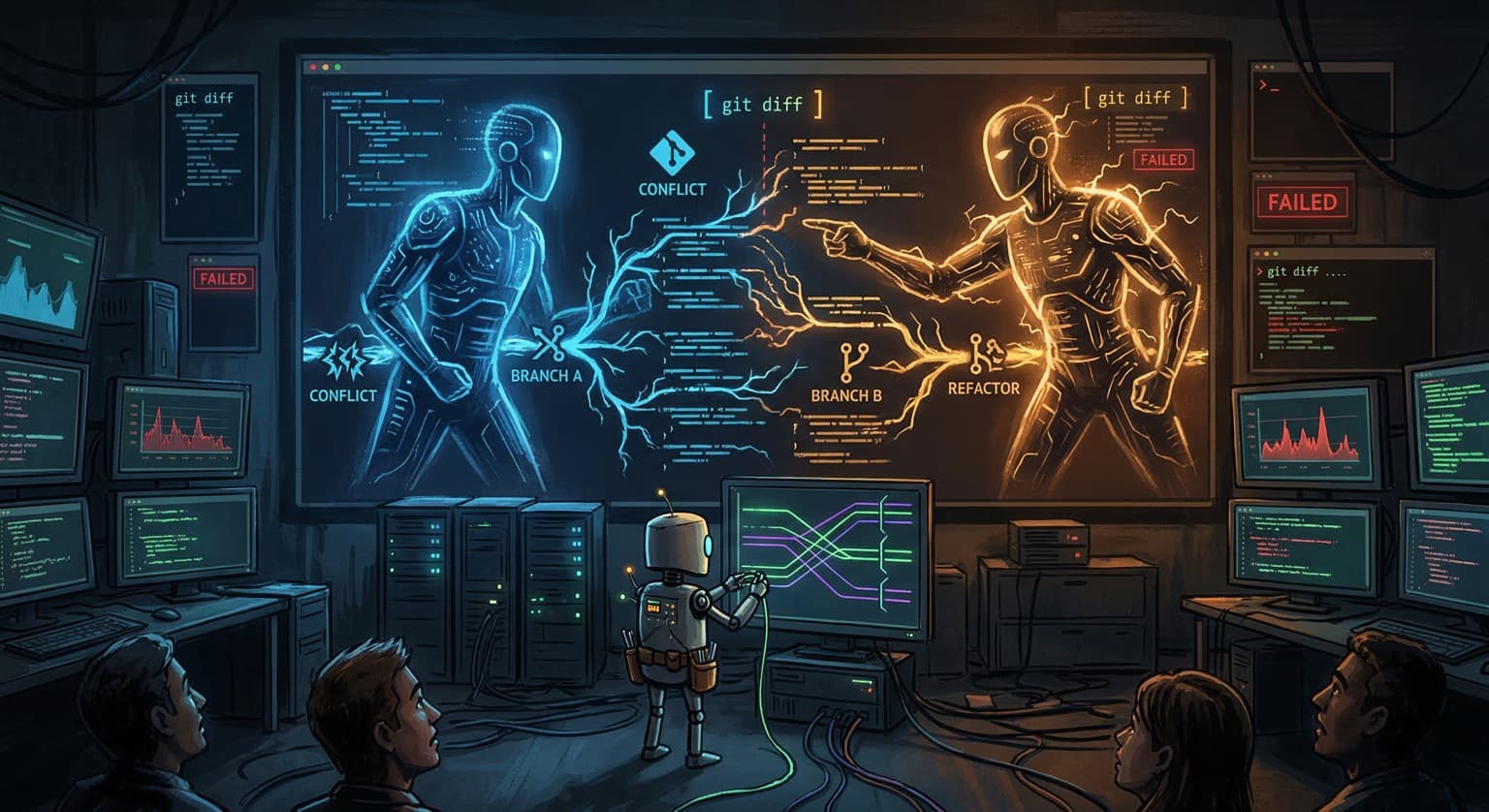
Most coverage of Stanford and SAP's new CooperBench paper stopped at the headline result: coding agents working in pairs do worse than a single agent doing both jobs. The more useful detail was buried in the evaluation section. When the researchers hit trivial merge conflicts, they did not count them as coordination failures right away. They ran a small Qwen 3 Coder 1.5B model to clean up the easy formatting-level collisions first. Even after that cleanup step, the paired agents still failed badly.
For a solo dev or ops lead at a 20-50 person software company, that changes the buying decision. If your stack is GitHub, Claude Code or Codex, CI on GitHub Actions, and a ticket queue in Linear, this is not a story about model intelligence in the abstract. It is a story about whether paying for two concurrent agents actually reduces delivery time. A simple budget estimate: if your team burns $30 a day on premium agent runs and roughly 20% of the action budget goes to back-and-forth messaging that does not improve pass rates, you are effectively paying about $6 a day for coordination theater before you count rework.
The footnote that changed the result
CooperBench includes 652 collaborative coding tasks across 12 libraries and 4 languages. The tasks were designed so two agents got different features that were logically compatible but likely to conflict in overlapping code.
That setup matters, because the benchmark was not measuring whether agents can survive obviously adversarial prompts. It was measuring whether they can behave like coworkers on the same repo.
The undercovered part is the merge policy. The paper says the team used git merge-file first. When that failed because of superficial differences like formatting or indentation style, they used a fine-tuned Qwen 3 Coder 1.5B model to resolve those trivial conflicts. In other words, the researchers already stripped out one of the easiest excuses for failure. The disappointing scores came after the cheap syntax problems had been cleared away.
Noise was expensive, but not decisive
The benchmark also found that agents can spend up to 20% of their action budget on communication. That sounds promising until you see the next result: communication reduced merge conflicts, but it did not improve overall success. The final merged code still failed tests.
That is the operational warning. Many product demos make multi-agent coding look like parallelism for free. CooperBench suggests the opposite. You can lower visible collision rates without increasing working output. The team looks busy. The repository still breaks.
For a lean engineering team, this is the difference between a tool that helps and a tool that creates a second layer of management overhead. If one agent can finish both features alone, adding a second agent may increase monitoring cost without improving shipped code.
The real defect was trust, not typing
The paper's failure analysis is uglier than a normal benchmark chart. The agents repeated themselves. They ignored direct questions. They made claims about code state that were false. They drifted from explicit commitments. The researchers describe agents holding incorrect expectations about each other's plans and observations, then overwriting work they assumed would merge cleanly.
That helps explain why the tiny merge-fix model did not save them. Superficial conflicts were never the core problem. The core problem was that each agent had the wrong mental model of what the other one was doing.
That also makes the benchmark more useful for buyers. If you are evaluating multi-agent coding tools, the feature checklist should move away from "how many agents can run at once" and toward boring controls: branch isolation, explicit file ownership, test-gated handoffs, and visible commitment tracking. Those sound less magical because they are. They are also the parts doing the real work.
Where the purchase decision actually lands
CooperBench reports that 77.3% of tasks had conflicting ground-truth solutions and still were designed to be jointly solvable. This was not a trick benchmark. It was built to resemble ordinary team development, where compatible work can still collide in shared code.
So the operator decision is straightforward: test multi-agent coding only inside a narrow, well-scaffolded workflow, and skip open-ended peer-style agent teams for production work today. One strong agent with clear tests beats two autonomous "teammates" negotiating in the dark.
Sources: CooperBench paper (arXiv 2601.13295v1), CooperBench project blog.
AI Pilot Readiness Checklist
Turn the idea into a pilot you can defend.
AI agent articles are easy to bookmark and hard to operationalize. Use the readiness questions as a shared way to decide whether a workflow is specific enough, safe enough, and measurable enough to pilot. If they surface a strong candidate, BaristaLabs can review it with you and help shape a first version that fits your systems, approval process, and risk tolerance.
Please do not submit PHI, customer records, credentials, or confidential workflow exports.
Practical AI Workflow Notes
Want more practical AI operations ideas?
Get short notes on applying AI inside real small-business workflows — from document handling and customer follow-up to internal reporting, compliance, and automation guardrails.