Perplexity Computer May Have Just Killed the $225K Martech Stack for SMB Ad Teams
Perplexity Computer connected to Google and Meta Ads APIs and replaced roughly $225K per year in marketing tools in a weekend.

Sean McLellan
Lead Architect & Founder
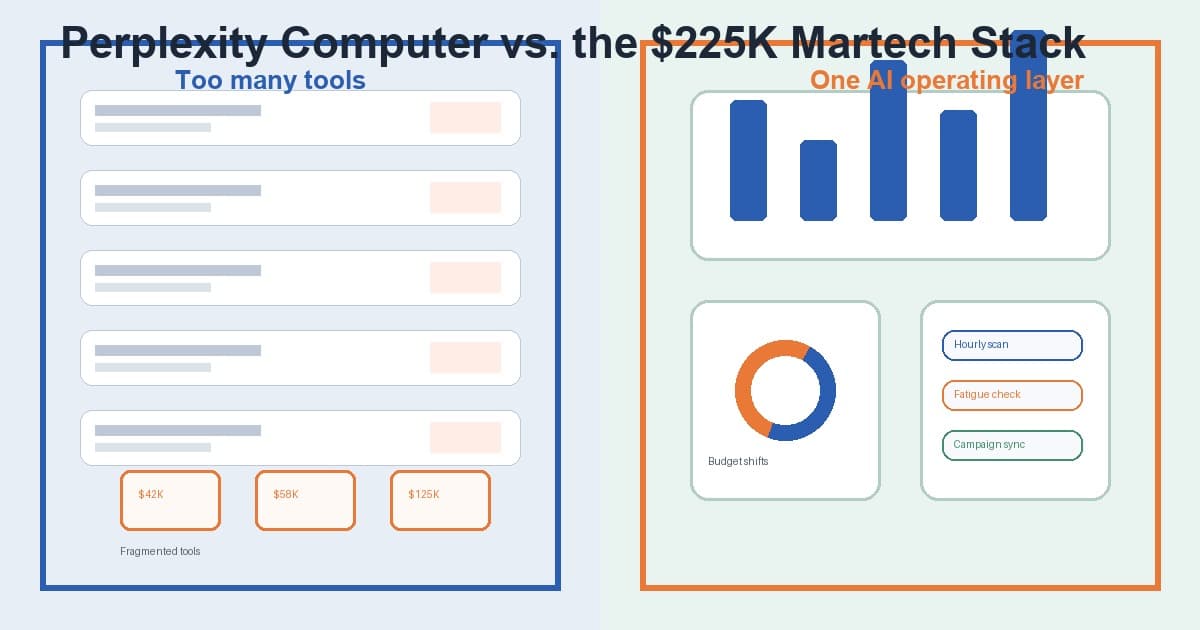
Perplexity just put a hard number on a trend a lot of marketers have been trying to ignore: $225,000 per year in marketing software may be replaceable by a capable AI agent with direct access to ad platforms.
In a new demo, Perplexity Computer connected to Google Ads and Meta Ads APIs and built a marketing automation workflow that reportedly came together in a single weekend. The system scanned campaigns hourly, managed budgets, detected creative fatigue, and coordinated multiple campaigns from analysis through execution.
That is not “AI helps write ad copy.” That is software starting to absorb the work of an entire martech layer.
For small and midsize businesses, this matters because most paid media stacks got expensive by being fragmented. One tool for bid management. Another for reporting. Another for attribution. Another for creative testing. Another for dashboards. Another for alerts. Another for recommendations nobody trusts enough to actually apply.
If one agent can sit on top of the ad platforms themselves and handle the repetitive operating work, the stack starts looking bloated fast.
What Perplexity Computer Actually Did
Based on Perplexity's own description, this marketing agent handled four practical jobs that normally get split across people and software:
- Hourly campaign scanning to check performance, spot changes, and identify issues before they burn budget for days.
- Budget management across campaigns, which is one of the most valuable and most tedious parts of paid media operations.
- Creative fatigue detection, meaning it watched for ads losing effectiveness instead of waiting for a weekly report to tell you performance slipped.
- End-to-end campaign coordination across multiple campaigns rather than acting like a single-purpose reporting assistant.
That combination is the important part. Plenty of tools do one of these jobs. The expensive stacks show up when a business tries to stitch all four together.
Ole Lehmann called it a game-changer for ecommerce businesses, and that take is fair. Ecommerce operators live inside fast feedback loops. When creative gets stale, CAC rises quickly. When budgets drift, margin disappears quietly. When reporting is delayed, decisions get made late. An hourly loop is a different operating model from a Monday morning spreadsheet.
The Tools This Threatens
Perplexity did not publish a one-for-one kill list, and it does not need to. The categories are obvious.
If this works reliably, it puts pressure on:
- Bid and budget management tools
- Analytics and reporting layers
- Creative testing and fatigue monitoring tools
- Alerting and optimization assistants
- Workflow glue that exists mostly to connect one platform's output to another platform's recommendation
That does not mean every vendor disappears. Some businesses will still want specialized attribution, MMM, or enterprise governance layers. But for SMBs spending meaningful money on Google and Meta, the question changes from “which extra tool should we add?” to “which of these tools still deserves to exist?”
That is a healthier question.
What This Means for SMBs Running Paid Ads
My take: the biggest change here is not lower headcount. It is lower coordination cost.
Most small businesses do not fail at paid media because they lack one more dashboard. They fail because campaign data lives in five places, nobody checks it often enough, and by the time a human notices the problem, the spend is already gone.
A system that checks performance hourly and can act on what it sees is valuable because it compresses reaction time.
For a local ecommerce brand or a multi-location service business, that could mean:
- less wasted spend on stale creative
- faster budget shifts toward winning campaigns
- fewer manual reporting hours every week
- fewer subscriptions purchased just to patch visibility gaps
If you are paying for a stack of point solutions that together cost more than a part-time employee, you should assume this category is now under attack.
What SMBs Should Do Next
Do not rip out your stack tomorrow. That would be dumb. Do this instead.
1. Audit your current paid media stack
List every tool you pay for that supports Google Ads or Meta Ads operations. Separate them into buckets: budget management, analytics, reporting, creative insights, attribution, and testing.
2. Mark which tools actually drive actions
A dashboard that nobody uses is not infrastructure. It is decor. Keep only the tools that create decisions or automate meaningful work.
3. Identify your hourly-risk gaps
Where do you currently lose money between checks? Overspend, underdelivery, creative fatigue, broken targeting, delayed reporting. Those are the best candidates for AI automation first.
4. Test automation on one account or campaign group
Start with a contained slice of spend. Measure whether an AI-driven workflow catches issues earlier, reduces manual hours, or improves budget allocation.
5. Rebuild your stack around APIs, not interfaces
The winners here will be businesses that can plug directly into core platforms and automate decisions. Pretty dashboards are losing leverage.
The Bottom Line
Perplexity Computer did not just show a clever marketing demo. It showed that direct API access plus a competent agent can replace a surprising amount of ad-ops software in very little time.
For SMBs, the practical takeaway is simple: if you are still paying enterprise-style money for a fragmented Google and Meta tool stack, start preparing for consolidation. The era of buying six tools to manage two ad platforms may be ending.
AI Pilot Readiness Checklist
Turn the idea into a pilot you can defend.
AI agent articles are easy to bookmark and hard to operationalize. Use the readiness questions as a shared way to decide whether a workflow is specific enough, safe enough, and measurable enough to pilot. If they surface a strong candidate, BaristaLabs can review it with you and help shape a first version that fits your systems, approval process, and risk tolerance.
Please do not submit PHI, customer records, credentials, or confidential workflow exports.
Practical AI Workflow Notes
Want more practical AI operations ideas?
Get short notes on applying AI inside real small-business workflows — from document handling and customer follow-up to internal reporting, compliance, and automation guardrails.