Perplexity Computer Can Run Claude Code Now. Should You Let It Touch Production?
Perplexity Computer now runs Claude Code and GitHub CLI inside its hosted agent workflow. The real question is not whether it works, but where a team should trust a remote coding harness over its own dev stack.

Sean McLellan
Lead Architect & Founder
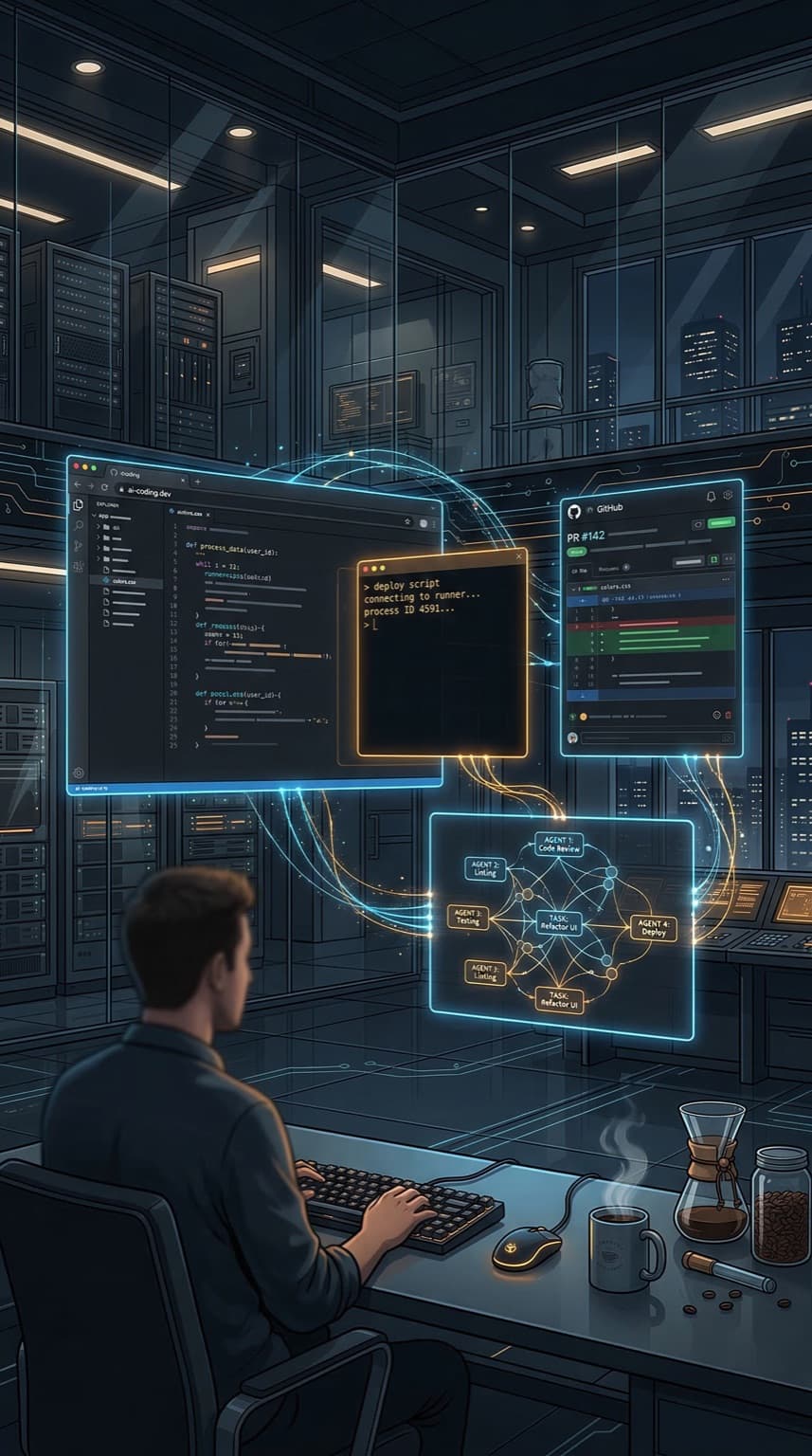
Perplexity is not shipping another chat shortcut; it is turning a hosted agent into a disposable dev workstation.
The trigger for today’s spike in attention was Perplexity’s announcement that Computer can now use Claude Code and GitHub CLI directly. That matters because the company did not position Computer as a single-model coding bot when it launched on February 25. In the primary launch post, Perplexity described Computer as a multi-model system that breaks work into subtasks, runs each task inside an isolated compute environment, and gives those subtasks access to a real filesystem, a real browser, and real tool integrations. The buried line most people skipped is the important one: the product is designed to run for hours or even months. Adding Claude Code to that stack turns the idea from “AI research assistant” into “remote software operator.”
Perplexity’s own MCP documentation fills in the second half of the story. The company already supports Claude Code as a first-class integration path through its MCP server, with setup instructions that explicitly target Claude Code, Codex, Cursor, and VS Code. So the new Computer workflow is not a random bolt-on. It is Perplexity collapsing search, planning, and execution into the same hosted loop.
The integration changes the unit of work
Most coding assistants still optimize for a prompt-response cycle: ask a question, get a patch, review the diff, repeat. Perplexity Computer is aiming at a different unit of work entirely. Instead of helping with a file, it wants to own a queue.
That distinction matters for an agency owner juggling maintenance across six client repos. A local Claude Code session is excellent when the developer already has the repo cloned, the environment booted, secrets loaded, and a clear task in mind. Perplexity Computer is better suited to the ugly middle of modern software work: read the issue, inspect the repo, gather context from docs, branch the fix, run a CLI, open GitHub, and hand back something reviewable. The official launch post is blunt about this ambition. Computer delegates, remembers, searches, builds, and delivers across subtasks, not just turns.
That is the first realistic hosted setup I have seen for teams that hate babysitting local tooling more than they hate paying for premium AI.
Hosted tooling beats local setup in one narrow case
My take: Perplexity Computer is stronger than a traditional local dev stack only when setup friction is the bottleneck.
If your developers already live inside tmux, local Docker, and repo-specific scripts, a hosted agent is usually slower, more expensive, and less trustworthy than opening Claude Code on the machine that already has the right context. But if your ops lead or technical account manager needs to push lightweight fixes across multiple properties without turning every task into a laptop ritual, Computer starts to look rational.
Use a concrete example. A 20-to-50 employee firm with one full-time developer and an ops lead often has a backlog full of annoying tasks: update a pricing table, fix a broken webhook path, patch a dependency warning, file an issue, and verify the change in GitHub. On a local machine, the overhead is death by a hundred cuts. Repo access, branch drift, VPN weirdness, stale node versions, missing secrets, and whatever else Friday decided to break. On Computer, Perplexity’s own architecture pitch is that each task runs in a fresh isolated environment with tool access already wired in.
If that cuts just 15 minutes of setup from four routine tasks per week, the ops lead gets back roughly 52 hours a year. At a fully loaded $70 per hour, that is about $3,640 in recovered capacity before anyone argues about model quality. The math only works if the agent is handling bounded tasks with clean review gates. Give it vague authority over production and you are just outsourcing chaos to a prettier interface.
The hidden cost is context, not tokens
The loud debate around products like this will focus on model quality. That is the wrong argument.
Perplexity’s launch post made the more interesting claim: Computer is model-agnostic and already routes work across different models for different jobs. The example lineup in the announcement is unusually specific, naming Opus 4.6 as the core reasoning engine, Gemini for deep research, Nano Banana for images, Veo 3.1 for video, Grok for lightweight speed, and ChatGPT 5.2 for long-context recall and broad search. Whether that exact stack changes next week is almost beside the point. The product thesis is that orchestration is now the moat.
For buyers, that creates a different risk surface. The hard part is not token spend. The hard part is whether a hosted agent can inherit enough repo context, policy context, and deployment context to make good decisions repeatedly. Claude Code inside Computer sounds powerful because it is powerful. It also means the failure mode moves up a layer. Instead of one model hallucinating a function name, you now have an orchestration layer making choices about which tool should act, where it should act, and how long it should keep acting before a human steps in.
That is why I would document three things before giving this system real repo access: branch protections, secret boundaries, and approval checkpoints for any action that leaves the sandbox. GitHub CLI plus an autonomous loop is useful right up to the moment it becomes confident in the wrong direction.
My call for a lean product team
If you run a lean product team, treat Perplexity Computer as a remote staging contractor, not as a staff engineer.
Let it research an issue, inspect a repo, generate a patch, open a branch, summarize the tradeoffs, and prepare the GitHub artifacts for review. Do not let it own deploy rights. Do not let it freestyle around undocumented infra. Do not confuse an isolated compute environment with operational safety.
The part of the story most coverage missed is that Perplexity is building a hosted operating layer for AI work, not merely adding one more coding model to the pile. Claude Code and GitHub CLI are just the first tools that make that obvious. For an agency owner or ops lead, the best use case is not “replace developers.” It is “remove the miserable setup tax around small but real engineering work.” That is narrower than the hype, but it is also where the value looks real.
My verdict: use it to compress setup-heavy development chores, and keep production judgment on a very short human leash.
AI Pilot Readiness Checklist
Turn the idea into a pilot you can defend.
AI agent articles are easy to bookmark and hard to operationalize. Use the readiness questions as a shared way to decide whether a workflow is specific enough, safe enough, and measurable enough to pilot. If they surface a strong candidate, BaristaLabs can review it with you and help shape a first version that fits your systems, approval process, and risk tolerance.
Please do not submit PHI, customer records, credentials, or confidential workflow exports.
Practical AI Workflow Notes
Want more practical AI operations ideas?
Get short notes on applying AI inside real small-business workflows — from document handling and customer follow-up to internal reporting, compliance, and automation guardrails.