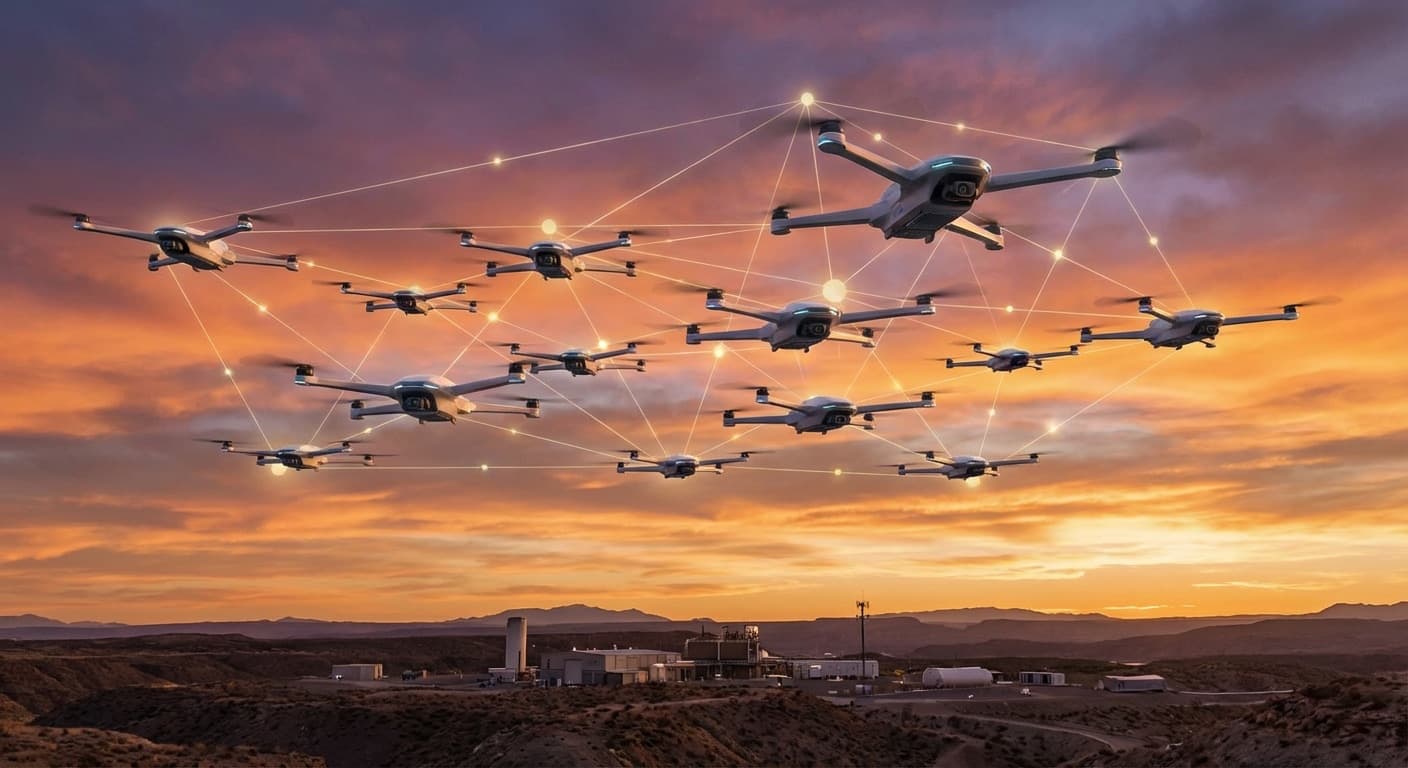

While the world has been fixated on the latest LLM benchmarks and chatbot capabilities, a quieter but equally significant revolution took flight this week. Palladyne AI Corp. (NASDAQ: PDYN) announced the successful first flight of its IntelliSwarm autonomy stack, integrated into the BRAIN X2 flight computer.
This isn't just another drone test. It marks a critical step toward breaking one of the biggest bottlenecks in robotics: the 1:1 operator ratio.
Breaking the 1:1 Barrier
For years, commercial drone operations have been limited by a simple constraint: one pilot, one drone. Even with advanced autopilots, human oversight has been a bottleneck for scalability. If you wanted to inspect a massive solar farm or monitor a long pipeline, you needed an army of pilots.
Palladyne's IntelliSwarm changes the equation. By enabling a single operator to manage a collaborative network of heterogeneous vehicles (drones and robots of different types), it shifts the paradigm from "piloting" to "orchestrating."
Example
"IntelliSwarm is flight-proven technology today - not a future concept. This successful integration fundamentally changes what's possible and economically viable in AI-enabled unmanned systems." — Ben Wolff, CEO of Palladyne AI
Inside the Tech: SwarmOS and BRAIN X2
At the core of this milestone is SwarmOS, Palladyne's software that allows machines to communicate and coordinate actions autonomously. Think of it as a "hive mind" for hardware.
The system was tested on the BRAIN X2, a ruggedized flight computer designed for the edge. This combination allows for:
- Collaborative Logic: Drones can share data and make decisions together (e.g., "I'll inspect this sector, you take that one").
- Heterogeneous Interoperability: Different types of robots (air and ground) working in concert.
- Resilience: If one unit fails, the swarm adapts to complete the mission.
Why This Matters for Business
The implications extend far beyond cool tech demos. For industries like logistics, agriculture, infrastructure inspection, and defense, swarm intelligence is the key to economic viability.
1. Scalable Infrastructure Inspection
Imagine a team of drones inspecting a bridge or power grid in a fraction of the time, with no single point of failure.
2. Autonomous Logistics
Warehouses and delivery networks can operate with fluid, self-organizing fleets that adapt to demand spikes instantly.
3. The Shift to "Physical AI"
We are entering a phase where AI leaves the screen and enters the physical world. Just as LLMs revolutionized knowledge work, Swarm AI will revolutionize physical work.
The BaristaLabs Perspective
At BaristaLabs, we often talk about AI as a tool for efficiency. But IntelliSwarm represents AI as a multiplier. It allows businesses to scale physical operations without a linear increase in labor costs.
While most small businesses aren't deploying drone swarms today, the underlying trend is clear: Autonomy is becoming accessible. The tools for managing complex, physical systems are trickling down from defense and enterprise to the broader market.
The question for forward-thinking leaders is: What part of your physical operations could be automated if the 1:1 human constraint were removed?
Ready to explore how AI can transform your business operations? Contact BaristaLabs to discuss your strategy for the autonomous future.
Turn this idea into a pilot
Which workflow should go first?
Use the readiness check to compare impact, effort, risk, owner, and next step before requesting a review.
- 3-5 minutes
- Deterministic score
- No sensitive data
Practical AI Workflow Notes
Want more practical AI operations ideas?
Get short notes on applying AI inside real small-business workflows — from document handling and customer follow-up to internal reporting, compliance, and automation guardrails.