


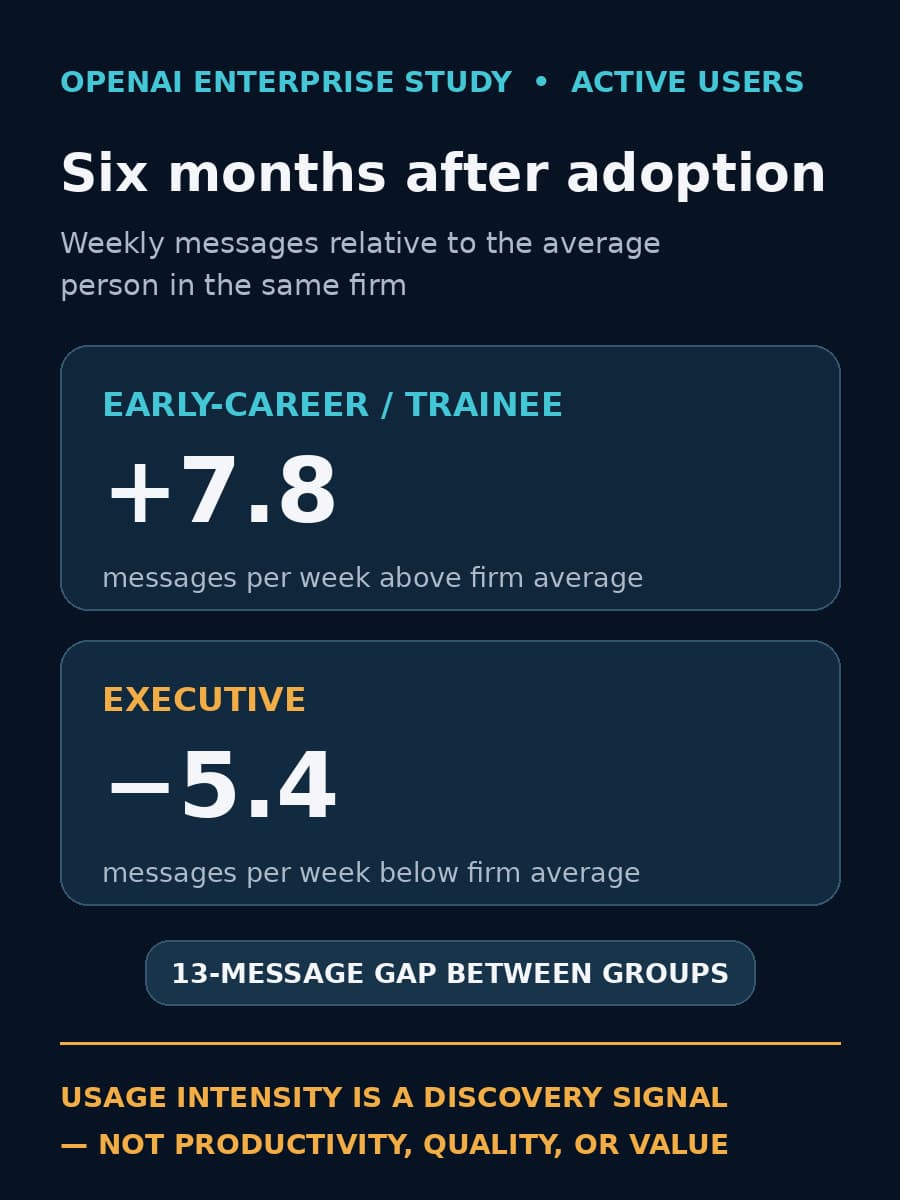
OpenAI's August 2026 enterprise research found that, among active ChatGPT Enterprise users measured six months after adoption, early-career employees sent 13 more messages per week than executives. The result challenges a common rollout assumption: the people with the most authority may not be the people developing the deepest day-to-day AI habits.
That does not make message volume a performance score, and it does not make junior employees the owners of AI policy. It gives managers a discovery signal. This article explains what OpenAI measured, what the result cannot establish, and how to turn one useful individual practice into a reviewed team workflow without confusing activity with business value.
What did OpenAI measure?
OpenAI published its overview, From assistance to execution, on August 12. The companion working paper, How Organizations Use AI: Evidence from ChatGPT, links ChatGPT Enterprise account records with usage, worker roles, task classifications, and public-company financial data through March 2026.
The paper says its worker-level sample at the six-month adoption horizon includes more than 1,500 organizations and more than 17 million messages. Its active-user analysis shows usage intensity falling with seniority. Relative to the average person in the same firm, early-career or trainee users sent 7.8 more messages per week, while executives sent 5.4 fewer. OpenAI's overview expresses the distance between those groups as 13 messages per week.
The population and denominator matter. These are workers at organizations that adopted ChatGPT Enterprise, and the comparison concerns active users at a common point in the adoption cycle. It does not include employees who did not use the product, activity in other AI systems, or work that happened outside ChatGPT.
The paper is also a working paper whose results can change. Two authors contributed as paid OpenAI contractors. OpenAI says the analysis uses privacy-preserving data, while its separate Enterprise Signals report says the enterprise analyses use aggregated, de-identified usage data and automated message classification.
Why does the seniority result matter for a rollout?
BaristaLabs' interpretation is that workflow discovery should not follow the organization chart alone. A leadership team can set priorities, budget, risk limits, and accountability. It may still be unable to see the small techniques employees have developed inside recurring work: how they frame a request, gather the right source material, split a task, verify an answer, or carry the result into the next system.
Higher usage intensity can help locate people worth interviewing. It cannot tell a manager whether those people are completing better work. Someone may send more messages because the task is complex, the model needs correction, the prompts are inefficient, or experimentation is encouraged. A shorter interaction may produce more value than a long one.
OpenAI makes the same caution about another measure. Enterprise Signals reports that firms in the top 10% of monthly usage generated 8.3 times as many output tokens per active user as firms around the middle of the distribution in June, up from a 2.6-times gap in January. OpenAI calls tokens an imperfect measure of business value: output length can indicate deeper work, but a long answer can still add little.
The seniority pattern should therefore change where discovery starts, not where judgment ends. Ask who has developed a repeated practice. Then inspect the practice itself.
Which practices are worth inspecting?
Look for a recurring task with a recognizable input, a useful output, and a person who can explain how they judge the result. Good candidates often leave evidence in normal work: a revised customer response, a reconciled spreadsheet, a research brief with sources, a test added to a codebase, or a draft that moved through an established approval path.
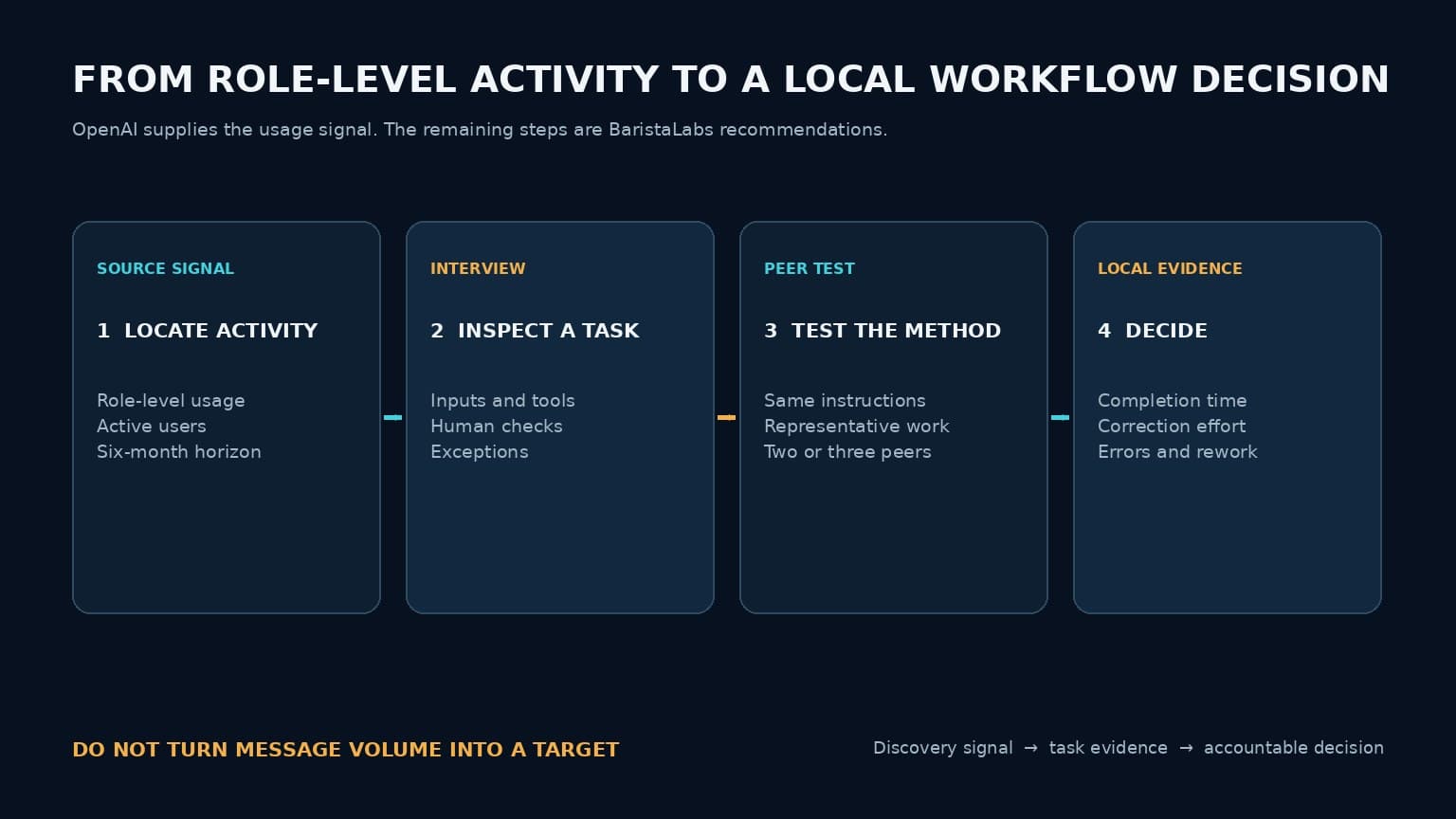
Avoid selecting a workflow because its user has the highest message count. Start with interviews across levels and functions, including people with low use who may understand exceptions or downstream consequences that a frequent user does not see. Ask for one recent task, not a general demonstration of prompting skill.
For that task, capture five concrete facts:
- the source material the worker provides;
- the instructions, tools, and product features used;
- the output the AI prepares or changes;
- the checks and decisions a person still performs;
- the exceptions that make the method slow, unsafe, or unsuitable.
These facts turn an individual habit into a candidate process. They also expose practices that should remain personal aids rather than become shared automation.
How do you test whether the practice can travel?
First, write the method so a peer can run it without relying on private memory. Name the approved sources, the task boundary, the expected output, the review point, and the stop condition. Preserve the original practitioner's judgment in the test; do not reduce a nuanced process to a prompt copied into a shared document.
Next, have two or three peers use the same method on representative work. Compare the result with the prior process. Measure the work rather than the conversation: completion time, correction effort, error or exception rate, downstream rework, and whether the required reviewer had enough evidence to decide.
A practice is not portable merely because another person can paste the prompt. The second user may lack source access, domain knowledge, tool permissions, or the ability to spot a plausible error. If performance depends on one person's tacit knowledge, document that dependency or keep the method under that person's control while the team learns more.
This is where role-level usage and task-level evidence separate. Usage data helps a team find a candidate. A controlled comparison establishes whether the candidate deserves wider use. Our analysis of Google's ATLAS workplace study makes the same measurement boundary: observed reach and task activity do not establish completion, quality, time saved, or economic value.
Who should own the shared workflow?
Do not force one person to carry three different kinds of ownership. The practitioner who found the method can explain the task and help maintain the instructions. The process owner remains accountable for the business result. A control owner decides what data, tools, actions, reviews, and records are allowed.
Those roles can belong to the same person in a small company, but the decisions should remain distinct. A high-intensity user should not inherit authority to connect customer data or enable write actions simply because the workflow began with them. A senior manager should not rewrite the working method without the people who understand its failure modes.
Record the model or product surface, instruction revision, allowed sources, tool permissions, reviewer, and change history. If the method starts using an app, plugin, skill, or external system, update the AI workflow controls before expanding access. The shared asset is not only a prompt; it is the full path from source to reviewed result.
What should leaders do with the wider enterprise findings?
OpenAI's data suggests that enterprise AI use is becoming more agentic and spreading beyond engineering. Since February, weekly active enterprise Codex users grew 108 times in legal, 41 times in sales, 41 times in recruiting, and 26 times in marketing, compared with five times in engineering. These are growth multiples from different starting points, not absolute adoption shares or proof that the workflows produced value.
Enterprise Signals also reports that among weekly active users, 21% at high-usage firms used plugins and 19% used skills, compared with 9% and 3% at typical firms. These measures show a relationship between intensive usage and advanced capabilities within OpenAI's customer base. They do not establish that installing more plugins or skills causes a firm to become more productive.
The practical response is not a mandate to raise token volume or copy the heaviest users. It is a repeatable discovery loop: use telemetry to locate activity, interview the people doing the work, select one bounded practice, test it with peers, measure the business task, and assign explicit operating and control ownership.
OpenAI's seniority result makes one part of that loop harder to ignore. Useful AI practices may emerge lower in the organization before leaders can see them. Management's job is to make those practices inspectable without turning activity into a target or experimentation into unreviewed authority.
BaristaLabs helps teams turn promising individual practices into bounded, measurable workflows through process automation. If one AI habit is already spreading informally, bring the task to a focused workflow review.
Sources
- OpenAI: From assistance to execution: How enterprises put AI to work, August 12, 2026.
- OpenAI: Enterprise Signals—What frontier firms are doing differently, updated August 12, 2026.
- Chatterji et al.: How Organizations Use AI: Evidence from ChatGPT, working paper last updated August 11, 2026.
OpenAI supplies the customer telemetry, definitions, and vendor analysis cited here. BaristaLabs supplies the workflow-discovery interpretation and operating recommendations. No cited source establishes productivity, quality, time savings, return on investment, or causality for the recommended process.
Workflow discovery
Turn one useful individual practice into a team-owned workflow
BaristaLabs can help document one recurring AI-assisted task, test it with peers, and separate the operating owner from review and control ownership.
Best fit when AI use is already happening but useful practices remain personal, uneven, or hard to evaluate.
Turn this idea into a pilot
Which workflow should go first?
Use the readiness check to compare impact, effort, risk, owner, and next step before requesting a review.
- 3-5 minutes
- Deterministic score
- No sensitive data
Practical AI Workflow Notes
Want more practical AI operations ideas?
Get short notes on applying AI inside real small-business workflows — from document handling and customer follow-up to internal reporting, compliance, and automation guardrails.