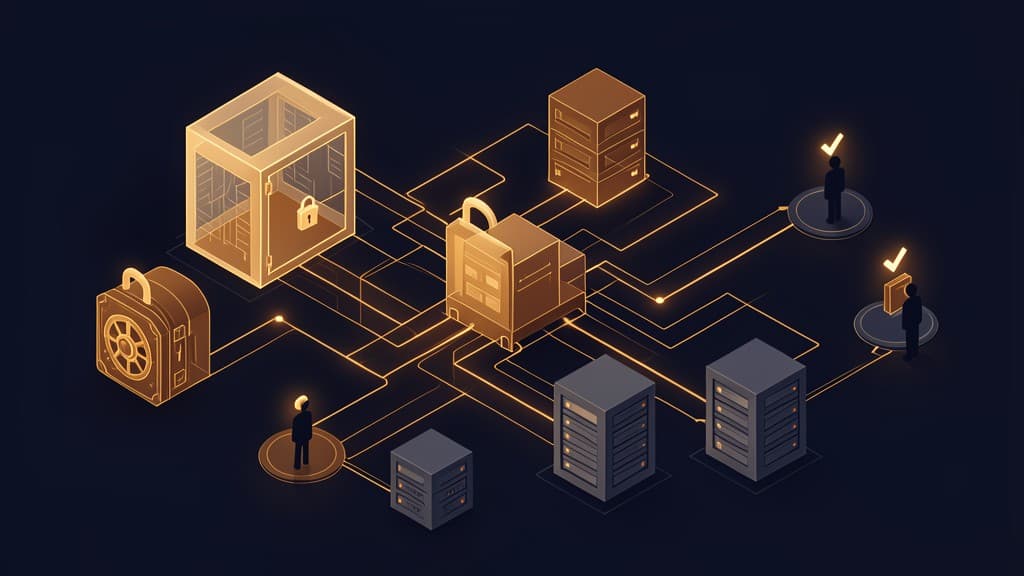

OpenAI and Dell's new Codex partnership is easy to read as another enterprise AI announcement. A big model company, a big infrastructure company, and a familiar promise: make AI useful inside large organizations.
But the more important signal is not simply that Codex is getting more enterprise distribution. It is that AI agents are moving closer to the places where real business work already happens: private codebases, internal systems, controlled infrastructure, regulated data, and workflows that need audit trails.
That matters for software teams. It also matters for operations leaders, service teams, finance teams, and business owners trying to use AI without creating a new security or compliance problem.
OpenAI said it is working with Dell to help enterprises deploy Codex in hybrid and on-premises environments, with Codex connecting to the Dell AI Data Platform and the companies exploring connections with Dell AI Factory. That is the part worth paying attention to.
The enterprise AI conversation is shifting from "which model is smartest?" to "where does the agent run, what can it access, who approves its actions, and how do we know what happened?"
Why this is bigger than coding
Codex started as a tool for software development, and OpenAI says more than 4 million developers use it every week. The obvious use cases are code review, test coverage, incident response, and reasoning across large repositories.
Those are useful. They are also a preview of a broader pattern.
A coding agent needs to understand a messy, high-context environment. It has to read existing systems, follow conventions, work with tools, propose changes, explain tradeoffs, and recover when something breaks. That is not so different from many business workflows.
A support workflow may need to pull from a CRM, help desk, order system, knowledge base, and policy document. A finance workflow may need to reconcile spreadsheets, approvals, vendor records, and exceptions. An operations workflow may need to route work across legacy systems that were never designed to talk to each other.
OpenAI described teams using Codex-powered agents beyond software work, including gathering context across tools, preparing reports, routing feedback, qualifying leads, writing follow-ups, and coordinating work across business systems. That is where the enterprise value starts to get interesting.
The question is not whether an agent can draft a response or summarize a document. The question is whether it can operate inside the real boundaries of a business.
Why location matters
Many AI demos assume clean data, simple permissions, and cloud access to everything. Most businesses do not work that way.
Important data may live in private repositories, old databases, file shares, ticketing systems, ERP tools, spreadsheets, and line-of-business apps. Some data cannot leave a controlled environment. Some actions need approval. Some workflows require logging. Some systems are brittle enough that "move fast and see what happens" is not acceptable.
That is why hybrid and on-premises deployment matters. It gives larger organizations more control over where data sits, how access is managed, and how AI systems fit into existing governance.
This is also where implementation work becomes more important than the model announcement. A useful agent needs the right data boundary, permissions model, tool access, monitoring, and escalation path. Without that, it is just another interface that can produce confident answers without enough operational accountability.
For companies exploring AI-assisted workflows, this is the same practical foundation behind strong process automation and integration: connect the right systems, define the right handoffs, and make the workflow observable enough that people can trust it.
Security is the design constraint
Enterprise buyers are not wrong to be cautious. If an AI agent can read source code, customer records, contracts, support history, or internal financial data, then access control is not a footnote. It is the architecture.
That does not mean companies should avoid AI agents. It means the agent needs to be designed around the same security expectations as any other business system.
Who can invoke it? What can it read? What can it write? Which actions require human approval? What gets logged? How are outputs reviewed? What happens when the agent is uncertain, blocked, or wrong?
These questions are not bureaucracy. They are how useful automation survives contact with real business risk.
That is why AI strategy should be connected to data security from the beginning, not added after a pilot gets popular. Teams that treat security as part of the design will move faster later because they will not need to rebuild the whole workflow when legal, compliance, or IT gets involved.
Agentic coding is becoming a category
OpenAI also said Gartner named it a Leader in the 2026 Magic Quadrant for Enterprise AI Coding Agents. Whether or not a company is ready to buy from that category, the category itself is worth noting.
"Coding assistant" used to mean autocomplete, chat, and small refactors. "Agentic coding" points to something more involved: systems that can reason across repositories, use tools, run tests, prepare changes, and support larger engineering workflows.
That does not eliminate the need for engineers. It changes what they supervise.
The same pattern will show up outside engineering. Agents will not replace operational judgment. They will take on more of the context gathering, first-pass analysis, routing, drafting, reconciliation, and follow-up work that slows teams down.
The businesses that benefit will not be the ones that turn agents loose everywhere. They will be the ones that choose narrow workflows, define success clearly, and keep people in the loop where judgment matters. That is the practical side of responsible AI: not avoiding automation, but deploying it with boundaries.
The model is not the whole system
IBM Research's Open Agent Leaderboard on Hugging Face is another useful signal because it evaluates full agent systems, not just models. The leaderboard looks at quality and cost across benchmarks such as SWE-Bench Verified, BrowseComp+, AppWorld, tau2-Bench Airline & Retail, and tau2-Bench Telecom.
That framing matters.
In real use, agent performance depends on more than the model. It depends on tools, planning, memory, retrieval, permissions, recovery behavior, cost controls, and the surrounding workflow. A weaker architecture around a stronger model can still fail. A well-scoped system around a capable model can be far more useful.
For business leaders, this is a helpful correction. Do not evaluate an enterprise agent only by the brand name on the model or the polish of the demo. Evaluate the system.
Can it access the right context without overreaching? Can it explain what it did? Can it stop when it should stop? Can it hand off to a person? Can the organization measure cost, accuracy, cycle time, and failure modes?
That is the difference between an impressive prototype and a dependable business tool.
What to test before committing
If you are considering enterprise agents, start with one workflow that is valuable but bounded.
Good candidates include support triage, internal reporting, quote preparation, lead qualification, test generation, release notes, invoice exception review, or operational handoffs between tools.
Before buying a platform or expanding a pilot, test five things:
- Context: Can the agent reach the information needed to do the job, and only that information?
- Permissions: Does it respect roles, approval steps, and data boundaries?
- Recovery: What happens when data is missing, tools fail, or the answer is uncertain?
- Auditability: Can a person see what the agent accessed, produced, changed, and recommended?
- Cost and quality: Does the workflow improve speed or consistency enough to justify the cost and supervision?
These questions apply whether the agent is helping developers, support teams, sales operations, or back-office staff.
At BaristaLabs, this is how we think about practical AI solutions: start with the workflow, map the systems and data involved, then decide where automation can safely remove friction.
The practical takeaway
The Dell-Codex partnership is not just about making a coding agent available to more enterprise customers. It points to a broader shift: AI agents are moving into governed business environments where data, infrastructure, permissions, and accountability matter.
That is a healthier conversation than the usual AI hype cycle.
The next wave of enterprise AI will not be won by the flashiest demo. It will be won by systems that can work inside the actual constraints of a business: private data, legacy tools, security reviews, human approvals, and measurable outcomes.
If your team is exploring where agentic AI could help without creating unnecessary risk, start with one workflow and one clear business result. Then design the agent around the data boundary, not the other way around.
If you want help identifying a safe, useful first workflow, contact BaristaLabs. We can help you turn the idea into a practical pilot.
Implementation help
Keep the workflow inside a visible boundary
BaristaLabs helps teams turn one candidate AI workflow into scoped data boundaries, reviewer evidence, receipts, and rollback paths before production use.
Best fit when the team can name one workflow, one owner, and the evidence a reviewer needs before the agent acts.
Turn this idea into a pilot
Which workflow should go first?
Use the readiness check to compare impact, effort, risk, owner, and next step before requesting a review.
- 3-5 minutes
- Deterministic score
- No sensitive data
Practical AI Workflow Notes
Want more practical AI operations ideas?
Get short notes on applying AI inside real small-business workflows — from document handling and customer follow-up to internal reporting, compliance, and automation guardrails.