


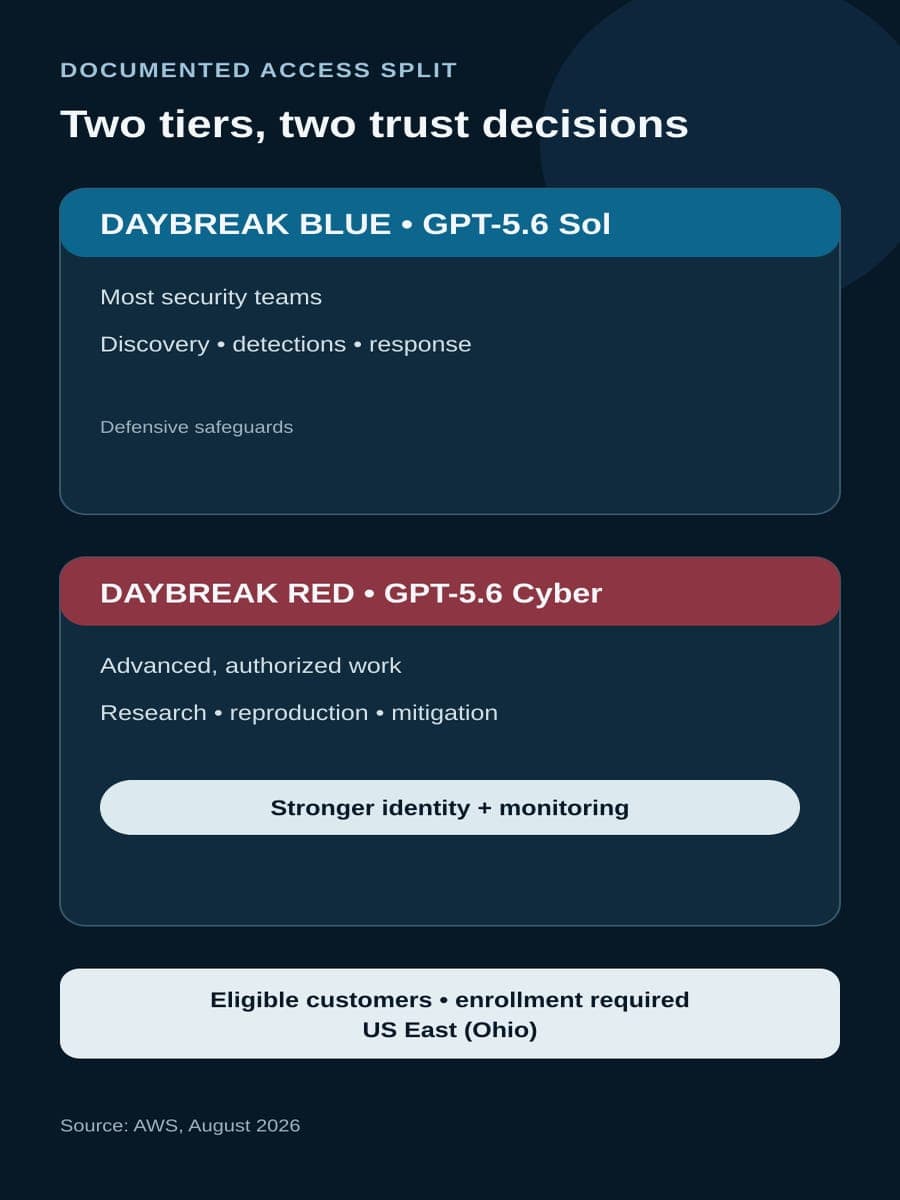
AWS has made OpenAI's Daybreak Blue and Daybreak Red available on Amazon Bedrock to eligible customers. Blue uses GPT-5.6 Sol with safeguards calibrated for defensive cybersecurity work; Red uses the more specialized GPT-5.6 Cyber for advanced, authorized work such as exploit reproduction and mitigation development.
The consequential change is not simply that security teams have two more models to test. AWS and OpenAI have split cyber work into access tiers, and the more permissive tier comes with stronger identity verification, monitoring, and access controls. This article explains the difference, the Bedrock data boundary AWS documents, and what a business should decide before requesting access.
What is the difference between Daybreak Blue and Red?
AWS describes Daybreak Blue as the starting point for most security teams. Its named workflows are vulnerability discovery, detection engineering, and incident response. The model is GPT-5.6 Sol with safeguards calibrated for defensive cybersecurity work.
Daybreak Red provides GPT-5.6 Cyber. AWS positions it for advanced, authorized work including vulnerability research, exploit reproduction, and mitigation development. Those requests are hard to classify from text alone because the same technical instruction can support a defender validating a flaw or an attacker developing an exploit.
The access design supplies context that a prompt cannot: who is using the model, where the work occurs, and which safeguards govern the session. AWS says Red uses a lower refusal threshold, paired with stronger identity verification, monitoring, and access controls. In other words, Red is not merely “Blue with fewer refusals.” It is a different trust decision around a narrower group of people and tasks.
That distinction should survive procurement. A security team should not request Red because some future test might need it. It should be able to name an authorized asset, the techniques allowed against it, the operator or service identity, the evidence the session may handle, and the person who can stop the work.
What does Bedrock control, and what remains your responsibility?
AWS says both models run on Bedrock's next-generation inference engine. The provider documents zero-operator access at the chip during inference, encryption in transit and at rest, access through AWS Identity and Access Management, CloudTrail logging, VPC endpoint routing, and organization-level data perimeter policies.
Those are useful infrastructure controls. They do not choose the correct IAM principal, decide whether a repository or production system is in scope, remove secrets from source material, or determine who may review generated exploit details. AWS provides control surfaces; the customer still configures and operates the boundary.
Start with separate invocation identities for separate jobs. A Blue workflow that analyzes sanitized detection rules should not automatically share a role with a Red workflow that can reproduce an exploit. Narrow resource permissions, session conditions, network routes, and log access make the distinction enforceable rather than descriptive.
CloudTrail can show that an AWS identity invoked a service. It does not by itself prove that the underlying security test was authorized, that every input was appropriate, or that a generated patch was safe to merge. Keep the asset authorization, test window, ticket, approver, and evidence review linked to the invocation records.
Which data may enter the model path?
Cybersecurity models can receive unusually sensitive material: proprietary source code, unpatched vulnerability details, production telemetry, credentials accidentally embedded in logs, and exploit reproducers. A model-access approval should therefore include an input decision, not just a model decision.
AWS states that inference data is not used for model training and that customers do not have to opt into sharing it with OpenAI. AWS also documents a separate automated abuse-detection path: classifier-flagged traffic may be retained by AWS for up to 30 days and processed programmatically. Customers may request zero data retention through their AWS account team.

“May request” is not the same as a default or guaranteed approval. Before sending source code or live telemetry, confirm the retention setting that actually applies to the account and model access. If the workflow requires zero retention, treat approval and verification of that setting as a prerequisite rather than a follow-up task.
The same discipline applies even when zero retention is approved. Remove credentials and unrelated customer data before inference, minimize the files and telemetry included, and keep output storage under a defined access and deletion policy. A shorter provider retention path does not govern copies placed in prompts, orchestration logs, ticket systems, model outputs, or analyst workspaces.
What should a team decide before requesting access?
The AWS availability notice says both models are currently available in US East (Ohio) to eligible customers. Access requires enrollment in OpenAI's Trusted Access for Cyber, followed by a request through an AWS account team. The selected public sources do not publish pricing, a complete eligibility rubric, or an enrollment timeline.
That makes readiness more useful than speculative cost comparison. Before contacting the vendors, write down answers to these questions:
Scroll sideways to see all 2 columns.
| Decision | Minimum evidence before access |
|---|---|
| Which tier fits? | A defined defensive job for Blue, or a documented need for advanced authorized research for Red. |
| What is in scope? | Named assets, owners, test windows, allowed techniques, and explicit exclusions. |
| Who invokes it? | A person or workload identity with least-privilege IAM, session conditions, and a revocation owner. |
| What may enter? | Approved source, telemetry, and vulnerability classes after secrets and unrelated data are removed. |
| Where does traffic travel? | Region, VPC endpoint path, egress rules, and data perimeter controls that have been tested. |
| What is recorded? | CloudTrail plus the local authorization, reviewer, test result, exceptions, and stop decision. |
| What retention applies? | The confirmed abuse-detection retention setting and policies for every downstream copy. |
| Who accepts the result? | A security owner who validates findings and a software owner who controls patch and release acceptance. |
Do not collapse the final row into model access. As our analysis of AI-generated security patches shows, finding a vulnerability and proposing a fix do not prove complete exploit closure, preserved behavior, or the absence of a new weakness. Daybreak may accelerate investigation; existing acceptance evidence still decides what reaches production.
When should a business wait?
Wait if the team cannot identify an authorized asset, isolate an invocation identity, or control the evidence entering and leaving the session. Red's broader ability is not a substitute for a mature testing boundary. It raises the value of getting that boundary right.
Also wait if the required retention or regional arrangement is unresolved. The published availability is limited to eligible customers in one named AWS Region, and a request-based zero-retention option is not the same as a verified account setting. Procurement should close those facts before a pilot handles sensitive material.
Daybreak's useful innovation is the explicit pairing of cyber capability with access context. Blue and Red turn model choice into an authorization design: job, asset, identity, network, evidence, retention, review, and stop authority. A team ready to name and enforce those dependencies has a credible pilot candidate. A team that only wants the most capable tier has not yet defined the work safely enough to begin.
Sources
Cyber-AI access review
Define one authorized security job before model access
BaristaLabs can help map one defensive workflow across asset authorization, IAM, network boundaries, input handling, evidence review, and stop conditions.
Bring a sanitized workflow description and control requirements. Do not send source code, vulnerability details, production telemetry, secrets, or exploit material through this form.
Turn this idea into a pilot
Which workflow should go first?
Use the readiness check to compare impact, effort, risk, owner, and next step before requesting a review.
- 3-5 minutes
- Deterministic score
- No sensitive data
Practical AI Workflow Notes
Want more practical AI operations ideas?
Get short notes on applying AI inside real small-business workflows — from document handling and customer follow-up to internal reporting, compliance, and automation guardrails.