
Accenture drew a border on a market map on July 7. Companies between $300 million and $3 billion in revenue now get their own commercial architecture for agentic AI, separate from the bespoke programs sold to the Fortune 500 and the do-it-yourself tools smaller firms assemble.
The offer arrives as six pre-built solution lanes, with Google Cloud products underneath and forward-deployed engineers to install them. It is a substantial move. Read Accenture's own material closely, though, and a harder proposition emerges: the package assumes the buyer is ready to absorb it.
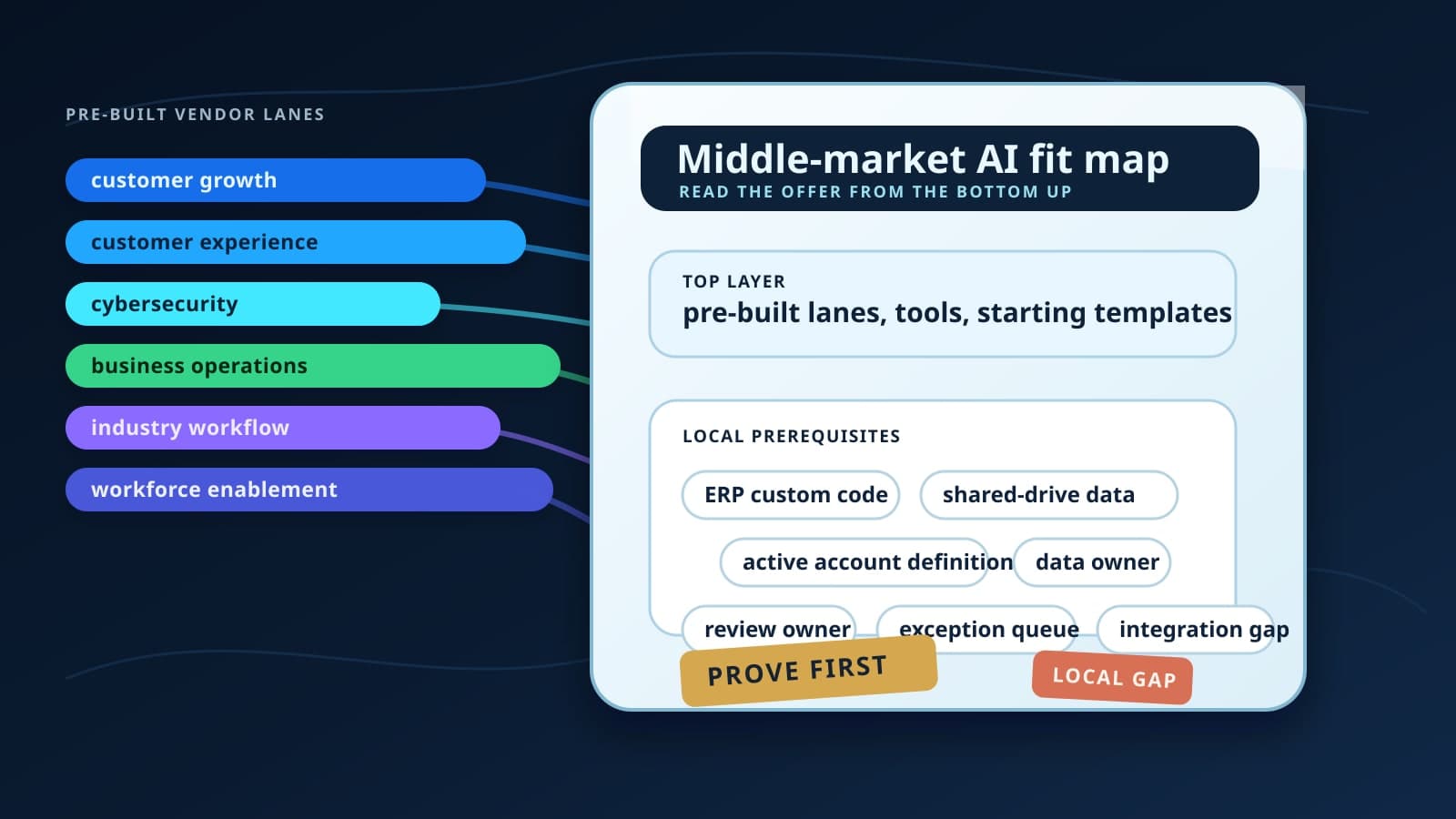
Picture the pitch meeting. The company here is illustrative, but any operator who has sat through an enterprise software presentation will recognize the room. A manufacturer doing $800 million a year sends its operations lead and three department heads to see six polished lanes: customer growth, customer experience, cybersecurity, business operations, industry workflows, and workforce enablement.
The slide is clean. The company underneath it is not. Its ERP depends on custom code nobody wants to touch. Its shared drive doubles as a customer database. Sales and support use different definitions of an active account. Two of the six lanes depend on data that has never been reconciled.
That gap is the story. The middle market is becoming a product, not a smaller enterprise.
The market boundary is the real announcement
Accenture Edge and Google Cloud announced pre-built, industry-specific agents built with the Gemini Enterprise app, Gemini Enterprise Agent Platform, Agentic Data Cloud, and AI Threat Defense. Accenture says its forward-deployed engineers will bring that stack into mid-market companies across six areas.
The release claims these packages can move companies from pilots to production faster. That is a vendor claim, not independent evidence of an outcome. Even so, the shape of the offer matters. Model access, data infrastructure, security products, starting workflow patterns, and an implementation team are being bundled for a named buyer class.
Accenture formally launched Edge on June 23. In that announcement, the firm described companies in the $300 million to $3 billion revenue band as a $240 billion addressable market growing at a high single-digit rate. Those are Accenture's estimates, but they explain the strategy. This is a large pool of buyers with meaningful budgets, entrenched technical debt, and smaller internal technology teams than global enterprises.
Enterprise software vendors have often served that band by taking a large-company product and trimming the implementation. Edge points toward something more deliberate: products, staffing, architecture, and sales language designed around the middle market as its own economic category.
The part Accenture actually built
There is real value in standardizing the top layer.
A team does not have to select and connect every model, agent framework, data service, threat tool, and deployment partner independently. It gets a defined Google Cloud foundation, Accenture intellectual property, pre-configured solutions, and engineers who know the stack. Accenture describes the collaboration as six agentic solution areas "purpose-built for mid-market needs."
That can reduce the number of technical decisions between a purchase order and a working implementation. For a company without an internal machine-learning platform team, fewer assembly decisions can be valuable on their own.
The six lanes also reveal how vendors expect agentic AI to enter ordinary business operations. Customer intelligence pairs personalization with one-to-one insights. Customer experience covers B2B and B2C interactions. Cybersecurity combines continuous analysis with prioritized response. Business operations promises context-aware automation for complex tasks. Industry solutions include retail, banking, telecommunications, consumer goods, and supply chain work. Workforce enablement brings Gemini into Google Workspace.
Together, the six lanes sketch where one vendor is betting reusable infrastructure can absorb work that used to require a person paying close attention.
The part no vendor can pre-build
Accenture's Edge page gives the most useful warning in the entire launch. "The proof isn't in the pilot. It's in what happens after."
The page names the friction directly: siloed data, outdated processes, scaling difficulty, continuing investment, integration, change management, and iteration. Every item on that list lives inside the buyer's company. None arrives pre-configured with Gemini Enterprise.
Install a customer-intelligence agent, and somebody still has to decide whether the CRM or the billing platform owns the definition of a customer. The agent has no opinion on that fight. Give a workforce assistant the ability to surface an answer, and the incentives that make one department ignore another department's process are untouched. A security package will prioritize a response only after the company has worked out which systems matter most and who is allowed to interrupt production to protect them.
Forward-deployed engineers speed up that local work. They do not relocate it.
The reusable layer includes the model stack, security tooling, implementation experience, and starter patterns. Everything else, including data definitions, process exceptions, systems integration, adoption, and the patience to keep iterating once the kickoff energy fades, stays with the company that hired the vendor.
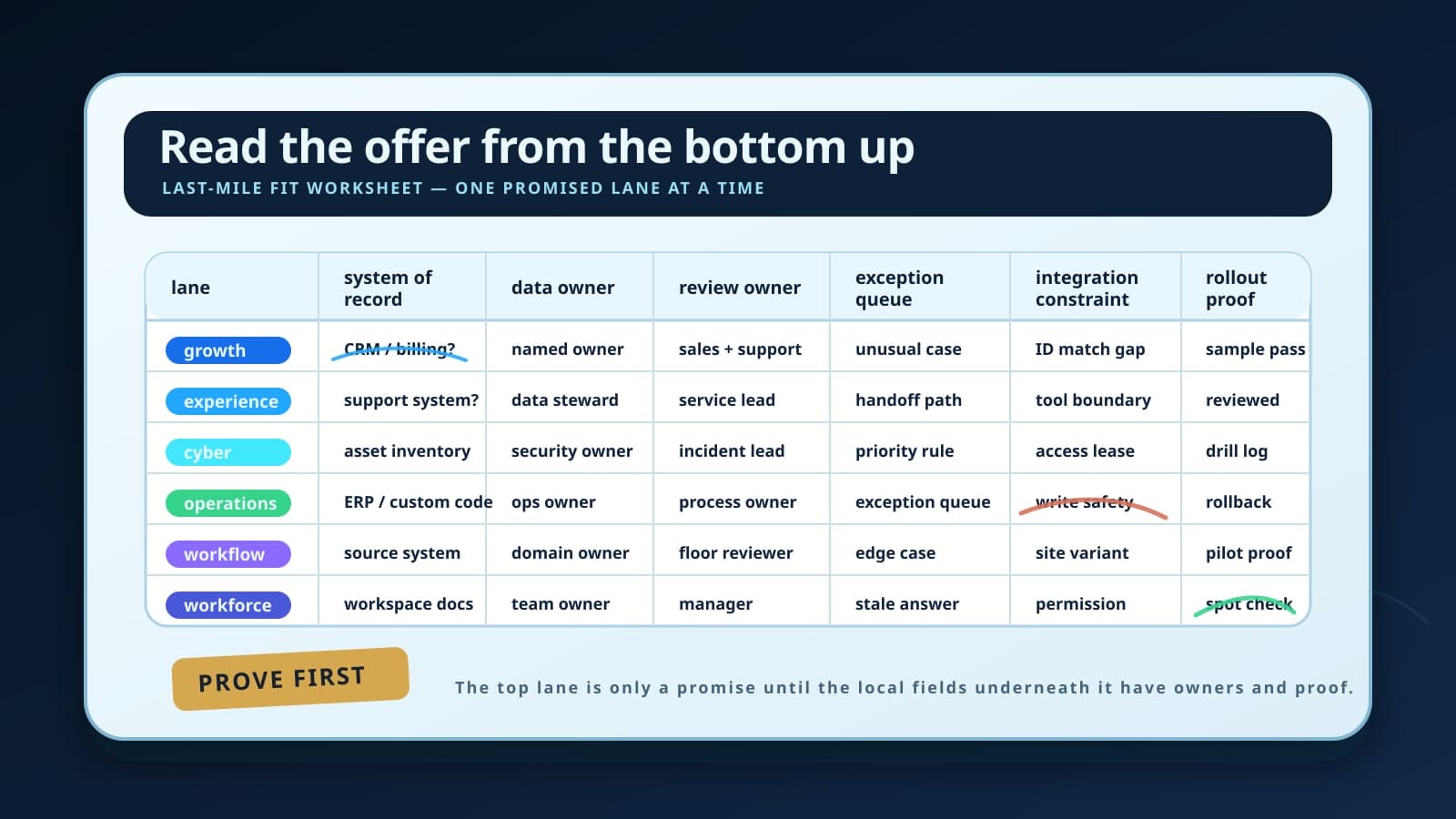
Read the offer from the bottom up
Most proposal reviews begin with the illuminated top layer: capabilities, integrations, timelines, demos. A better reading starts underneath it.
Take one promised outcome from the proposal and trace it into the operating company. If the offer promises personalized growth, identify the source records that make personalization trustworthy. If it promises better customer experience, look at the handoff between the agent and the person who resolves the unusual case. If it promises streamlined operations, follow the work through every system it must read or change.
This is not the same decision as choosing a first workflow by how safely it can be undone. The workflow may already be chosen. The question here is whether the standardized package fits the local reality beneath it.
It also differs from a narrow workflow kit such as the finance-agent packages we examined earlier. A tightly scoped kit can make its boundaries obvious. A six-lane transformation offer creates more surface area for local assumptions to hide.
The useful buying conversation is therefore concrete. Which parts of the proposed result come from reusable vendor infrastructure? Which depend on company-specific data or process repair? What must remain true after the forward-deployed team leaves? Where will the first quarter of iteration happen, and does the buyer have people available to do it? The comparison hub turns that fit review into a decision among packaged tooling, workflow repair, and a bounded implementation partner instead of treating every path as equivalent.
Those questions do not diminish the package. They expose its actual shape.
A product category with a local last mile
Accenture's bet is understandable. A large population of companies has outgrown small-business AI tools but cannot support a sprawling enterprise transformation. Packaging the model stack, security layer, industry patterns, and implementation talent is a rational answer to that gap.
The six polished lanes were never the whole product, however. The last mile still runs through the buyer's definitions, systems, habits, and willingness to repair old work before automating it.
That is where BaristaLabs' AI consulting and process automation work begins. We help teams read the proposal against the company they actually run, including the systems and operating constraints the demo cannot show.
If a packaged agentic AI offer has landed on your desk, bring us one promised outcome. We will trace it from the vendor's reusable layer into your local operating reality and tell you plainly what is already solved, what remains yours, and what should happen before anyone calls it production. Start that review.
Implementation fit
Read the proposal against the company you actually run
BaristaLabs helps teams separate reusable platform value from the integrations, decisions, and operating changes that remain local.
Best fit when a packaged AI offer looks production-ready but the local implementation burden is still unclear.
Turn this idea into a pilot
Which workflow should go first?
Use the readiness check to compare impact, effort, risk, owner, and next step before requesting a review.
- 3-5 minutes
- Deterministic score
- No sensitive data
Practical AI Workflow Notes
Want more practical AI operations ideas?
Get short notes on applying AI inside real small-business workflows — from document handling and customer follow-up to internal reporting, compliance, and automation guardrails.