GPT-5.4's Context Window Problem: What Your ChatGPT Subscription Actually Gets You
GPT-5.4 offers 1M tokens via API but only 32K on ChatGPT Plus. Here is what the context window gap means for real business tasks and when it actually matters.

Sean McLellan
Lead Architect & Founder
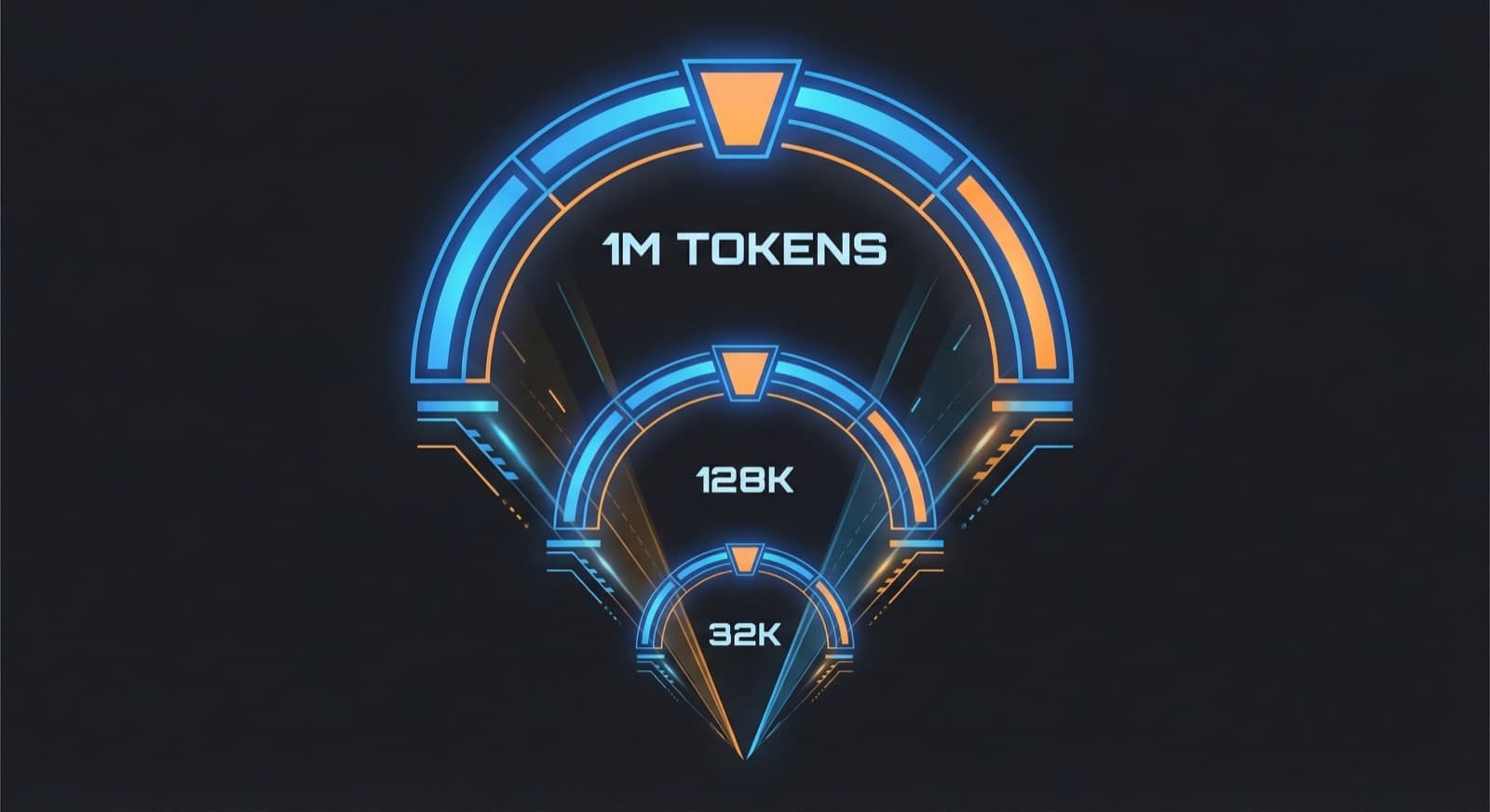
OpenAI's GPT-5.4 launched with a 1 million token context window. That is roughly 750 pages of text in a single prompt. But if you are using ChatGPT Plus at $20/month, you get 32,000 tokens. That is about 25 pages.
The gap between the API and the subscription tiers is massive. And most small business owners have no idea it exists.
As reported by @diegocabezas01 on X, the context window breakdown looks like this:
- ChatGPT Plus ($20/month): 32K tokens (~25 pages)
- ChatGPT Pro ($200/month): 128K tokens (~100 pages)
- API access (pay-per-use): 1M tokens (~750 pages)
This is not a minor difference. It is a 31x gap between what Plus subscribers get and what the API supports. For some businesses, that gap does not matter at all. For others, it is the difference between a useful tool and an expensive toy.
What Is a Context Window, and Why Should You Care?
The context window is the amount of text a model can "see" at once. Everything you paste in, everything the model responds with, the full conversation history: it all counts against that limit.
When you hit the limit, the model starts forgetting. It drops the earliest parts of your conversation. It loses track of details you mentioned 20 minutes ago. It starts contradicting itself.
For a quick question like "Write me a subject line for this email," 32K tokens is plenty. For anything involving large documents, long conversations, or complex multi-step analysis, the limit becomes a wall.
Where 32K Tokens Falls Short
Here are real scenarios where ChatGPT Plus users will hit the ceiling:
Reviewing contracts or legal documents. A standard commercial lease runs 15 to 30 pages. A single contract might fit inside the 32K window, but you will not have room for much conversation about it. Ask three follow-up questions and the model starts losing context from the original document.
Analyzing financial reports. A quarterly financial package for a small business, including P&L, balance sheet, cash flow, and notes, can easily run 40 to 60 pages. That does not fit in 32K. You would have to chop it into pieces and feed them in separately, which means the model cannot see the full picture.
Processing customer feedback at scale. If you export six months of customer reviews or support tickets, you might have 200 pages of text. At 32K, you can only show the model about 12% of that data at once. Any summary it gives you is based on a small slice.
Long research or planning sessions. Context windows are not just about what you paste in. Your back-and-forth conversation eats into the limit too. A 45-minute strategy session with ChatGPT can burn through 32K tokens just from the conversation itself, before you even paste in a document.
Where 128K Gets You (and Where It Does Not)
ChatGPT Pro at $200/month bumps you to 128K tokens. That is a big step up. About 100 pages of text in a single conversation.
For most single-document tasks, 128K is comfortable. You can paste in a full contract, a policy manual, or a detailed business plan and still have room for extended conversation.
But 128K still falls short for:
- Comparing multiple large documents side by side (two 60-page contracts already maxes it out)
- Processing a full year of customer data or transaction records
- Running an AI agent through a complex, multi-step workflow that generates lots of intermediate output
- Analyzing a complete employee handbook alongside HR policies alongside a specific case
If your work regularly involves more than one large document at a time, you will feel the 128K ceiling.
The API: 1M Tokens, Different Trade-offs
The API gives you the full 1M token context window. That is enough to process an entire operations manual, a full year of meeting transcripts, or a complete codebase in one shot.
But API access is not a subscription you log into. It is a developer tool. You pay per token (input and output), you need to write code or use a tool that connects to the API, and there is no chat interface included.
For a small business, the practical options for using the API are:
- Hire a developer to build a custom tool that calls the API for your specific use case.
- Use a third-party app that connects to the OpenAI API and provides a chat interface (tools like Cursor, Typingmind, or custom GPT wrappers).
- Use OpenAI's Playground, which gives you API-level access through a web interface, but is designed for testing rather than daily work.
The cost math is also different. Instead of a flat monthly fee, you pay per token. A single 1M-token prompt with GPT-5.4 might cost $5 to $15 depending on output length. If you are doing that ten times a day, costs add up fast. If you are doing it once a week for a specific high-value task, it might cost less than a Pro subscription.
How to Decide What You Actually Need
Before you upgrade or start exploring API access, ask yourself these questions:
What is the longest document you regularly work with? If your typical task is "write an email" or "summarize this 3-page memo," 32K is fine. Save your $20 and stop worrying about context windows.
Do you need to compare or cross-reference multiple documents? If you regularly ask ChatGPT to compare two contracts, reconcile two reports, or synthesize information across several sources, you need at least 128K. Probably more.
How long are your conversations? If you use ChatGPT for quick one-off questions, context window size barely matters. If you have extended back-and-forth sessions where you build on previous responses, you will burn through 32K fast.
Is this a daily tool or an occasional power tool? If you need the 1M context once a week for a specific high-value task (like quarterly report analysis or annual contract review), the API on a per-use basis might be cheaper than a Pro subscription. If you need large context every day, Pro or a dedicated API workflow makes more sense.
The Practical Breakdown
Scroll sideways to see all 4 columns.
| Use Case | 32K (Plus) | 128K (Pro) | 1M (API) |
|---|---|---|---|
| Quick emails and drafts | Works fine | Overkill | Overkill |
| Single document analysis (<30 pages) | Tight fit | Comfortable | Overkill |
| Multi-document comparison | Not enough | Works for 2-3 docs | Best option |
| Quarterly financial review | Not enough | Workable | Ideal |
| Large dataset analysis | Not enough | Not enough | Required |
| Extended conversation sessions | Hits limits | Usually fine | No issues |
What This Means Going Forward
The context window gap between subscription tiers and API access is not new. OpenAI has done this before with GPT-4 and GPT-4 Turbo. The pattern is consistent: the API gets the full capability, and the subscription products get a subset.
This is a business decision, not a technical limitation. Running large context windows costs OpenAI more in compute. Subscription products need to be profitable at fixed price points, so they cap usage.
For small businesses, the takeaway is straightforward. Know what you are paying for. A $20/month ChatGPT Plus subscription is a good deal for everyday tasks. But if you are trying to do serious document analysis, financial review, or data processing, you are working with roughly 3% of the model's actual capacity.
That does not mean you need to rush to the API. It means you should be honest about whether your current tier matches your actual use case. If you keep hitting limits, bumping to Pro or exploring API access through a third-party tool is worth the investment. If you are not hitting limits, do not pay for capacity you will not use.
The 1M context window is impressive. But for most small businesses, the question is not "how big is the window?" It is "how much window do I actually need?"
AI Pilot Readiness Checklist
Turn the idea into a pilot you can defend.
AI agent articles are easy to bookmark and hard to operationalize. Use the readiness questions as a shared way to decide whether a workflow is specific enough, safe enough, and measurable enough to pilot. If they surface a strong candidate, BaristaLabs can review it with you and help shape a first version that fits your systems, approval process, and risk tolerance.
Please do not submit PHI, customer records, credentials, or confidential workflow exports.
Practical AI Workflow Notes
Want more practical AI operations ideas?
Get short notes on applying AI inside real small-business workflows — from document handling and customer follow-up to internal reporting, compliance, and automation guardrails.