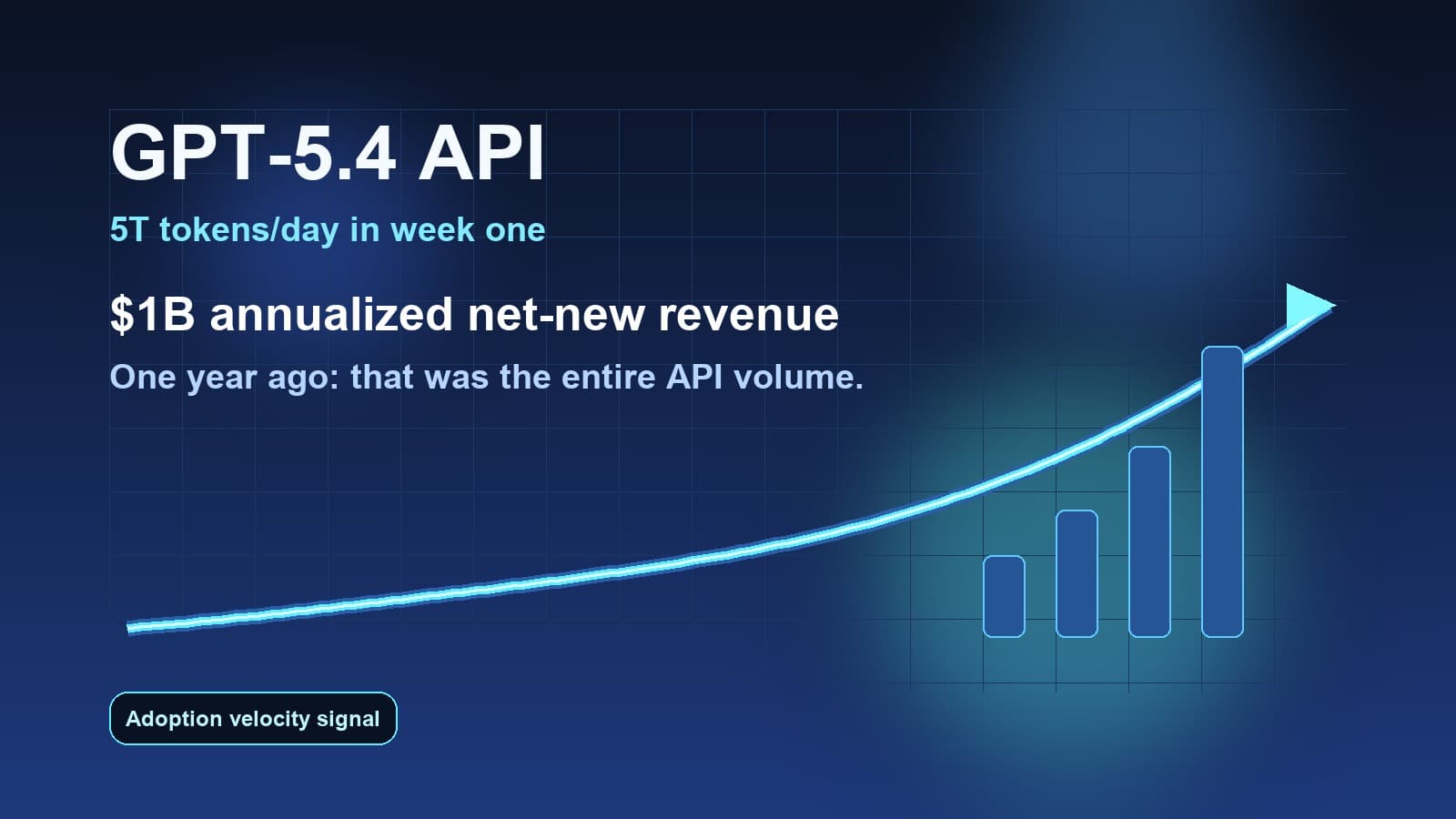

One week. That is how long it took GPT-5.4 to reach 5 trillion tokens per day across OpenAI's API.
Greg Brockman posted the milestone on X, noting that the single-model daily volume now exceeds the total API throughput OpenAI handled across all models one year ago. Sam Altman confirmed the figure and added that GPT-5.4 is already on a $1 billion annualized run rate in net-new API revenue -- spend that did not exist before the model launched.
Those two numbers deserve separate attention, because they measure different things.
The volume number is about trust
Five trillion tokens per day is not an experiment. At that scale, developers are routing production traffic through GPT-5.4. They are sending customer queries, processing documents, running agents, and generating outputs that land in front of real users.
A year ago, five trillion tokens per day was the ceiling for the entire OpenAI API -- every model, every tier, every use case combined. Now a single model matches that throughput in its first week. The gap between "launched" and "load-bearing" has compressed to days.
That compression is the real story. The API ecosystem has matured to a point where integration patterns, observability tooling, prompt management layers, and fallback architectures are already in place. Teams are not spending weeks evaluating GPT-5.4 in sandboxes. They are swapping it into existing pipelines with enough confidence to push production volume immediately.
The revenue number is about incremental demand
The $1 billion annualized figure is specifically described as net-new. Brockman was clear on this -- it is not cannibalization of GPT-5.3 or GPT-4o spend. It represents additional API consumption that appeared alongside existing usage.
That distinction matters. When a new model simply replaces the old one at the same volume, the launch is a substitution event. When it adds a billion dollars in annualized spend on top of what was already there, it means developers found workloads that GPT-5.4 can handle but its predecessors could not -- or could not handle economically enough to justify the API calls.
The likely candidates: longer-context agentic workflows that benefit from GPT-5.4's expanded reasoning window, latency-sensitive pipelines that can now afford to use a frontier model, and new applications that were blocked by capability thresholds. Whatever the mix, the pattern is expansion, not rotation.
What the ramp says about the developer base
OpenAI's API customer base has quietly become enormous. Hitting five trillion tokens per day in a single week requires not just a few hyperscale customers flipping a switch, but a long tail of teams with automated deployment paths that can absorb a new model version quickly.
That implies a level of operational maturity across the developer ecosystem that was not visible even six months ago. Consider what has to be true for that ramp to happen:
- Evaluation is automated. Teams are running benchmark suites and regression tests against new models as part of CI, not as quarterly projects.
- Routing is abstracted. Model selection is a configuration change or a feature flag, not a code rewrite.
- Cost controls are in place. Nobody routes five trillion tokens per day without per-request budgets, rate limiting, and spend alerts already wired in.
The speed of adoption is less about GPT-5.4 being impressive and more about the infrastructure around it being ready. The model is the catalyst. The ramp is the infrastructure's fingerprint.
A spending signal, not a hype signal
Token volume is easy to inflate with synthetic benchmarks or internal testing. Revenue is harder to fake. When Altman cites a billion-dollar annualized run rate in net-new spend, he is describing real invoices from real API customers making real allocation decisions.
That makes this a useful leading indicator for anyone planning AI budgets. Developer teams are not pulling back. They are not consolidating onto fewer models to save money. They are adding capacity on the newest frontier model within days of availability, at a scale that moves the revenue needle for a company already generating billions in API income.
For teams building on OpenAI's API, the implication is that you are operating in a market where your competitors adopted the latest model before you finished reading the changelog. The competitive window between "model available" and "model deployed in production" is now measured in hours, not quarters.
Speed as a market feature
The broader signal here is that AI model adoption now behaves like infrastructure upgrades rather than technology evaluations. When AWS releases a new instance type, large customers migrate workloads within days because their deployment tooling handles it. The GPT-5.4 ramp suggests the AI API ecosystem has crossed that same threshold.
That is a maturity marker. It means the era of careful, months-long model evaluations before committing production traffic is ending for teams with modern tooling. It also means that model providers who cannot support this kind of instant-ramp deployment -- fast provisioning, stable endpoints, predictable pricing at scale -- will lose share to those who can.
Five trillion tokens per day in one week is not just a big number. It is a timestamp on when AI APIs stopped being a technology bet and started being operational infrastructure.
AI Pilot Readiness Checklist
Turn the idea into a pilot you can defend.
AI agent articles are easy to bookmark and hard to operationalize. Use the readiness questions as a shared way to decide whether a workflow is specific enough, safe enough, and measurable enough to pilot. If they surface a strong candidate, BaristaLabs can review it with you and help shape a first version that fits your systems, approval process, and risk tolerance.
Please do not submit PHI, customer records, credentials, or confidential workflow exports.
Practical AI Workflow Notes
Want more practical AI operations ideas?
Get short notes on applying AI inside real small-business workflows — from document handling and customer follow-up to internal reporting, compliance, and automation guardrails.