


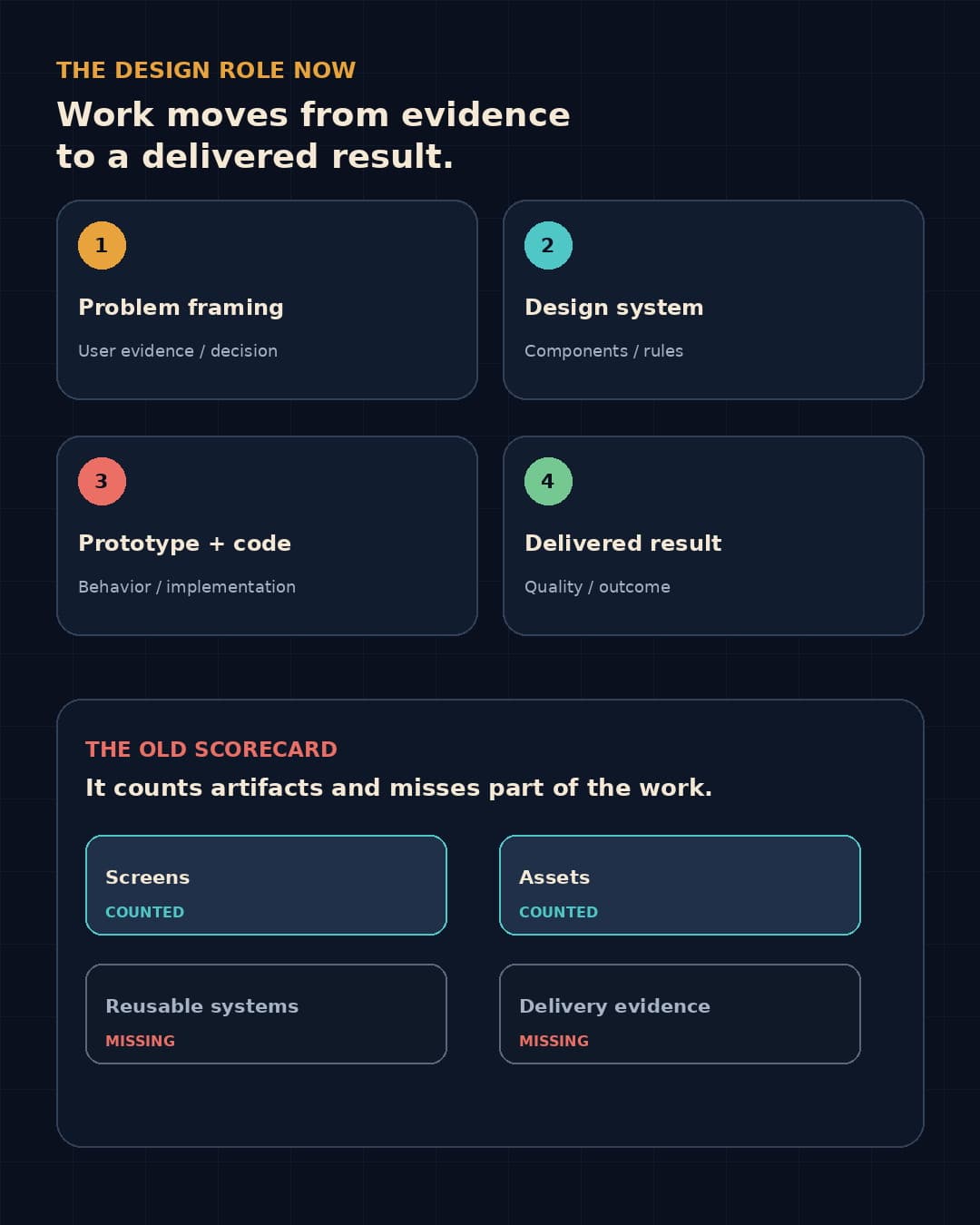
A product designer fixes a component in production. A brand designer builds a tool that lets marketers create approved campaign variations. A design leader prototypes a workflow instead of waiting for engineering capacity. These are no longer edge cases. They are part of the work described in the 2026 AI in Design report from Designer Fund and Foundation Capital.
The report surveyed more than 900 designers across more than 60 countries and combined the results with interviews and company case studies. Half of respondents said they had pushed AI-generated code to production. The group included product and brand designers as well as design engineers. Performance reviews that focus on mockups and output volume can miss code, systems work, product judgment, and delivery. This article explains how design leaders can update their scorecards without rewarding AI use by itself.
Surveyed designers now use AI throughout the design process
In the report's Tools chapter, 54% of surveyed designers said they used AI for design work each week in 2025. In 2026, 91% reported weekly use, and 75% reported daily use. The average reported tool stack grew from three AI tools to seven.
The tools also spread across the full process. Designers reported using AI for research synthesis, ideation, interface copy, prototyping, documentation, design systems, code generation, design quality checks, and developer handoff. The largest year-over-year changes included code generation, wireframing, design systems, and design quality work.
This is different from adding an image generator to the existing process. AI reduces the cost of moving between stages. Research notes can become themes, themes can become interface directions, and a direction can become a working prototype in one session. The designer can inspect the behavior, change the implementation, and continue the cycle without converting every decision into a static artifact first.
Our earlier look at Google Stitch covered one tool-level version of this change: a canvas that connects design rules, generated interfaces, and code. The new report shows the wider workforce effect. Designers are becoming builders even when their title has not changed.
Design responsibilities expanded before performance systems changed
The Teams chapter reports that 65% of surveyed designers are taking on more product or engineering responsibilities. Forty percent also reported movement in the other direction, with product managers and engineers contributing more to design.
That overlap can make a team faster. It can also hide ownership. If a designer changes production code, who reviews the implementation? If a product manager generates a usable interface, who checks accessibility, interaction quality, and consistency with the product system? If a brand designer builds a self-service campaign tool, is performance judged by the assets they personally made or by the quality of the system everyone else can use?
The organizational response is still limited. Seventy-three percent of designers reported rising expectations around output, quality, or speed. Only 28% of leaders said their companies had made formal changes to evaluation, compensation, or hiring. The report says only 8% had changed performance metrics, and 4% had adjusted compensation structures.
This creates a bad default: the company keeps the old measures and adds new expectations. Designers remain accountable for visual execution while also taking on code, product reasoning, workflow design, and delivery. More responsibility appears in the work before it appears in the level, title, review, or pay.
Counting artifacts rewards the part AI makes cheapest
When output is expensive, the number of completed screens, campaign assets, or design tickets can look like a useful capacity measure. When AI makes production faster, that measure becomes easier to inflate and less connected to value.
A designer can now generate many plausible options. That does not show that the options came from sound research, fit the strategy, work as a system, or deserve to reach users. The Tools chapter reports that 62% of surveyed designers cite inconsistent or unreliable output as their biggest challenge when using AI for design work. It also reports that 80% say reliable, high-quality output is what makes an AI tool one they keep using.
AI makes plausible first passes easier to produce. Final judgment still depends on context: the audience, the product promise, the system around the interface, the risk of an error, and the difference the experience must create. A clean screen can still be the wrong screen.
Hiring managers reported more emphasis on the ability to use AI tools, systems thinking, strategic skills, and storytelling. Only 5% of surveyed design leaders said they were placing less emphasis on execution craft when hiring. The skills in demand changed, but the quality bar did not fall.
Review evidence from problem choice through delivery
A useful design review now needs evidence from the whole path between problem and delivered behavior.
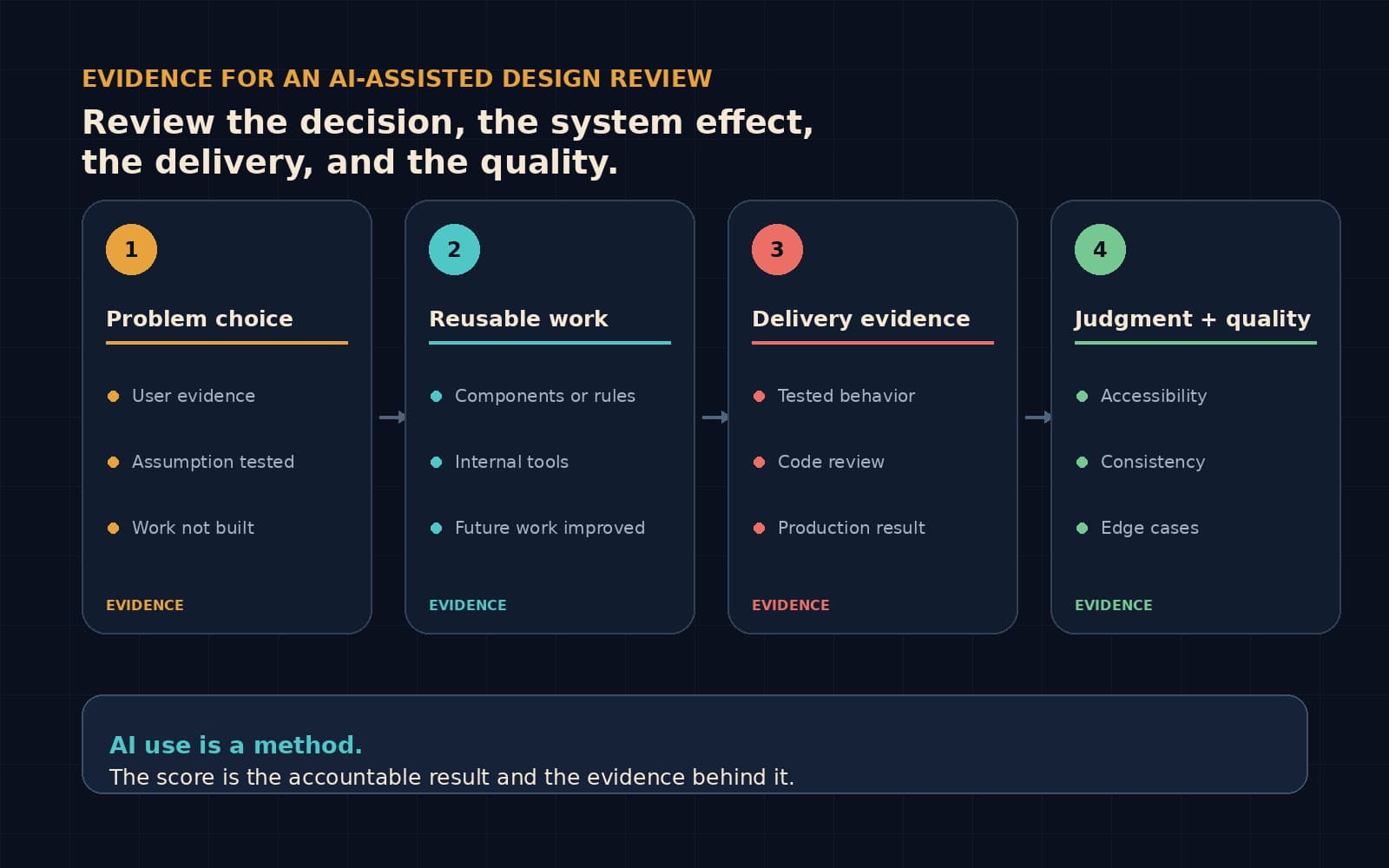
Start with the problem choice. What user or business evidence justified the work? Which assumption did the designer test? What did the team decide not to build? AI can help synthesize research, but the designer remains responsible for the framing and the limits of that synthesis.
Then review how the work affects future work. Did it improve one screen, or did it create a component, rule, tool, or process that others can reuse? The report describes designers building small internal tools, reusable design infrastructure, and tools that let colleagues generate work within set rules. These contributions can improve later work even when they reduce the number of artifacts the designer personally makes.
Review delivery as well as intent. A prototype that proves behavior, a production code change submitted for review, a tested design-system change, or a working internal tool each provides different evidence than a static mockup. Designers can share implementation work and still stay close enough to final delivery to see where the original intent changed.
Finally, review judgment. Which generated options were rejected and why? Where did the designer override the average answer? How did the work account for accessibility, trust, brand, edge cases, and the user's actual setting? The reasons for these decisions show the designer's judgment.
Under this scorecard, AI use is only a method. Leaders evaluate the choices, reusable work, delivery evidence, and quality for which the designer is accountable.
AI use can reduce collaboration
The report also found a warning inside the speed gains. In 2025, 5% of respondents said collaboration had decreased because of AI. In 2026, the figure rose to 20%.
Some designers described more time working alone with prompts and terminals and less time in direct exchange with teammates. A person can move further before asking for input, which makes the eventual review larger and harder. A working prototype can also look more resolved than the underlying decisions really are.
Teams need review points that match the shorter process. Review the problem before a polished prototype makes it feel settled. Check changes to shared components and rules before generated code spreads a local decision across the product. Review the implementation before release so design quality checks do not become later cleanup.
Among surveyed designers, peer learning rose from 24% to 70%, while recommendations from leadership fell from 32% to 16%. Leaders should create time for experiments, make working methods visible, and connect those methods to quality and accountability.
Most surveyed leaders expect headcount to hold or grow
The report does not support a simple claim that AI is eliminating design teams. Sixty percent of surveyed design leaders expect to keep or grow design headcount during the next year. Twenty-eight percent plan to grow their teams, and 32% expect headcount to stay about the same while output expectations increase. Ten percent expect reductions. Another 8% are shifting investment toward hybrid roles such as design engineering.
These plans do not guarantee that every design job is safe. They describe the expectations of surveyed leaders, not the future of every company. BaristaLabs reads the figures as evidence that role scope is changing faster than total headcount. BaristaLabs expects the most pressure on work centered on asset production and pixel execution because AI lowers the cost of acceptable first passes. Designers who frame problems, maintain a product point of view, work across systems, and stay involved through delivery can contribute to more of the product process.
The report does not measure client budgets for freelancers or agencies. BaristaLabs sees a related risk: clients can create rough concepts, social assets, and passable layouts without buying the same volume of production hours. A studio that sells mainly artifact volume should test whether demand and budgets are changing in its market.
A more durable offer focuses on work around production: defining the problem, understanding the audience, establishing a visual and interaction system, directing the tools, and rejecting polished but wrong work. Our analysis of Canva Magic Layers shows one way routine rework can become cheaper while brand judgment and quality control remain necessary.
Change the scorecard before the next review cycle
The report shows that many designers have already changed how they work. Performance reviews now need criteria for the broader role.
A current design scorecard should recognize problem framing, user evidence, improvements that help future work, collaboration, delivered behavior, and execution quality. Different roles can require different levels of technical fluency. The scorecard should measure production speed separately from whether the delivered work solves the defined problem and meets quality standards.
Generative AI lowers the cost of first-pass screens and assets. As production becomes cheaper, user insight, systems thinking, problem definition, judgment, and responsibility for delivery carry more weight.
Design leaders should make this broader work visible in evaluation, career, and compensation systems.
Sources
- Designer Fund and Foundation Capital: AI in Design Report 2026
- Tools: The great toolstack shakeup
- Craft: Craft in an age of infinite output
- Teams: Redesigning the design team
- Designer Fund: AI in Design 2026 — The inflection point is here
Make the review system match the work
BaristaLabs can review one AI-assisted product or creative workflow with the people who own design, product, marketing, and engineering. Start with one real path from evidence to production. Define who decides, what the team reviews, which reusable improvements belong in the performance review, and what evidence shows that the work is ready.
Process Automation
Does your scorecard match the work AI changed?
Review one AI-assisted product or creative workflow across problem framing, production, quality, delivery, and accountability.
Built for product, design, marketing, and operations teams whose AI use has moved beyond experiments.
Turn this idea into a pilot
Which workflow should go first?
Use the readiness check to compare impact, effort, risk, owner, and next step before requesting a review.
- 3-5 minutes
- Deterministic score
- No sensitive data
Practical AI Workflow Notes
Want more practical AI operations ideas?
Get short notes on applying AI inside real small-business workflows — from document handling and customer follow-up to internal reporting, compliance, and automation guardrails.