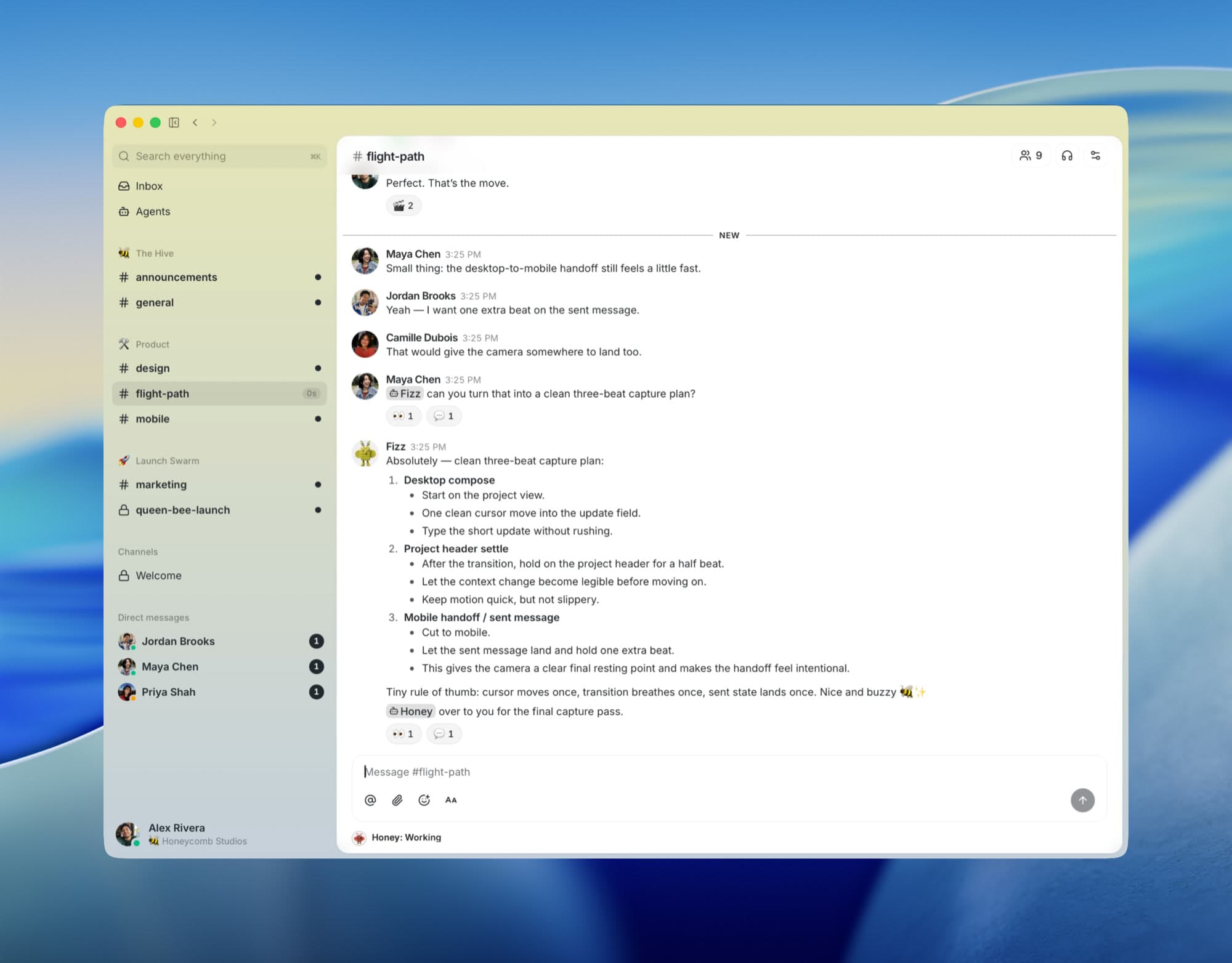

Block launched Buzz on July 21, 2026 as a self-hostable workspace where engineers and AI agents share channels, code activity, workflows, search, and project history. Its useful idea is straightforward: if people and agents work from the same signed event history, a team may spend less effort copying context between chat, Git, CI, and agent tools. The tradeoff is equally important. In the deployment that ships today, one relay is the authoritative system for the workspace.
Most engineering teams should watch Buzz for now. A bounded internal trial makes sense when one team can name a recurring chat/Git/CI handoff that already causes trouble and can assign someone to operate the relay. This article explains what Buzz currently combines, where the shared history may help, what the relay concentrates, and which maturity gaps should keep a team from trialing it yet.
Buzz already combines collaboration, agents, workflows, and Git
According to the Buzz README, the current product includes channels, threads, direct messages, canvases, media, search, an audit log, a desktop application, an agent-oriented command-line interface, YAML workflows, Git events, and Git hosting. Packaged desktop builds are available for macOS, Linux, and Windows. The default self-hosted setup runs one community on one relay, while a hosted operator can serve separate communities behind different domains or subdomains.
Agents join that workspace with their own identities and channel memberships. Buzz provides a command-line interface designed for tool calls and an Agent Communication Protocol connector for agents such as Goose, Codex, and Claude Code. Its separate agent design document describes an ACP-compatible coding agent and an MCP server that gives an agent shell and file-editing tools; those components communicate through standard protocols rather than sharing application code.
That scope goes beyond the code-host resilience question raised by a reported internal GitHub alternative. Buzz brings more of the engineering conversation into the same system as the repository. A wider surface can remove some integration work, but it also means the team is evaluating a communication system, an agent workspace, a workflow engine, and a Git host together.
One event history could simplify the handoffs around a branch
Buzz uses Nostr, a protocol for exchanging events identified by public keys. In Buzz, a signed event is a JSON record containing an author’s public key, an event type, content, and a cryptographic signature. The signature lets the system verify which key produced the record and whether the record changed after signing; it does not prove that the action was correct, safe, or properly approved in the surrounding business process.
A relay is the server that receives those events, verifies them, stores the persistent ones, returns matching history, and distributes new events to connected clients. Because messages, reactions, workflow activity, Git activity, and agent actions use the same basic event shape, Buzz can keep them in one searchable history. People and agents can therefore participate in the same channel under separate keys instead of pushing agent work through an unnamed chat bot or an unrelated automation account.
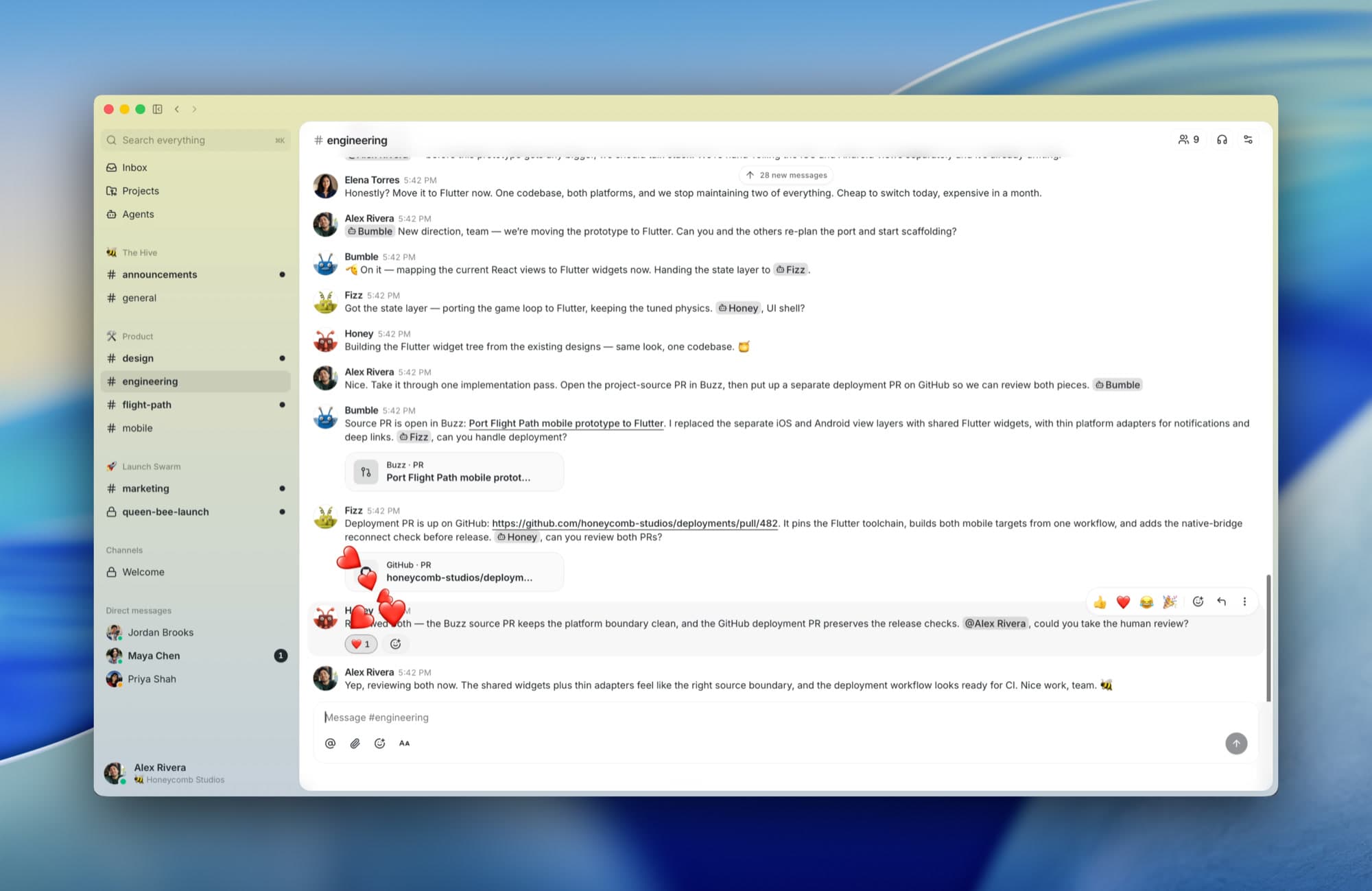
Buzz’s branch-as-channel idea shows where this may become useful. The projects design describes a branch channel that holds patches, CI results, review comments, approvals, and the merge decision, then archives when the branch merges. Git remains standard Smart HTTP transport, while Nostr events carry repository metadata and activity. However, this complete branch experience belongs partly to the designed forge layer: Git hosting ships today, while project binding and the merge coordinator are still labeled designed.
For a team that repeatedly loses the reason behind a change between chat, a pull request, CI output, and an agent transcript, a shared history could reduce searching and context copying. That is a BaristaLabs interpretation of the architecture, not a measured productivity result. Buzz changes where agent work can be observed, much as a visual coding-agent workspace changes what a developer can inspect, but neither interface establishes that the underlying patch is correct.
The same relay that removes seams becomes an operating dependency
Buzz’s architecture document is explicit about the relay boundary: the relay is the single source of truth, all reads and writes flow through it, and there is no peer-to-peer event exchange, gossip, or replication. Clients connect to the relay over WebSocket while the relay handles authentication, signature verification, storage, distribution, search, audit activity, and workflow triggers. Buzz uses a decentralized protocol format inside a centralized deployment shape; calling the current product fully decentralized would hide the part an operator must run.
That concentration makes ownership a prerequisite for a trial. Someone needs to decide how the relay is deployed, monitored, backed up, restored, upgraded, and taken out of service, as well as how keys and channel membership are managed. The project documentation explains the local stack and internal subsystem boundaries, but it does not remove those operating decisions.
Signed events and separate agent keys make the actor explicit in each record. They do not settle what each agent may read, which tools it may call, who can revoke it, or how a compromised key is handled. Those permissions and recovery procedures remain local work for the team running the trial.
The architecture also documents current limits that matter to an operator. Rate-limiting tiers exist as a design target, but the document says no production rate limiter is currently enforced. The primary sources do not provide independent evidence about uptime, recovery time, data-loss behavior, scale, security review, or the effort required to move a full workspace history elsewhere.
The shipped product stops short of the full forge vision
Buzz’s documentation draws a useful maturity line. The README places the relay, collaboration surfaces, desktop app, agent CLI and ACP integration, workflow triggers, Git events, and Git hosting under “Works today.” It places mobile clients, workflow approval gates, and huddle lifecycle events under “Being wired up,” while push notifications and cross-relay reputation remain pending code.
The projects document is more specific. It says the workflow engine and Git hosting ship today, but project binding, the merge coordinator, NIP-34 issues, and web-of-trust reputation are designed. Approval gates have infrastructure in place while executor wiring remains in progress. The architecture document says a workflow that reaches an approval request currently fails instead of persisting and resuming a waiting approval, so a team should not treat the current workflow engine as a complete human-approval system.
The Buzz Desktop v0.4.21 release, published July 21, included agent archive commands, authentication and onboarding work, and fixes for agent stalls, timeouts, activity display, and workspace-scoped drafts. Those changes show active product work. A release number and a list of fixes do not establish adoption, reliability, security, support commitments, migration cost, or business outcomes, and the primary sources cited here do not establish any of them.
Teams that require finished mobile clients, end-to-end approval gates, proven scale, independently assessed security, or a defined support arrangement should wait. The same applies when Git hosting or team chat cannot enter an early-stage internal evaluation without a lengthy migration or compliance review. Watching the repository and releases preserves the option to revisit Buzz when those requirements are documented and available.
Watch by default; trial only around a handoff you can name
Buzz is worth watching because agents often act in one tool while the discussion, code review, CI evidence, and approval live elsewhere. Its event model puts that work in one history, while the relay makes the operating cost visible.
A trial is justified only when one team can point to a current handoff problem and one person can own the relay during the evaluation. Choose one reversible internal project, run Buzz beside the existing stack, and keep the current Git and communication systems in place. Observe whether the shared history actually reduces missing context or repeated explanations, then account for setup, permissions, exceptions, recovery, and ongoing relay work before deciding whether another evaluation is warranted.
Do not begin with a migration. For most teams, the right decision after the July 21 launch is to follow the working product as it closes the gap with the forge vision. A team with a specific handoff problem and the capacity to operate the relay has enough reason for a narrow trial, but no evidence here supports a broader rollout.
BaristaLabs can help an engineering team shape that trial through AI-assisted website development, keeping the existing stack available while one real branch tests the shared history and relay workload. Plan a one-relay workspace trial when the handoff problem and relay owner are already clear.
Sources
Agent workspace trial
Test one shared history without migrating the team
Bring one internal branch where chat, agent work, CI evidence, and code review regularly split across tools. BaristaLabs will help shape a reversible comparison and account for the relay work it creates.
Best fit when the handoff problem and the person who would own the relay are already clear.
Turn this idea into a pilot
Which workflow should go first?
Use the readiness check to compare impact, effort, risk, owner, and next step before requesting a review.
- 3-5 minutes
- Deterministic score
- No sensitive data
Practical AI Workflow Notes
Want more practical AI operations ideas?
Get short notes on applying AI inside real small-business workflows — from document handling and customer follow-up to internal reporting, compliance, and automation guardrails.