Why we are turning AI news into workflow artifacts
A BaristaLabs field note on why more AI coverage should end as receipts, approval queues, workflow audits, security worksheets, launch packets, and review lanes.

Sean McLellan
Lead Architect & Founder
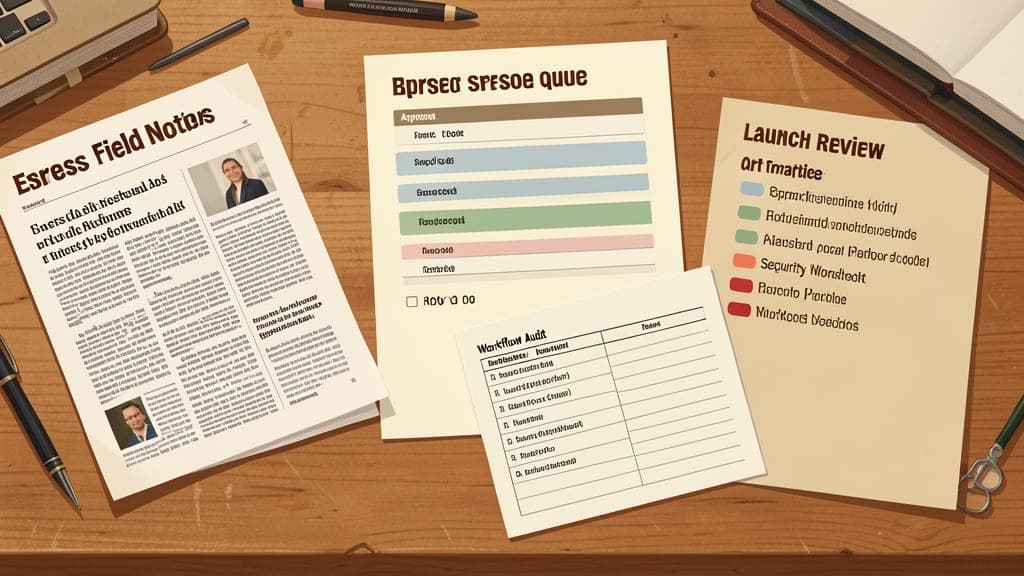
The same vendor announcement can turn into ten posts before lunch.
One version recaps the launch. One predicts winners and losers. One quotes the benchmark chart. One explains the pricing. One asks whether every small business should care.
Most of them expire quickly.
The version we keep wanting is the one that helps an operator change something on Monday morning. Which review step moves? Which data boundary gets tighter? Which receipt field should exist now? Which queue needs a human owner before the tool gets more permission?
That is the editorial shift we are making at BaristaLabs.
We will still watch model releases, agent launches, security incidents, search changes, and the strange little product updates that tell you where the market is going. But the default output should not be another reaction to the news. It should be a workbench artifact a team can use after the tab is closed.
News is useful when it changes a checklist
A vendor launch is not automatically a strategy moment.
Sometimes the right response is a short note in the internal watchlist: interesting, not ready, revisit later. Sometimes it deserves a comparison, because buyers will search for the difference and need a grounded answer. Sometimes it deserves a warning, because the new feature touches credentials, customer data, approvals, or a public channel.
The editorial test is simple: after reading the story, what would a small team edit in its actual operating materials?
If the answer is "nothing," the story may still be interesting, but it probably does not need a full BaristaLabs treatment. If the answer is concrete, the post should end with a named artifact: a checklist row, a source packet question, a review lane, a launch-readiness field, a sample decision log, or a worksheet prompt a team can copy into its own process.
That shift changes how we assign stories. A model release is not just a model release; it may be a pricing assumption to update in a planning worksheet. A security incident is not just a scare story; it may be a new data-boundary question. A coding-agent demo is not just a product reaction; it may be a maintainer handoff pattern.
The artifact is the point. The news is the reason to revisit it.
The workbench is becoming the site map
You can see the pattern in the pages we keep building.
The Learn center is less interested in AI as a topic category and more interested in the moment when a team has to choose a first workflow. The responsible AI pages are not written like policy theater. They keep pulling the reader back to named decisions: who reviews, what evidence is visible, which systems are in scope, and what happens when a pilot should pause.
The same pattern shows up in posts that started as outside news.
A story about AI code review tools became a piece on review lanes, because the useful question was not whether another bot could comment on a pull request. It was how a maintainer keeps findings, autofix attempts, stale branch states, and human approval from colliding in one thread.
A broader field note on workflow receipts explains the evidence record that should travel with an AI-assisted action after the demo.
This article is the editorial layer above that pattern: how we decide which news items deserve to become templates, checklists, worksheets, and decision pages in the first place.
We are choosing reusable artifacts over disposable reactions
This can sound like we are trying to make AI coverage heavier.
We are trying to make it easier to act on.
A good artifact has a job. It names the owner of the next decision. It narrows the workflow being discussed. It gives the reviewer a visible standard. It makes the data question explicit before a vendor integration gets blessed. It keeps a promising feature from turning into a vague transformation project.
These artifacts do not answer every strategic question. They do something more useful for most teams: they make the next edit visible.
Should the security worksheet add a new credential-handling prompt? Should the approval guide separate customer-facing drafts from internal notes? Should a launch packet include a shadow-week evidence field? Should a code-review lane track which bot suggested an autofix and which human accepted it?
That is the level where small businesses usually need help. Not with believing that AI matters. With turning a fast-moving story into one practical change in the way work is reviewed, launched, or improved.
The promise to readers
Our editorial promise is simple: when an AI story matters, we will try to turn it into work you can inspect.
Some posts will still be timely. Some will still explain a launch or compare tools. But the useful endpoint should be more durable than a take.
Bring the story back to the workbench. Name the boundary. Show the reviewer. Write the receipt. Check the data path. Keep the rollback owner visible. Decide what changes on Monday.
If an AI story cannot do any of that, it probably does not need a whole BaristaLabs post.
And if your team already has one story that feels relevant but fuzzy, start there. Pick the workflow it would touch, then turn the excitement into one artifact someone can actually use.
Copy the agent receipt template
Turn one AI story into a usable workflow artifact
BaristaLabs helps small teams choose the first workflow, write the review boundary, and leave behind enough evidence for a safer launch.
Best fit when a vendor launch sounds promising, but your team still needs to decide what changes in the work.
Turn this idea into a pilot
Which workflow should go first?
Use the readiness check to compare impact, effort, risk, owner, and next step before requesting a review.
- 3-5 minutes
- Deterministic score
- No sensitive data
Practical AI Workflow Notes
Want more practical AI operations ideas?
Get short notes on applying AI inside real small-business workflows — from document handling and customer follow-up to internal reporting, compliance, and automation guardrails.