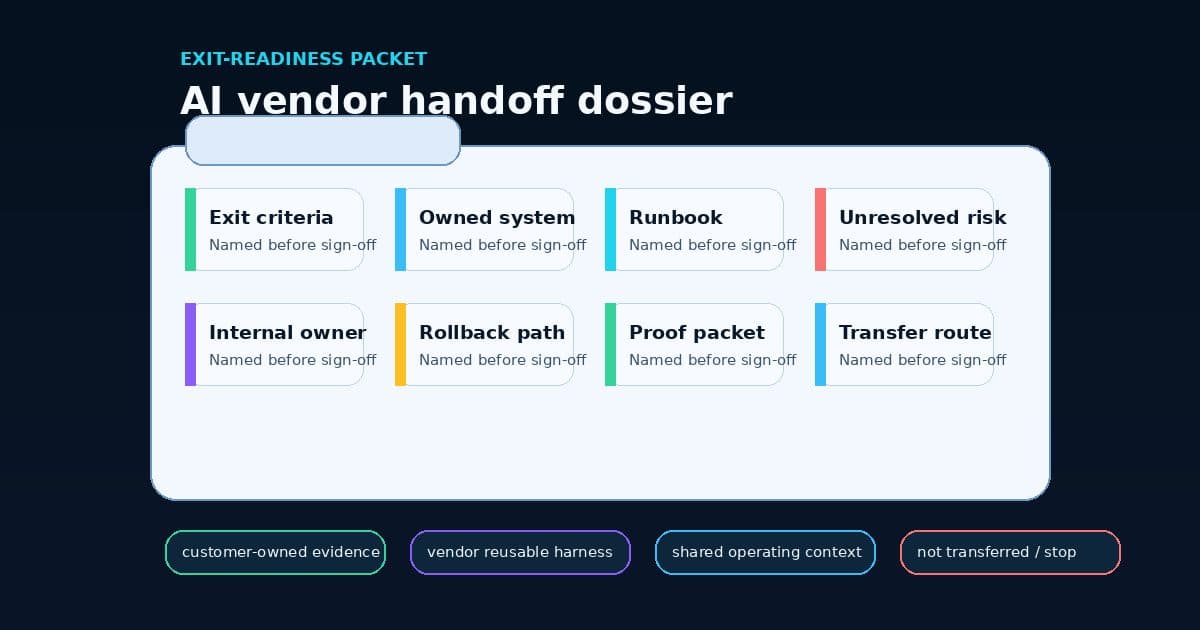

AWS is turning the implementation team into part of the product.
On June 30, the company announced a $1 billion Forward Deployed Engineering organization built to embed with customers and co-develop agentic AI systems on real business workflows. AWS says the new group will put thousands of experts beside customer teams, use agentic AI to build agentic AI, and compress deployments "from months to days." CNBC reported that an initial pod of roughly five or six engineers will sit inside a customer engagement at a time, working alongside AI agents instead of only supervising them.
That is a different product promise from a model API, a console feature, or a reference architecture. It says: let the experts come inside the work, rebuild the process with you, and leave faster than a normal enterprise implementation ever would.
The buyer question changes with it. The old question was, "Can this vendor build the thing?" The new question is, "What can my team operate when the vendor is gone?"
Speed is the selling point. The handoff is the product.
AWS's own announcement is careful to make self-sufficiency part of the promise. It says customers gain deployed systems, knowledge graphs, runbooks, architectural documentation, and trained internal champions. It also says the agents reason over a governed, versioned knowledge graph in the customer's own AWS account, so domain expertise lives in customer code rather than in the heads of people who may rotate off the project.
That is the sentence worth underlining. If it is true in practice, the customer is not just buying an impressive build week. The customer is buying a transfer of operating capability.
But the same day, AWS published a second post for partners that makes the economics of this model more visible. In the AWS Partner Network version, each partner-led engagement builds a reusable delivery harness: domain ontologies, evaluation frameworks, MCP servers, agent operations tooling, and a context graph that records architecture choices, evaluation criteria, and domain patterns. AWS says the delivery IP and compounding advantage stay with the partner. The business outcome belongs to the customer.
That is the hidden fork in the road: outcome is not the same as operating capability.
A vendor can leave you a working agent and still keep the most reusable part of the work. That is not necessarily bad. A good implementation partner should get better from one engagement to the next. The danger is accepting a finished outcome without naming which tests, maps, runbooks, tool inventories, and ownership paths become yours. Before treating the demo as sufficient proof, review how BaristaLabs separates public evidence from private delivery context in its case studies.
Route the handoff before the build starts
Exit-path map
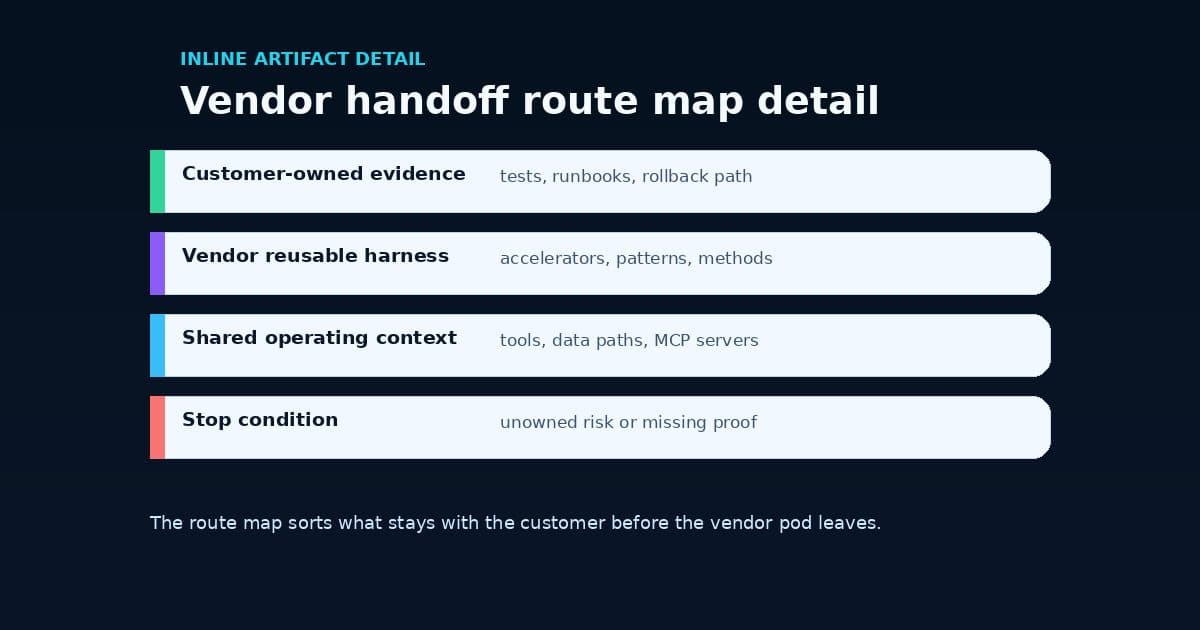
The AI vendor handoff route map
Sort each piece of an embedded AI engagement before the work starts. If it is not routed, it will be argued over after the demo.
Customer-owned evidence
- Input:
- Workflow map, acceptance tests, evaluation harness, runbooks, ownership chart, rollback path
- Route:
- Stored where the customer's team can read, update, and audit it
- Decision:
- Engagement is not done until these artifacts have named owners
- Consequence:
- The system can be operated after the vendor leaves
- Receipt question:
- Can an internal owner explain the system and prove it still works next month?
Vendor reusable harness
- Input:
- Domain patterns, implementation accelerators, delivery tooling, partner methods
- Route:
- Stays with the vendor or partner unless the contract says otherwise
- Decision:
- Buyer decides which pieces are acceptable as black-box acceleration
- Consequence:
- Speed improves, but future changes may still depend on the builder
- Receipt question:
- Which parts of the build can only the vendor reproduce?
Shared operating context
- Input:
- Knowledge graph map, tool registry, data sources, MCP servers, security notes
- Route:
- Copied into customer-owned systems with access, change control, and review cadence
- Decision:
- No production approval without a current inventory
- Consequence:
- The team can see what the agent knows and what it can touch
- Receipt question:
- Who owns every tool, data path, and permission after launch?
Stop condition
- Input:
- Unowned tool, missing test, unclear data boundary, untrained internal champion, no rollback path
- Route:
- Paused before broader rollout or production dependency
- Decision:
- Fix the missing handoff evidence before accepting the build
- Consequence:
- A polished demo cannot outrun the operating gap
- Receipt question:
- What exactly blocks sign-off if this field is still blank?
The route that matters most is not from prototype to demo. It is from vendor knowledge to customer operation.
The handoff dossier is not a folder of after-the-fact documentation. It is a routing map for the engagement itself.
Every meaningful part of an embedded AI build should land in one of four places. Some evidence must become customer-owned: the before-and-after workflow map, the acceptance tests, the runbooks, the rollback path, the names of the people who can operate the system. Some material will reasonably remain vendor-owned: accelerators, reusable patterns, delivery tooling, and the lessons that make the next customer engagement faster. Some context has to be shared and governed: data sources, tool permissions, MCP servers, knowledge-graph structure, security notes. And some missing items should stop the rollout until they are resolved.
That route map matters because the engagement will otherwise define ownership by momentum. The pod builds. The demo works. The internal team learns by watching. The final week fills with polish, stakeholder walkthroughs, and small fixes. By the time someone asks who owns the evaluation harness, the calendar pressure is pointing toward sign-off.
Write the route map while the engagement is still negotiable.
The four routes that decide whether capability stays
Customer-owned evidence is the part your team needs to keep operating the workflow after the outside team leaves. It includes the workflow map, production acceptance tests, the evaluation harness, runbooks, ownership chart, and rollback path. If these artifacts live only in the vendor's working memory, you do not have self-sufficiency. You have a successful visit.
Vendor reusable harness is the part the builder gets to compound across customers: delivery methods, implementation accelerators, reusable agent patterns, and partner tooling. There is nothing inherently wrong with that. AWS is explicit that partner-led FDE work is meant to create a harness the partner owns permanently. The buyer's job is not to demand every accelerator. It is to distinguish the vendor's reusable machinery from the customer's operating evidence.
Shared operating context is where agentic projects become fragile if nobody writes them down. Which systems can the agent read? Which tools can it call? Which MCP servers or APIs are in the path? Where does the knowledge graph live? Who owns each permission after launch? The same discipline behind agent-written code sandbox contracts applies here: if software is going to act inside the business, the boundary has to survive the people who built it.
Stop conditions are the missing handoff items that block sign-off. No rollback path. No named internal champion. No evaluation harness. No current tool registry. No answer for where domain knowledge lives. Those are not documentation chores. They are acceptance criteria. A polished demo should not be allowed to outrun them.
The thin public reaction still points at the right concern
The broader public conversation is early. A short Hacker News thread on CNBC's story had only two comments when checked, so it should not be treated as broad sentiment. But the concern was pointed: one commenter asked whether AWS is footing the bill to onboard and lock in customers, while another observed that the FDE role keeps expanding into software engineers making and selling code.
The lock-in question is useful because lock-in does not always look like a proprietary API. Sometimes it looks like a system your company technically owns but cannot confidently change.
That is why the dossier should include more than architecture diagrams. It should include a rehearsal path. Can your internal owner explain why the agent made a disputed decision? Can they run the evaluation harness without the vendor? Can they add or remove a tool permission? Can they turn the workflow off and return to the manual path for a day? Can they trace the next change through an audit trail? If not, the project is still depending on the pod, even if the pod has left.
BaristaLabs has written about this from the other side of the operating table: audit-chain rehearsals for agent-made changes, wake leases for automation that keeps running after the human walks away, and sandbox contracts for code an agent writes or executes. The FDE model puts all three concerns into one commercial package. It is implementation, tooling, and operating authority arriving together.
Make self-sufficiency measurable
The most useful phrase in AWS's announcement is also the one buyers should refuse to leave vague: self-sufficient.
Make it measurable before the first sprint. Name the internal champions. Name the test suite they will run after launch. Name the owner of every tool and data path. Name the rollback route. Name the meeting cadence that keeps the evaluation harness from becoming a stale artifact. Name which parts of the reusable harness stay with the vendor and which parts become customer-owned evidence.
If the answer to any of those is "we will figure that out at the end," the handoff has already become the riskiest part of the build.
The opportunity in AWS's new model is real: a small embedded team, amplified by agents, can move faster than a normal enterprise implementation. For a team stuck between AI ambition and operating reality, that speed may be exactly what gets the first useful system into production.
Just do not mistake speed for transfer.
If you are evaluating an embedded AI engineering engagement, whether with AWS, a systems integrator, or an internal pod modeled on the same pattern, bring BaristaLabs one workflow before the pod arrives. We will help map the acceptance tests, tool registry, ownership chart, and rollback route that should still be in your hands after the demo is over.
FDE handoff dossier
Bring one workflow before the pod arrives
Map the before-and-after workflow, acceptance tests, tool registry, ownership chart, and rollback path for one process you are considering handing to an embedded AI team.
Best fit for teams evaluating embedded AI engineering, agentic workflow pilots, or implementation partners.
Turn this idea into a pilot
Which workflow should go first?
Use the readiness check to compare impact, effort, risk, owner, and next step before requesting a review.
- 3-5 minutes
- Deterministic score
- No sensitive data
Practical AI Workflow Notes
Want more practical AI operations ideas?
Get short notes on applying AI inside real small-business workflows — from document handling and customer follow-up to internal reporting, compliance, and automation guardrails.