

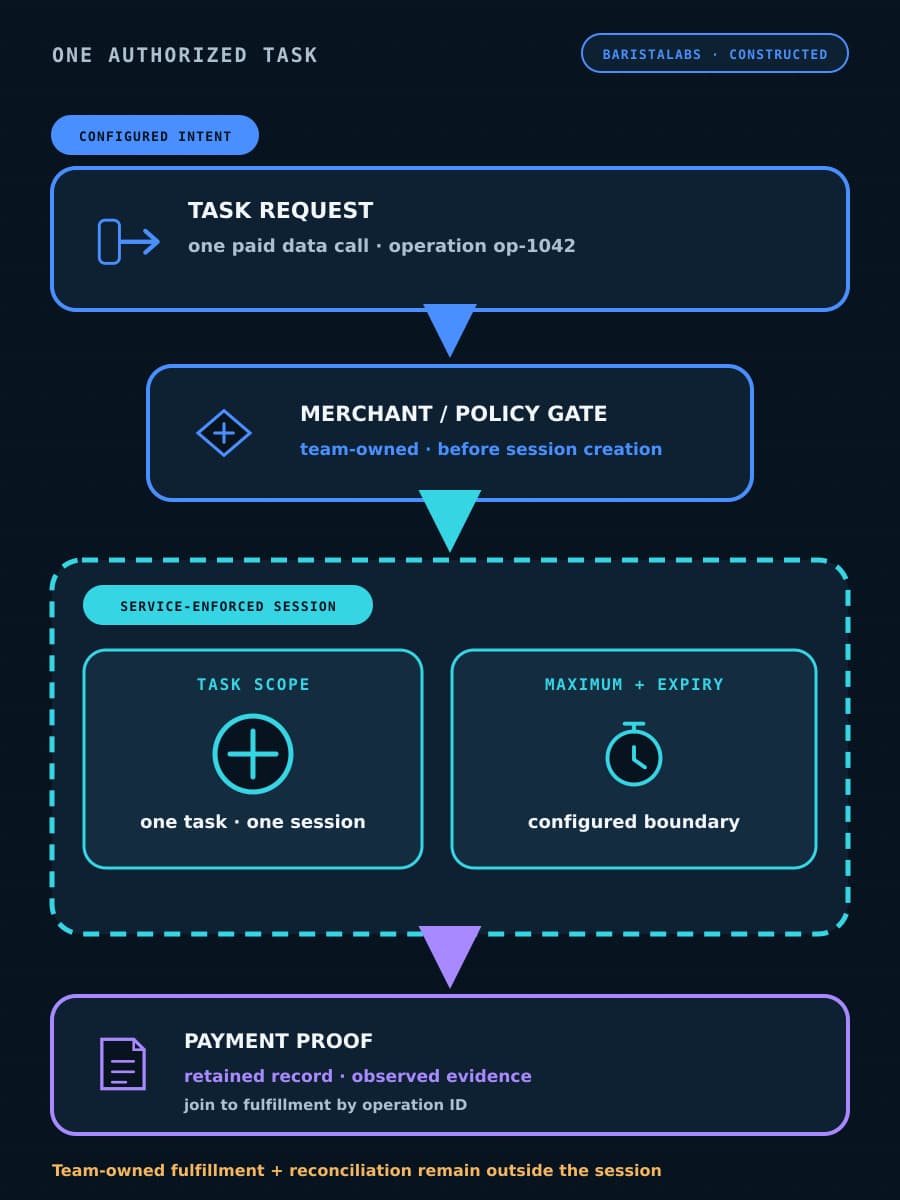

Amazon Bedrock AgentCore Payments became generally available on August 18, 2026. AWS now offers a managed path for agents to pay for metered APIs, MCP servers, and web content through supported stablecoin wallets, with a maximum amount and expiry attached to each payment session.
The production decision is not simply whether an agent can pay. It is whether the business can grant narrowly bounded authority, detect retries and wrong merchants, reconcile the result, and stop spending when evidence becomes ambiguous. This article explains what AWS's session budget actually controls, what remains the implementing team's responsibility, and which first use case is narrow enough to test.
What did AWS make generally available?
AWS's launch post says AgentCore Payments moved from preview to general availability. The service sits on the buyer-agent side of a payment: it receives a merchant's payment request, checks the active payment session, asks a configured wallet provider to sign the transaction, and returns payment proof to the merchant.
The AgentCore Payments documentation describes the target as microtransactions for paid APIs, MCP servers, and content, often below one dollar or even fractions of a cent. That makes the service relevant to an agent that encounters a metered data endpoint mid-task, selects paid inference dynamically, or reaches paid web content without a pre-existing subscription.
At general availability, AWS names two wallet integrations: Coinbase CDP and Stripe Privy. AWS says users fund a wallet and delegate spending authority to the agent. Developer wallet credentials are stored through AgentCore Identity, and the model does not receive the raw credentials. Short-lived tokens are used when AgentCore directs the wallet provider to perform an operation.
AgentCore Payments supports the HTTP-native x402 and Machine Payments Protocol, or MPP. Both use the 402 Payment Required response to let a service request programmatic payment. AWS also added the x402 upto scheme, in which the buyer sets a ceiling and the merchant can charge for measured consumption after the call rather than naming one fixed amount in advance.
Those mechanisms reduce integration work. They do not make the merchant, purchase, or business purpose correct.
What does a payment session control?
A payment session is a scoped payment context for one agent interaction. AWS documents three boundary values:
maxSpendAmount, the maximum spend;currency, the currency for that limit; and- an expiry time.
Before signing a payment, AWS says AgentCore applies a deterministic infrastructure-layer check. A request that would exceed the remaining session budget is rejected, and further requests are denied when the session expires. The documentation also says that if signing fails after a budget deduction, the failed payment does not consume the budget.
That is a meaningful control because a language model should not be the final authority on whether its own proposed payment stays inside a limit. The model can decide that a paid tool may help; a separate service enforces the amount and time boundary.
The word session matters. A ten-dollar ceiling that expires in five minutes answers, “How much may this interaction spend before this time?” It does not answer, “How much may this department spend this month?” or “May this agent buy from this merchant at all?”
BaristaLabs therefore interprets the payment session as a short-lived authorization primitive, not as a finance policy.
What remains outside the session cap?
A cap limits exposure, but it does not establish the legitimacy of every payment below the cap. The AWS sources reviewed for this article do not claim that a session budget automatically supplies the following controls:
- an approved merchant or endpoint allowlist;
- a business-purpose or cost-center check;
- duplicate-charge prevention across retries and resumed tasks;
- a monthly team or company budget;
- invoice, tax, refund, or accounting treatment;
- price-quality comparison between paid endpoints;
- human approval at a business-defined threshold; or
- an incident switch that disables new sessions across an application.
Those are not criticisms of the documented feature. They are the surrounding operating system a business needs when model-selected tool use can move value.
Consider a request that costs well below the session maximum but goes to the wrong endpoint. The amount check passes. The merchant policy should not. A second request may also remain below the cap after a network timeout, yet still duplicate a purchase the merchant already accepted. The retry control, merchant receipt, and reconciliation process have to resolve that state.
The distinction is the same one that applies to non-payment tool calls: permission to invoke a tool is not proof that this invocation is appropriate. Our earlier AgentCore Gateway guide covers the policy boundary around tool execution. Payments adds a narrower question inside that boundary: what value may this task transfer, to whom, and with what retained receipt?

Why are retries a payment problem?
Agent workflows retry. A tool can time out after the merchant accepted a payment but before the agent received proof. A framework can resume a step after a worker restart. The model can decide to call the same endpoint again because the first response looked incomplete.
A session cap bounds the total amount, so it can reduce the damage from repeated calls. It does not by itself tell the application whether two payment attempts represent one business action or two. That requires a stable operation identifier carried from the agent's intended purchase through payment and merchant fulfillment.
For a pilot, assign one idempotency key to one intended paid action. Store the requested merchant, quoted or maximum amount, session ID, payment attempt IDs, merchant response, payment proof, fulfillment result, and final reconciliation state under that key. On retry, first retrieve that state. Do not ask the model to infer from prose whether the previous attempt succeeded.
This is an implementation recommendation, not a claim about a universal x402 or MPP merchant behavior. Test the exact merchant and protocol path you intend to use. Our duplicate-safe retry tutorial provides the wider workflow test; for payments, the receipt must connect value movement to fulfillment.
What evidence does AgentCore expose?
AWS documents automatic spans and metrics for payment data-plane calls through CloudWatch and X-Ray. A ProcessPayment span can include the payment session ID, spend amount and currency, remaining session budget, merchant, token-fetch latency, and payment-agent name. Published metrics include spend amount, active sessions, payment request count, success count, failure count, and latency.
That telemetry is useful for operating the payment service. It can show that a payment request occurred, how much budget remained, and whether the service reported success or failure.
It is not the whole business receipt. A finance or operations reviewer also needs to know why the payment was attempted, which approved endpoint fulfilled it, what asset or response was delivered, whether the result was usable, which internal owner accepted the charge, and how an exception was closed. Join payment telemetry to the workflow's operation ID rather than leaving it as a separate dashboard.
Also verify feature availability in the target AWS Region before designing the path. General availability does not mean every AgentCore feature is present in every region.
Which first payment should a business pilot?
Start with a paid machine resource, not a customer purchase.
A metered API, paid research endpoint, or bounded inference call is easier to test than travel booking or physical commerce. The amount is small, fulfillment can usually be represented by a response ID or content hash, the approved merchant list can contain one endpoint, and a failed result does not create shipping, cancellation, refund, or customer-service obligations.
Keep the first pilot inside these boundaries:
- One agent and one paid endpoint.
- One fixed or tightly bounded purpose.
- A small per-session maximum and short expiry.
- One stable operation ID and documented retry behavior.
- A merchant allowlist enforced outside the model.
- A daily aggregate alert and a hard way to stop new sessions.
- Reconciliation between payment proof and delivered result.
- A named reviewer for every unknown or mismatched state.
Do not use the pilot to prove that the agent is “safe to spend.” Use it to establish evidence for specific failure paths: over-cap request, expired session, disallowed merchant, timeout after acceptance, repeated operation ID, payment without fulfillment, fulfillment without usable output, and telemetry that cannot be reconciled.
When should a person approve the payment?
Human approval should depend on consequence, not on whether the protocol is automated.
A two-cent call to an approved endpoint may pass automatically if the workflow is reversible, the aggregate budget is bounded, and the result is easy to verify. A hotel booking, supplier payment, customer credit, regulated data purchase, or variable-price request may need approval before the session is created or before the final payment is signed.
The reviewer needs more than an amount. Show the merchant, business purpose, maximum exposure, expiry, data being sent, expected fulfillment, cancellation or refund path, and whether the request is a retry. An approval that hides those facts is only a pause.
Stablecoin funding also creates legal, accounting, tax, custody, and regional questions that differ by organization and jurisdiction. AgentCore's wallet integration does not answer those questions. Involve the appropriate finance, legal, security, and compliance owners before a production wallet is funded; this article is operational guidance, not legal or financial advice.
The useful unit is one authorized task
AgentCore Payments makes a previously custom layer available as managed infrastructure: wallet integration, protocol handling, a task-scoped amount and expiry, and payment telemetry. That is enough to make a narrow production pilot plausible.
It is not enough to hand an agent a general spending role. The safer design creates one payment session for one authorized task, keeps merchant and business rules outside the model, makes retries duplicate-safe, links payment to fulfillment, and closes every mismatch through reconciliation or an explicit incident path.
Transacting-agent control review
Test one paid agent action before granting a wallet
BaristaLabs will help you define the approval rule, duplicate-safe retry path, reconciliation evidence, and incident stop for one paid agent action.
Bring a sanitized workflow and expected payment states. Do not send wallet credentials, private keys, customer payment data, or production transaction records.
Turn this idea into a pilot
Which workflow should go first?
Use the readiness check to compare impact, effort, risk, owner, and next step before requesting a review.
- 3-5 minutes
- Deterministic score
- No sensitive data
Practical AI Workflow Notes
Want more practical AI operations ideas?
Get short notes on applying AI inside real small-business workflows — from document handling and customer follow-up to internal reporting, compliance, and automation guardrails.