The $8 Trillion AI Commerce Forecast Nobody's Stress-Testing
ARK Invest projects AI agents will facilitate $8 trillion in online commerce by 2030. The number is probably achievable. The infrastructure layer required to get there is barely in production — and most coverage skipped it entirely.

Sean McLellan
Lead Architect & Founder
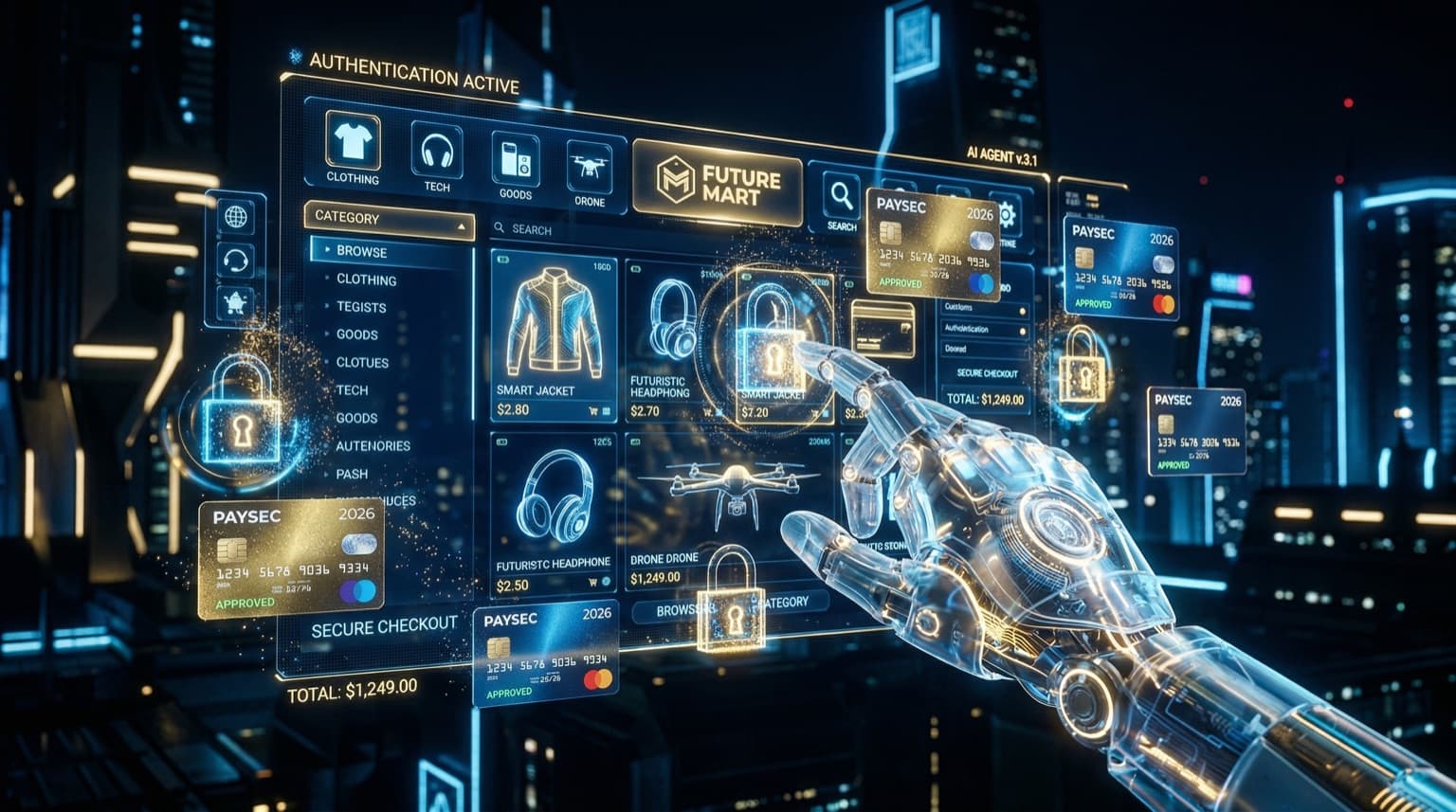
ARK Invest's Big Ideas 2026 report dropped a number that's now driving a lot of agent pilot conversations: AI agents will facilitate over $8 trillion in global online consumer spending by 2030, growing from roughly 2% of online sales today to 25%. The report frames it alongside AI infrastructure investment tripling to $1.4 trillion and agents reshaping how software is sold and used.
The forecast is plausible. The coverage around it mostly isn't.
The Number That's Defining Pilot Roadmaps
The $8T figure is getting cited in board decks, vendor pitches, and startup fundraising memos as justification for building agentic commerce capabilities now. The logic runs: if agents are going to handle 25% of online spend in four years, any operator not building agent-friendly infrastructure today is already behind.
That logic isn't wrong. Walmart and Google formalized it in January 2026 with a direct Gemini integration into Walmart and Sam's Club shopping experiences via something called the Universal Commerce Protocol — allowing agents to shop within Google's AI interface as a first-class workflow, not a browser hack. That's a real signal that the timeline is compressing.
But the path from today's browser agent to a production system handling $8 trillion in authorized purchases involves a layer that almost no coverage has touched: the authentication and payment mandate problem.
What Agent Commerce Actually Requires
McKinsey's analysis of "Level 3" agentic commerce — the tier where agents act fully on a customer's behalf — identifies three non-negotiable requirements: purchasing authorization limited by budget, time window, merchant, or category; auditable activity logs showing what was bought and why; and reversible actions with easy cancellations when the agent makes a mistake.
None of those are model problems. GPT-5.4 at 75% on OSWorld can navigate a browser and fill a form. That's not the bottleneck. The bottleneck is whether a retailer's checkout flow accepts a cryptographically signed agent mandate instead of a human session cookie, and whether your org has a governance layer deciding which agents can spend up to $500 on SaaS renewals without a human approval step.
Browser-Use, one of the leading browser automation frameworks, published a benchmark in January 2026 covering 120 tasks drawn from WebBench, Mind2Web, GAIA, and BrowseComp. The benchmark explicitly excludes two task categories: those requiring authentication, and those that make real changes to websites (purchases, form submissions, account modifications). The stated reason: "there has yet to be an economical solution for running these at scale."
That exclusion is not a benchmark limitation. It's a description of the current state of production-grade agent commerce. The tasks that drive $8 trillion in spend are exactly the tasks no benchmark is measuring.
Three Protocols Quietly Closing the Gap
The infrastructure response has been moving fast, mostly under the radar of the coverage that picked up the ARK number.
MCP (Model Context Protocol) gives agents and tools a standardized way to share persistent context across sessions — solving the problem where an agent successfully logs into a vendor portal in session one, and has no memory of it in session two. Without persistent authenticated context, every agent commerce workflow restarts from scratch, which is why the WhatsApp-web-check task that developer @Yampeleg described (and confirmed almost always fails in March 2026) keeps breaking: the agent loses session state.
A2A (Agent-to-Agent Protocol) lets agents across platforms coordinate tasks — relevant when a procurement workflow spans a travel booking agent, a budget approval agent, and a vendor portal agent that all need to hand off context without losing authorization state.
AP2 (Agent Payment Protocol) is the one that directly addresses commerce. It gives agents a verifiable, standardized way to pay on behalf of users through cryptographically signed mandates — scoped by amount, merchant category, and time window. It's the technical answer to McKinsey's "limited purchasing authorization" requirement. It is not yet widely deployed.
For Raj — an operations lead at a 25-person professional services firm evaluating whether to build an agent-driven procurement workflow for SaaS renewals — the practical read is this: AP2 is production-grade at zero of his current vendors. MCP is production-grade at a handful of them. The infrastructure is real and moving, but it's not in place at the mid-market vendor stack he actually buys from.
The Gap Between Benchmark Performance and Production Spend
Developer @thekitze put it plainly in March 2026: "it's march 2026, every fkn agent sucks at using a browser, despite the benchmark claims." @Yampeleg confirmed from a more specific case: basic authenticated tasks on real consumer apps fail consistently.
These are developers building with today's best models, against the best browser automation frameworks, on production infrastructure. The benchmark scores don't lie — GPT-5.4 genuinely is at 75% on computer-use tasks. But OSWorld measures app navigation in sandboxed environments. It doesn't measure what happens when your procurement agent hits a vendor portal requiring 2FA, a CAPTCHA, and a session token that expires in 20 minutes.
The gap isn't model capability. It's infrastructure maturity.
ARK's $8 trillion is achievable — but it arrives as MCP, A2A, and AP2 reach critical vendor mass, not as models improve their OSWorld scores. For an ops lead evaluating agent pilots today, the right scope is workflows that don't require authenticated external sessions: internal document processing, internal data lookup, structured extraction from content already inside your stack. The purchasing automation playbook becomes worth building in earnest when your top five SaaS vendors have MCP-native endpoints and AP2 support. Check that list in Q4 2026, not Q1.
AI Pilot Readiness Checklist
Turn the idea into a pilot you can defend.
AI agent articles are easy to bookmark and hard to operationalize. Use the readiness questions as a shared way to decide whether a workflow is specific enough, safe enough, and measurable enough to pilot. If they surface a strong candidate, BaristaLabs can review it with you and help shape a first version that fits your systems, approval process, and risk tolerance.
Please do not submit PHI, customer records, credentials, or confidential workflow exports.
Practical AI Workflow Notes
Want more practical AI operations ideas?
Get short notes on applying AI inside real small-business workflows — from document handling and customer follow-up to internal reporting, compliance, and automation guardrails.