

A grocery assistant can help someone assemble dinner. An internal merchant tool can help someone decide which products to promote. Both produce recommendations, but they are not doing the same job—and a convincing answer is not enough to establish that either one works.
In its October 1 partnership update, OpenAI says Albertsons Companies is expanding its use of ChatGPT Enterprise and custom OpenAI-powered applications. The most useful detail for a smaller retailer is behind the shopping experience: Albertsons is combining predictive models with generative AI to produce explainable, data-driven recommendations and promotional insights for merchants.
That is a decision-support story, not just another place to put a chat box. It raises a practical question: what evidence would let a merchant trust a recommendation enough to change a promotion?
What is new, and what was already available
The October update describes an expanded partnership and work across selected internal teams. OpenAI says focused deployments can help Albertsons evaluate useful practices before broader adoption. It does not establish that every employee or every business function has the same tools.
The Safeway shopping experience is part of that story, but it was not launched on October 1. Albertsons announced its ChatGPT plugin on August 5. Shoppers can ask for products using a recipe, photo, list, or ordinary language, review and modify the cart, and then go to Safeway to check out. This is not a claim that payment takes place inside ChatGPT.
It also builds on the shopping assistant Albertsons announced in December 2025. The October announcement should therefore be read as a broader account of how shopper assistance and internal work connect, not as the first appearance of AI in its grocery business.
A useful explanation is not a tested promotion
OpenAI describes the merchant recommendations as explainable and data-driven. It does not publish the predictive models, the input fields, a merchant evaluation protocol, or measured promotion results in this announcement. There is no basis here for attributing a specific sales lift, margin improvement, or forecast-accuracy gain to the system.
The distinction between predictive and generative work is still worth noticing. A predictive model may estimate an outcome. A generative model may help explain a proposed choice in language a merchant can use. That is a possible design pattern, not a disclosed architecture for Albertsons’ implementation.
A fluent explanation can make a forecast easier to discuss without making the forecast more accurate. If the underlying records are stale, incomplete, or poorly matched to the decision, the explanation can make the wrong recommendation sound reasonable.
For a smaller retailer, the lesson is not to reproduce a national chain’s deployment. It is to name the decision before choosing the assistant.
Two recommendations, two kinds of evidence
Customer basket assistance should be evaluated against the shopper’s request: did the suggested products fit the stated meal, quantities, preferences, and constraints? Could the shopper correct the cart? Did the handoff preserve what they intended to buy? Product availability and substitutions can change whether an otherwise plausible suggestion is useful.
A merchant recommendation has a different test. It must fit the business decision and the information available at the time. A promotion suggestion that ignores stock, supplier terms, existing commitments, or margin can be easy to explain and expensive to follow.
Scroll sideways to see all 3 columns.
| Question | Shopper assistance | Merchant decision support |
|---|---|---|
| Who decides? | The shopper reviews the basket and purchase. | A named merchant reviews the business recommendation. |
| What should be checked? | Fit to the request, quantities, available products, and corrections. | Input freshness, business constraints, baseline comparison, and reasons to reject the recommendation. |
| What counts as evidence? | Reviewed task outcomes and a correct cart handoff. | Recorded recommendations, review decisions, and subsequent outcomes compared with a defined baseline. |
| What remains unproven in the announcement? | Measured improvement in completed shopping tasks. | Measured improvement in promotion or merchandising results. |
These are BaristaLabs’ suggested evaluation questions, not controls that Albertsons has disclosed. Our earlier commerce-agent pilot article discusses limiting what an agent can do. Here, the separate issue is whether a recommendation deserves to influence a merchant’s decision at all.
Start with one recurring merchant decision
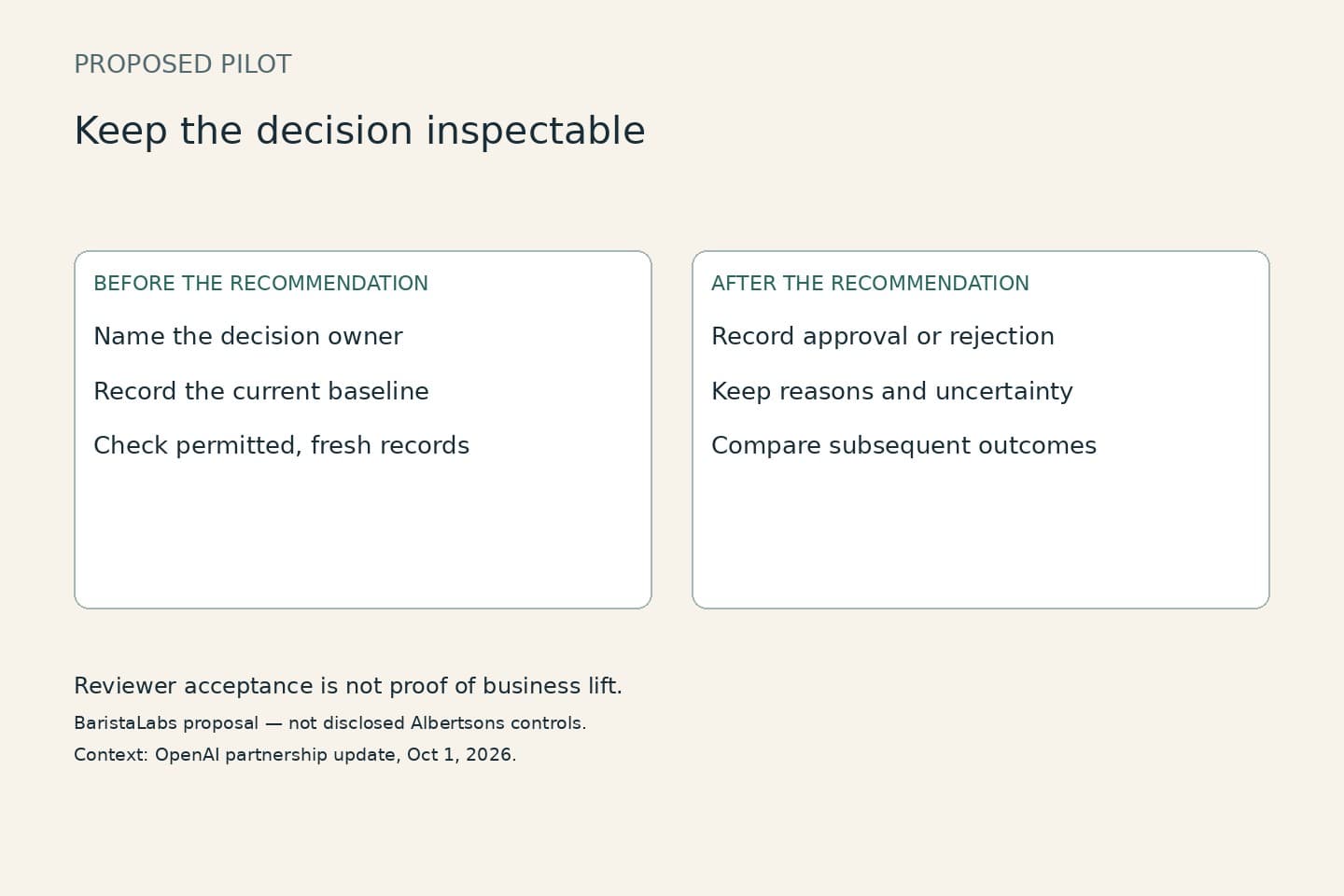
A manageable pilot could ask an assistant to prepare suggestions for one weekly promotion meeting. Keep the existing planning process in place while the team evaluates the suggestions alongside it. Do not begin by giving the assistant authority to publish prices or change live promotions.
Before running that pilot, write down:
- The decision and owner. Which promotion question is being considered, and who can approve or reject the recommendation?
- The baseline. What would the team recommend using its current process, and what evidence supports that choice?
- The permitted records. Which inventory, pricing, and performance records are relevant, current, and authorized for this use? Keep customer data out unless the workflow actually needs it and its use has been reviewed.
- The review criteria. What makes a suggestion unusable—for example, unavailable stock, a conflicting promotion, missing margin information, or an unsupported reason?
- The outcome record. Save the suggestion, the records it relied on, the reviewer’s decision, and the eventual outcome. Record uncertainty rather than filling gaps with an attractive explanation.
Measure review effort as well as recommendation quality. A tool that generates more suggestions but takes merchants longer to verify may not improve the workflow. A suggestion accepted by a reviewer is also not proof of improved business performance; the later result needs its own comparison.
If the pilot proceeds to live promotions, use a design that can separate the recommendation’s effect from other changes. Seasonality, stock availability, pricing, and competing promotions can all complicate a before-and-after comparison. Where a clean comparison is not possible, describe the limits rather than report a causal improvement.
Keep the claim as narrow as the evidence
The Albertsons update shows that customer-facing assistance and internal decision support can sit within the same AI partnership. It does not show that their success can be measured with one adoption number or one enthusiastic explanation.
A smaller business can take the more useful lesson: choose a recurring decision, keep its owner visible, and compare the assistant’s work with the current process. Give the explanation a job—to make the recommendation inspectable—not the authority to certify its own result.
If you need help selecting that first workflow, explore process automation and integration or request a workflow review. Start with the decision your team already makes, not the number of AI features a larger company has announced.
Retail decision support
Choose one recommendation worth testing
BaristaLabs can help define a baseline, identify the records a recommendation needs, and design a review process before connecting it to live promotions.
Bring a workflow description and a sanitized example. Do not send customer records, credentials, or supplier-confidential pricing through the contact form.
Turn this idea into a pilot
Which workflow should go first?
Use the readiness check to compare impact, effort, risk, owner, and next step before requesting a review.
- 3-5 minutes
- Deterministic score
- No sensitive data
Practical AI Workflow Notes
Want more practical AI operations ideas?
Get short notes on applying AI inside real small-business workflows — from document handling and customer follow-up to internal reporting, compliance, and automation guardrails.