Adobe Just Confirmed What SMB Marketers Are Already Doing: Swapping Stock Photos for AI Images
Adobe says its traditional stock business is declining faster than expected while Firefly keeps growing. For SMBs, that is a strong sign AI-generated images have become a real budget-saving option.

Sean McLellan
Lead Architect & Founder
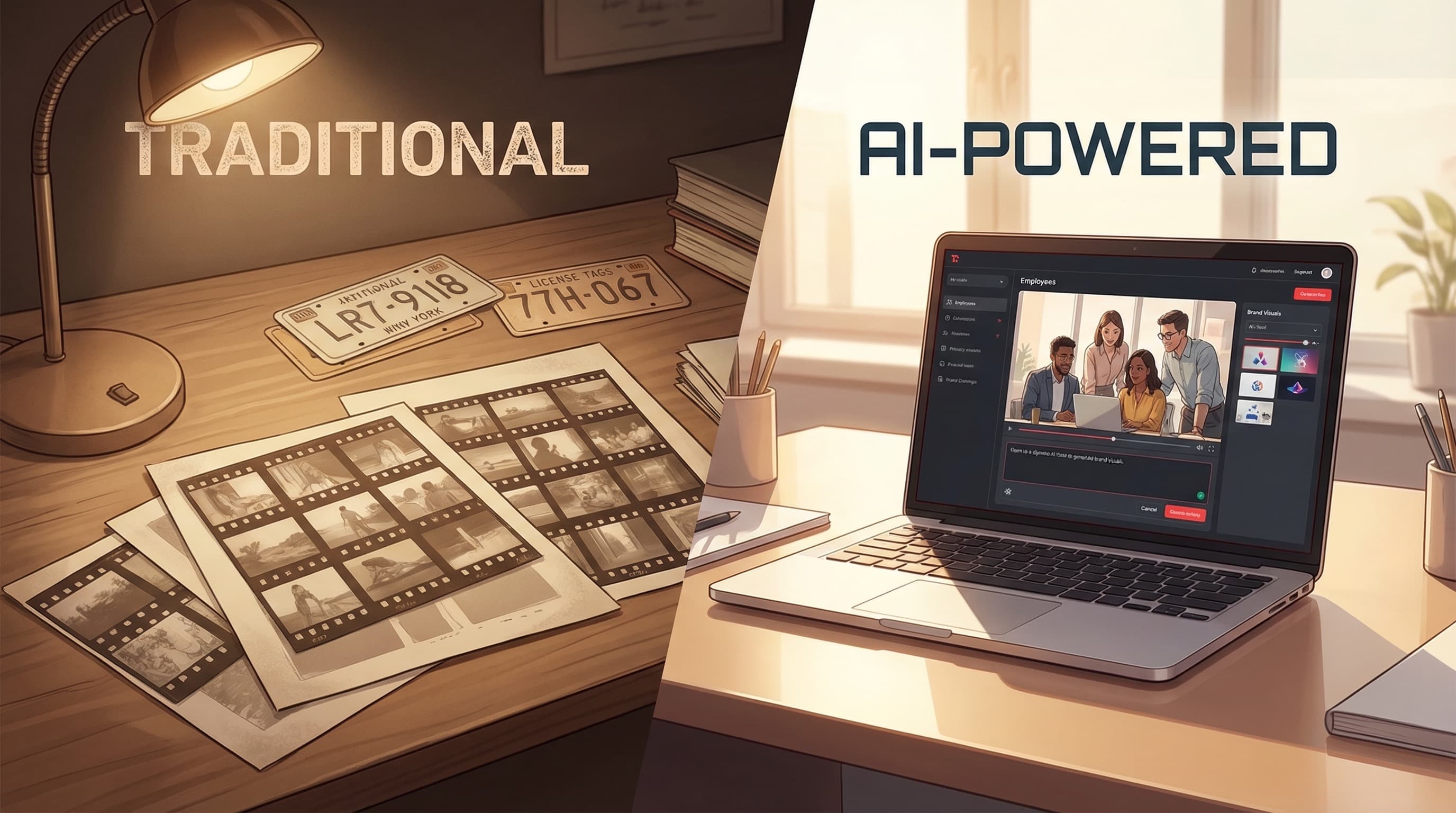
Adobe just said the quiet part out loud.
In its Q1 FY2026 earnings materials, the company said its traditional Stock business declined more sharply than expected. On page 11 of Adobe's earnings script and slides, management said, "our traditional Stock business saw a steeper decline than we expected." On page 20, CFO Dan Durn put it even more plainly: Adobe saw a "greater-than-anticipated decline in our traditional, standalone Stock book of business."
That matters because Adobe is not some random observer. It owns one of the biggest stock image businesses on the planet. If Adobe is saying demand is falling faster than expected while its AI image business is climbing, the market has already moved.
For small and midsize businesses, this is less of a media story and more of a budgeting story.
What Adobe's numbers are really saying
The same earnings materials show the other side of the shift.
Adobe said Firefly credit consumption grew more than 45% quarter over quarter. Firefly subscription and credit pack ending ARR grew 75% quarter over quarter. Firefly ending ARR also exceeded $250 million. Adobe also said Firefly Enterprise new customer acquisition grew 50% year over year.
Put those numbers next to the Stock comments and the picture is pretty clear: buyers still need images, but more of them are choosing generated images instead of licensing traditional stock photography.
That does not mean stock photography disappears tomorrow. It does mean the old default is breaking.
For years, the standard playbook looked like this: pay for a stock subscription, search forever, settle for "close enough," then crop it into six different formats.
Now a marketer can type a prompt, generate five on-brand options in minutes, tweak the background, change aspect ratios, and move on.
That is why this matters for SMBs. You do not need abstract AI hype to justify the change. The workflow is just cheaper and faster.
Why stock subscriptions are getting harder to defend
Stock libraries still have real value. They are useful when you need editorial-style imagery, specific locations, or rights-cleared assets for certain use cases.
But for a lot of everyday marketing work, they are starting to look expensive.
Think about the images most small businesses actually need every week:
- blog headers
- social graphics
- website section backgrounds
- campaign variations
- product mockups
- seasonal promo visuals
- ad creative tests
A stock subscription gives you access to a huge library, but not necessarily the exact image you want. AI generation flips that. Instead of hunting through a database, you create something closer to the brief from the start.
That is a big deal when your team is small and every hour counts.
If you are running marketing for a local service business, a B2B firm, an ecommerce brand, or a small agency, the real cost is not just the subscription fee. It is the time spent searching, compromising, editing, and reusing the same safe-looking visuals everyone else found too.
AI images are not perfect, but they are now good enough for a huge slice of routine content.
What SMBs should do next
Do not cancel every stock tool tonight. That would be sloppy.
Instead, split your image needs into two buckets.
Keep stock photography for:
- highly specific real-world scenes,
- editorial or documentary use,
- cases where authenticity matters more than polish,
- and campaigns where licensing certainty is non-negotiable.
Use AI generation for:
- blog art,
- landing page visuals,
- social posts,
- ad concept testing,
- product or service illustrations,
- and fast-turn campaign variations.
Then run a simple 30-day test.
Track how long your team spends finding or making images, how much you spend on subscriptions or one-off licenses, and whether the final creative feels more on-brand. Most SMBs will probably find that AI handles a much bigger share of the workload than expected.
That is the practical takeaway from Adobe's report. The company is not waving a giant flag that says "stock is dead." It is doing something more useful: admitting, in investor language, that the shift is already underway.
When the owner of a major stock image business says the decline is happening faster than expected, you should listen.
The bigger budget implication
This shift gives smaller companies a chance to reallocate money instead of just cutting it.
If AI image generation reduces your reliance on stock subscriptions, that budget can move into better copy, faster testing, more landing pages, stronger email creative, or paid distribution. In other words, you can spend less on image sourcing and more on results.
That is the real opportunity here.
AI images are no longer just a novelty or a side experiment for marketers. Adobe's own earnings materials suggest they are becoming part of the default content stack.
For SMBs, the smart move is not to debate whether this trend is real. Adobe already answered that.
The smart move is to build a workflow that uses stock where it still makes sense, uses AI where it is faster and cheaper, and treats visual production like an operational advantage instead of a recurring bottleneck.
If your team wants help building a practical AI content workflow without blowing up brand quality, contact us.
Back-Office Automation ROI Worksheet
Choose the first automation with evidence, not vibes.
AI tools can make almost any workflow look automatable. The ROI worksheet helps you pick the one most likely to pay back quickly. If one workflow rises to the top, BaristaLabs can help decide whether a lightweight tool, integration, or custom pilot is the best next step.
Use broad workflow categories in the form; save specifics for a scoped conversation.
Turn this idea into a pilot
Which workflow should go first?
Use the readiness check to compare impact, effort, risk, owner, and next step before requesting a review.
- 3-5 minutes
- Deterministic score
- No sensitive data
Practical AI Workflow Notes
Want more practical AI operations ideas?
Get short notes on applying AI inside real small-business workflows — from document handling and customer follow-up to internal reporting, compliance, and automation guardrails.
Related Posts