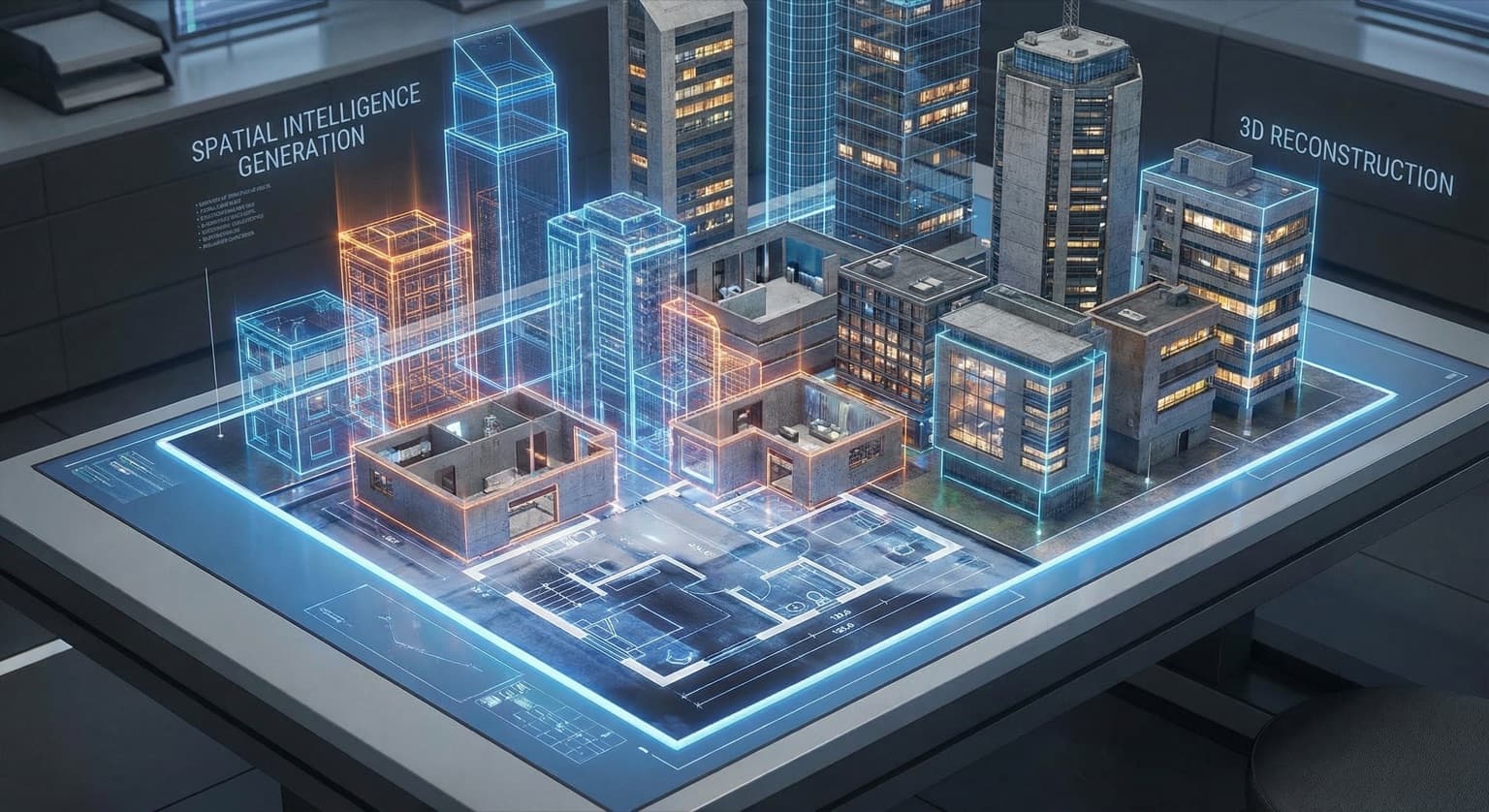

Most AI today understands words. It reads documents, generates text, writes code, and analyzes images -- all in flat, two-dimensional space. World Labs, the startup founded by Stanford AI pioneer Fei-Fei Li, just raised $1 billion to build AI that understands three-dimensional space. The round was backed by NVIDIA, AMD, Autodesk, Fidelity, Emerson Collective, and Sea, with Autodesk committing $200 million and signing on as a research advisor.
That investor list is not random. It is a roadmap. The companies that make chips for 3D rendering, the company that makes the software designers and architects use every day, and the financial firms willing to bet at a rumored $5 billion valuation -- they all see the same thing: the next wave of AI is not about generating better paragraphs. It is about generating and reasoning about the physical world.
What Spatial Intelligence Actually Is
Today's large language models are trained on text and images. They can describe a room, but they cannot reason about the geometry of the objects in it, the physics of how those objects interact, or the dynamics of how a person would move through the space.
Spatial intelligence changes that. World Labs' foundational models can perceive, generate, and interact with 3D environments. Their first commercial product, Marble, released last November, lets users create editable, downloadable 3D environments from text prompts, images, or video. These are not static renderings -- they are interactive 3D scenes that understand physical constraints.
As Li put it: "If AI is to be truly useful, it must understand worlds, not just words. Worlds are governed by geometry, physics, and dynamics, and reconciling the semantic, spatial, and physical is the next great frontier of AI."
That statement sounds academic, but the commercial implications are immediate and concrete.
Why Autodesk Wrote a $200 Million Check
Autodesk makes the software that architects, engineers, filmmakers, and product designers use to create things in the physical world. AutoCAD, Revit, Maya, Fusion -- these are tools that have defined 3D design workflows for decades. Autodesk investing $200 million in World Labs and serving as a research advisor is not a speculative bet. It is a statement about where their core product is heading.
Daron Green, Autodesk's chief scientist, told TechCrunch the collaboration could work in multiple directions. A designer might start with a World Labs prompt to generate an office layout, then drill into specific elements like furniture design in Autodesk's tools. Or they might take an object designed in Autodesk and drop it into a World Labs-generated environment to see how it looks and functions in context.
Autodesk is also developing what they call "neural CAD" -- generative AI models trained on geometric data that can generate working 3D models with an understanding of real-world physics. Combined with World Labs' spatial intelligence, the path toward AI-assisted design of entire physical spaces becomes visible. Not just a rendering of a building, but a model that understands how people flow through it, how light interacts with surfaces, and how structural loads distribute.
The Competitive Landscape: Who Else Is Building World Models
World Labs is not alone in this space. Google DeepMind's Genie family of models can generate and simulate 3D environments. Runway released its first world model in December, alongside raising $315 million at a $5.3 billion valuation. And Yann LeCun, Meta's former chief AI scientist, left to launch AMI Labs with a reported $35 billion valuation target, focused on advanced machine intelligence through world models.
The concentration of talent and capital in world models is no accident. The AI industry has recognized that understanding the physical world is the next capability frontier after language and vision. This matters because it unlocks applications that current AI simply cannot handle -- robotics, autonomous navigation, architectural simulation, surgical planning, and interactive entertainment.
What This Means for Businesses
If your business involves physical spaces, products, or design, spatial AI is going to reshape your workflows sooner than you might expect. Here is how to think about it:
Architecture and construction. Imagine generating a preliminary building design from a text description, walking through it virtually, and having the AI flag structural concerns before you ever open AutoCAD. The Autodesk partnership makes this trajectory explicit.
Retail and e-commerce. Product visualization is already moving to 3D. Spatial AI could generate interactive showrooms from product catalogs, letting customers explore items in realistic settings. Marble worlds are already compatible with Vision Pro and Quest 3 headsets.
Manufacturing and product design. Generating 3D prototypes from specifications, simulating how components interact, and iterating on designs without physical models. This compresses product development cycles from months to days.
Media and entertainment. This is where World Labs and Autodesk plan to start their collaboration. AI-generated 3D environments for film, games, and VR could dramatically reduce production costs. The gaming industry, as World Labs notes, is "starved for content" -- and world models can produce it at scale.
Real estate. Virtual staging is primitive today. Spatial AI could generate fully interactive, physically accurate walk-throughs of properties from floor plans and a few photos.
The Practical Takeaway
World Labs' $1 billion round is a signal that the AI industry is moving beyond text and images into the physical world. For businesses that have been watching AI infrastructure investments pile up and wondering when the capabilities would catch up, this is one answer.
The technology is not ready for production integration today -- Marble is a first-generation product, and the Autodesk partnership is explicitly described as early-stage. But the direction is clear. Businesses that work with physical spaces and products should start asking: what would it mean for our workflow if we could generate, edit, and reason about 3D environments as easily as we generate text today?
If 2025 was the year AI learned to reason and write code, 2026 is shaping up to be the year AI learns to see and understand the physical world. The $1 billion bet from some of the smartest investors in AI says the odds are good.
Working with physical products, spaces, or designs? BaristaLabs helps businesses identify where AI tools like spatial intelligence and 3D generation fit into real workflows -- without the hype. Let us talk about what is actually practical for your business today.
AI Pilot Readiness Checklist
Turn the idea into a pilot you can defend.
AI agent articles are easy to bookmark and hard to operationalize. Use the readiness questions as a shared way to decide whether a workflow is specific enough, safe enough, and measurable enough to pilot. If they surface a strong candidate, BaristaLabs can review it with you and help shape a first version that fits your systems, approval process, and risk tolerance.
Please do not submit PHI, customer records, credentials, or confidential workflow exports.
Practical AI Workflow Notes
Want more practical AI operations ideas?
Get short notes on applying AI inside real small-business workflows — from document handling and customer follow-up to internal reporting, compliance, and automation guardrails.