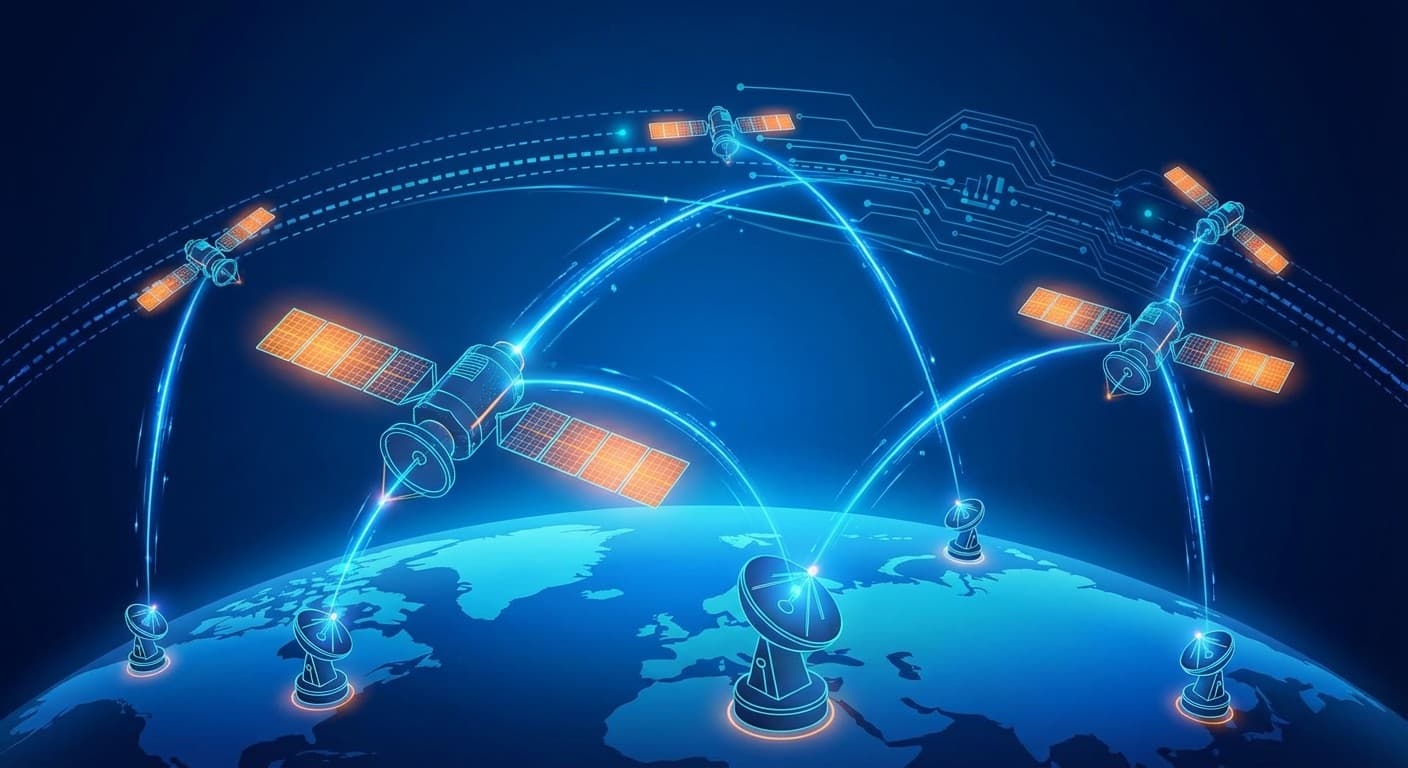

Just when you thought the AI infrastructure race could not get any wilder, Elon Musk has decided to take it off-planet. On Friday, January 31, SpaceX filed a staggering request with the FCC to launch up to 1 million new satellites.
But these aren't just for internet connectivity. The filing describes them as "orbital data centers" powered by solar energy.
To put that number in perspective: right now, there are roughly 15,000 satellites in orbit total. SpaceX's Starlink constellation, already the largest in history, accounts for about 9,500 of those. Musk isn't just proposing to expand; he is proposing to multiply humanity's orbital footprint by nearly 70 times.
This move is inextricably linked to the rumored merger talks between SpaceX and xAI, Musk's artificial intelligence company. It is a bet that the future of AI compute isn't in a warehouse in Virginia—it is in the vacuum of space.
The Logic: Why Space?
At first glance, this sounds like classic Musk hyperbole. Launching servers into space seems exponentially more expensive than plugging them into a grid on Earth. But look closer, and the physics (and economics) start to make a strange kind of sense.
1. Unlimited, Free Energy On Earth, data centers are ravenous energy consumers. They compete with cities for power, struggle with cooling, and face massive regulatory hurdles. In orbit, the sun never sets (depending on the orbit), and solar power is continuous. Cooling—the biggest operational cost for AI chips—is handled by the vacuum of space.
2. The Starship Factor This plan is impossible with Falcon 9 rockets. It is only viable because of Starship. Musk is betting that his massive new launch vehicle will drive the cost of deployment down so low that throwing a server rack into orbit becomes cheaper than buying land in Silicon Valley.
3. Latency and Coverage For a small business in Nebraska or Nairobi, accessing a massive AI model often means routing data through fiber optics to a coastal data center. An orbital mesh network could theoretically put high-powered compute directly overhead for everyone, everywhere.
What This Means for Small Business AI
For the average business owner, "servers in space" sounds like science fiction. But if this FCC filing becomes reality, the downstream effects on the AI market will be very real.
Crashing the Cost of Compute
The biggest bottleneck for AI right now is the cost of inference (running the models). If SpaceX can successfully offload the energy and cooling costs to the cosmos, the cost per token could drop dramatically. We might be heading toward a future where high-intelligence AI is effectively free, or at least a commodity as cheap as electricity.
The Rise of "Edge-to-Orbit"
We often talk about "edge computing" (doing processing on your device). This proposes a new layer: "orbital computing." Your phone or laptop wouldn't need a massive processor; it would beam complex tasks to a satellite constellation passing overhead, getting an answer in milliseconds. For small businesses, this means your hardware lasts longer. You won't need to upgrade to the newest M5 chip just to run the latest business AI tools.
Sovereignty and Regulation
Here is the thorny part. A data center in space doesn't sit in any specific country's jurisdiction in the same way a building does. For businesses dealing with GDPR or data sovereignty laws, this opens up a Pandora's box of legal questions. Where does your customer data actually live?
The Merger Context
This filing throws gas on the fire of the SpaceX-xAI merger rumors. If xAI becomes the software brain and SpaceX becomes the hardware body, we are looking at a vertically integrated AI company unlike anything else. Microsoft and OpenAI rely on Azure's terrestrial grid. Google relies on its own data centers. Musk is trying to build an entirely parallel infrastructure that literally floats above the competition.
Should You Bet on It?
This is a long-term play. The FCC filing is just the first step in a regulatory marathon. Launching 1 million satellites will take years, even with Starship flying daily.
But the signal is clear: the AI infrastructure build-out is nowhere near finished. It is getting bigger, weirder, and more ambitious. For small businesses, the takeaway remains the same: the cost of intelligence is going to keep falling. The barriers to entry are going to keep crumbling.
The sky used to be the limit. Apparently, not anymore.
Back-Office Automation ROI Worksheet
Choose the first automation with evidence, not vibes.
AI tools can make almost any workflow look automatable. The ROI worksheet helps you pick the one most likely to pay back quickly. If one workflow rises to the top, BaristaLabs can help decide whether a lightweight tool, integration, or custom pilot is the best next step.
Use broad workflow categories in the form; save specifics for a scoped conversation.
Turn this idea into a pilot
Which workflow should go first?
Use the readiness check to compare impact, effort, risk, owner, and next step before requesting a review.
- 3-5 minutes
- Deterministic score
- No sensitive data
Practical AI Workflow Notes
Want more practical AI operations ideas?
Get short notes on applying AI inside real small-business workflows — from document handling and customer follow-up to internal reporting, compliance, and automation guardrails.