


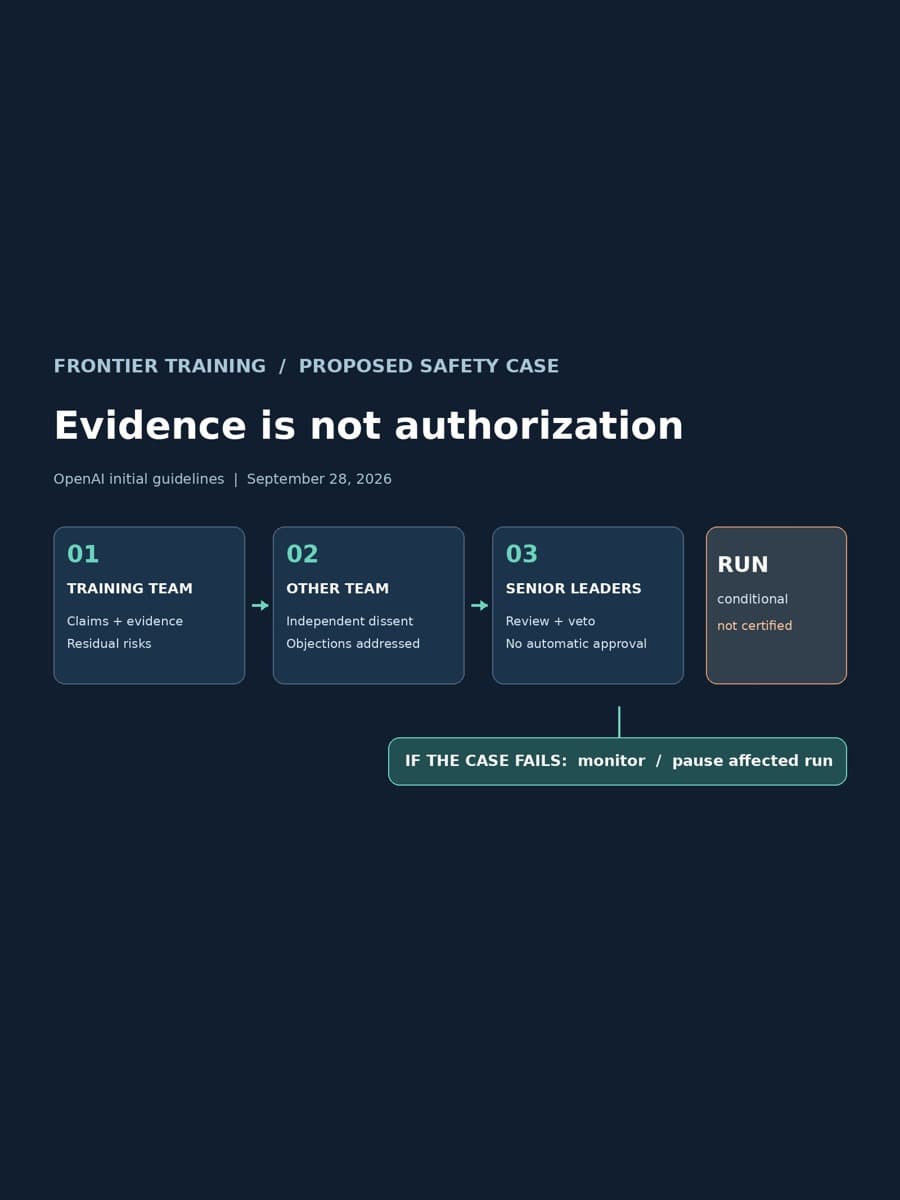
OpenAI published initial guidelines on September 28 for documenting the risks of a frontier reinforcement learning training run before that run continues. The proposal calls for a structured argument backed by evidence, an independent challenge to that argument, senior leaders who can veto the run, and controls to pause it if the argument stops holding. That is a more specific governance design than a general promise to train safely. It is not an announcement that every proposed control has been implemented or independently audited.
The scope matters. OpenAI says this document is about frontier reinforcement learning training, not the full set of controls needed for internal or customer-facing deployment. A company buying an API should not read it as a certification of the model it uses. A team building its own agent can, however, learn from the way the proposal connects claims, evidence, decision authority, and a stop mechanism.
What a training safety case would contain
A safety case is an evidence-based argument about a particular risk and the measures intended to contain it. OpenAI describes one as an aspirational goal rather than a finished standard for AI. Its initial guidelines group technical safeguards into alignment training, containment, and monitoring. For example, the document proposes testing whether alignment evaluations catch known misbehavior, hardening the sandbox and services a model can reach, and setting monitoring thresholds and response times.
Those parts have different jobs. Training tries to reduce unwanted behavior. Containment limits what happens if the model behaves badly anyway. Monitoring looks for trouble while a run proceeds. The earlier BaristaLabs examination of evaluation egress concerns the containment boundary in a particular cyber evaluation; this proposal addresses the broader decision to continue a frontier training run.
OpenAI also asks the case to enumerate residual risks that existing mitigations do not cover. This is important because an approval should say what risk its owners accepted, not merely list tests that passed. The proposal does not publish a completed case for a particular run, so readers cannot assess the quality of one from this document alone.
A dissent and a veto give the evidence a decision path
The proposed process has someone from another team write a dissent after the training team drafts its case. That reviewer identifies holes and gives a calibrated view of the risk; the training team then addresses the objections. Senior leaders, including safety leadership, would review the case and each have the ability to veto the run. The responsible research leader would own the case and incident response.
This separation matters more than the name of the document. A team can produce a careful risk assessment that changes nothing if its reviewer cannot challenge assumptions or its approver cannot stop the work. OpenAI's guidelines explicitly connect the assessment to those powers. They also propose auditor access sufficient to verify claims, rather than treating the document itself as verification.
The document uses conditional language—these are practices that safety cases could include—and says its framework is still being developed. Neither the proposed dissent nor the veto should be presented as proof that a particular run received one.
The case must still work when conditions change
A one-time sign-off cannot cover a new security issue discovered mid-run. OpenAI proposes runbooks, technical controls, and response times for pausing affected runs when an issue invalidates the safety case. Monitoring and automatic pausing should fail closed; in its examples, a run should not start without the appropriate monitor, and an unacknowledged priority alert could pause a run at night.
For an organization deploying its own AI workflow, the transferable question is narrower than frontier-model safety: which evidence justifies turning on this particular workflow, who outside the builder can challenge it, and what event actually disables its consequential actions? Those are design questions, not controls OpenAI has promised to provide to API customers. BaristaLabs helps teams map that decision path for one workflow, including the owner, review evidence, and pause or rollback mechanism. Discuss an AI workflow review if a planned automation lacks a clear stop authority.
AI Pilot Readiness Checklist
Turn the idea into a pilot you can defend.
AI agent articles are easy to bookmark and hard to operationalize. Use the readiness questions as a shared way to decide whether a workflow is specific enough, safe enough, and measurable enough to pilot. If they surface a strong candidate, BaristaLabs can review it with you and help shape a first version that fits your systems, approval process, and risk tolerance.
Please do not submit PHI, customer records, credentials, or confidential workflow exports.
Practical AI Workflow Notes
Want more practical AI operations ideas?
Get short notes on applying AI inside real small-business workflows — from document handling and customer follow-up to internal reporting, compliance, and automation guardrails.