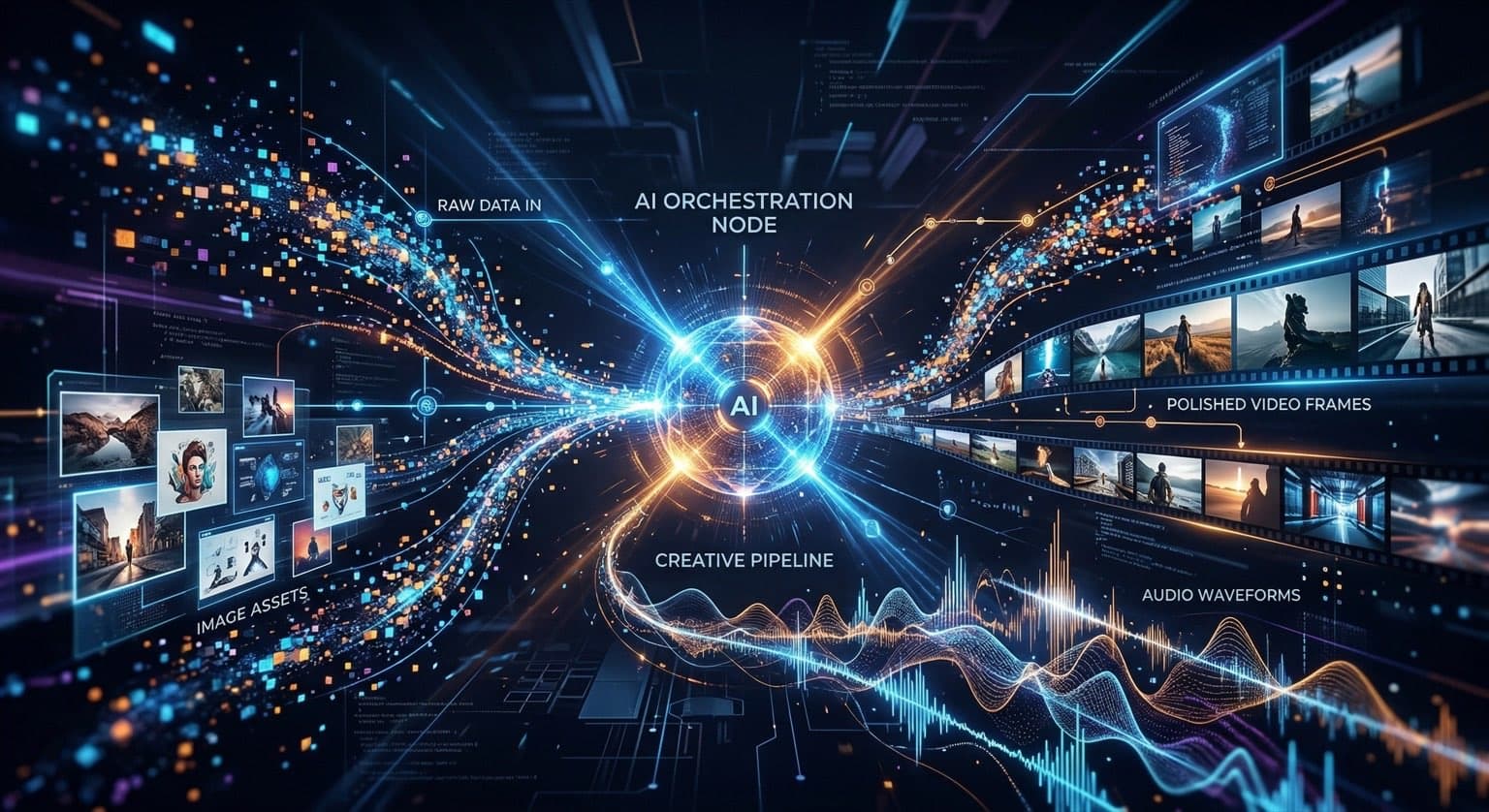

Luma launched Luma Agents today, and the coverage is already framing it as a creative-worker superpower — AI that helps designers and filmmakers move faster. That's technically true and mostly beside the point.
What Luma actually shipped is a production orchestration layer. For agency ops leads managing multi-vendor AI stacks, that's a fundamentally different conversation.
The Pipeline Nobody Talked About
The current state of AI in creative agencies isn't one tool — it's six. Image generation lives in one platform, video in another, voice in a third, copy in a fourth. Each vendor has its own prompt dialect, its own rate limits, its own model update cycle. Someone on your team is spending real hours context-switching between Midjourney, Runway, ElevenLabs, and whatever LLM the copywriter prefers this month.
Luma Agents is a bet that the multi-vendor chaos is the actual problem. The system coordinates across Luma's own Ray 3.14 model, Google's Veo 3 and Nano Banana Pro, ByteDance's Seedream for images, and ElevenLabs for voice — all from a single brief. You don't pick tools; you describe the deliverable.
That's not a creative assist. That's a production router.
What Unified Intelligence Actually Does
Under the hood, Luma Agents runs on Uni-1, the first model in Luma's new Unified Intelligence family. It's trained across audio, video, image, language, and spatial reasoning in a single architecture — not a router dispatching to specialized models, but one system that, per CEO Amit Jain, "thinks in language and imagines and renders in pixels."
The practical difference: Uni-1 can evaluate its own outputs and iterate without a human in the loop prompting each correction. Jain describes it as the same feedback loop that made coding agents useful — generate, check, revise, repeat — applied to creative assets.
Subsequent releases will extend Uni-1's output capabilities to audio and video natively, rather than relying on external model coordination. The current version handles text and image generation natively; video and audio route to partner models for now.
The Stack This Consolidates
Luma has already onboarded Publicis Groupe, Serviceplan, Adidas, and Mazda. That's not a list of early adopters experimenting with AI. Those are organizations with established multi-tool creative workflows and real production budgets.
For a 25-person agency currently paying for Midjourney Pro ($60/month), Runway Gen-4 ($95/month), ElevenLabs Creator (~$22/month), and a Claude or GPT API contract, the consolidation math is worth running. Luma hasn't published public pricing for the Agents tier yet, but the pitch is clear: one contract, one context window, one review cycle.
What you give up in flexibility — you're in Luma's model ecosystem for orchestration decisions — you may recover in throughput. An agent that maintains persistent context across a campaign, knowing that the Adidas brief calls for a specific visual language across 12 assets, doesn't lose that context between tool switches because there are no tool switches.
One Brief, Dozens of Variations — Without the Prompt Tax
The workflow demonstration Jain showed TechCrunch is the clearest proof of the ops case: a 200-word brief and a single product image generated a full set of creative variations. The user steers direction through conversation rather than re-prompting from scratch in each tool.
Filmmaker PJ Ace built a cinematic teaser for the Red Rising book series using Luma's stack in under a week — work he described as previously requiring a $200M+ greenlight. That's a production-scale claim, not a hobbyist one.
The honest caveat: orchestrated multi-model pipelines have failure modes that single-tool workflows don't. If Veo 3 is rate-limited or a partner model update changes output style, an entire campaign's asset set shifts without touching a single prompt. Agency ops leads should document which models are handling which asset types and build QA checkpoints into the workflow rather than treating the pipeline as a black box.
Luma Agents is the most credible attempt yet to collapse the creative AI stack from a vendor sprawl problem into a single orchestration contract. Whether the Uni-1 architecture holds up against dedicated models for each modality is a real question — for the agency ops lead who spent last quarter managing six vendor dashboards, the consolidation bet is at least worth a pilot.
AI Pilot Readiness Checklist
Turn the idea into a pilot you can defend.
AI agent articles are easy to bookmark and hard to operationalize. Use the readiness questions as a shared way to decide whether a workflow is specific enough, safe enough, and measurable enough to pilot. If they surface a strong candidate, BaristaLabs can review it with you and help shape a first version that fits your systems, approval process, and risk tolerance.
Please do not submit PHI, customer records, credentials, or confidential workflow exports.
Practical AI Workflow Notes
Want more practical AI operations ideas?
Get short notes on applying AI inside real small-business workflows — from document handling and customer follow-up to internal reporting, compliance, and automation guardrails.