
Something extraordinary happened on Wall Street today, and it has direct implications for every small business still running legacy software.
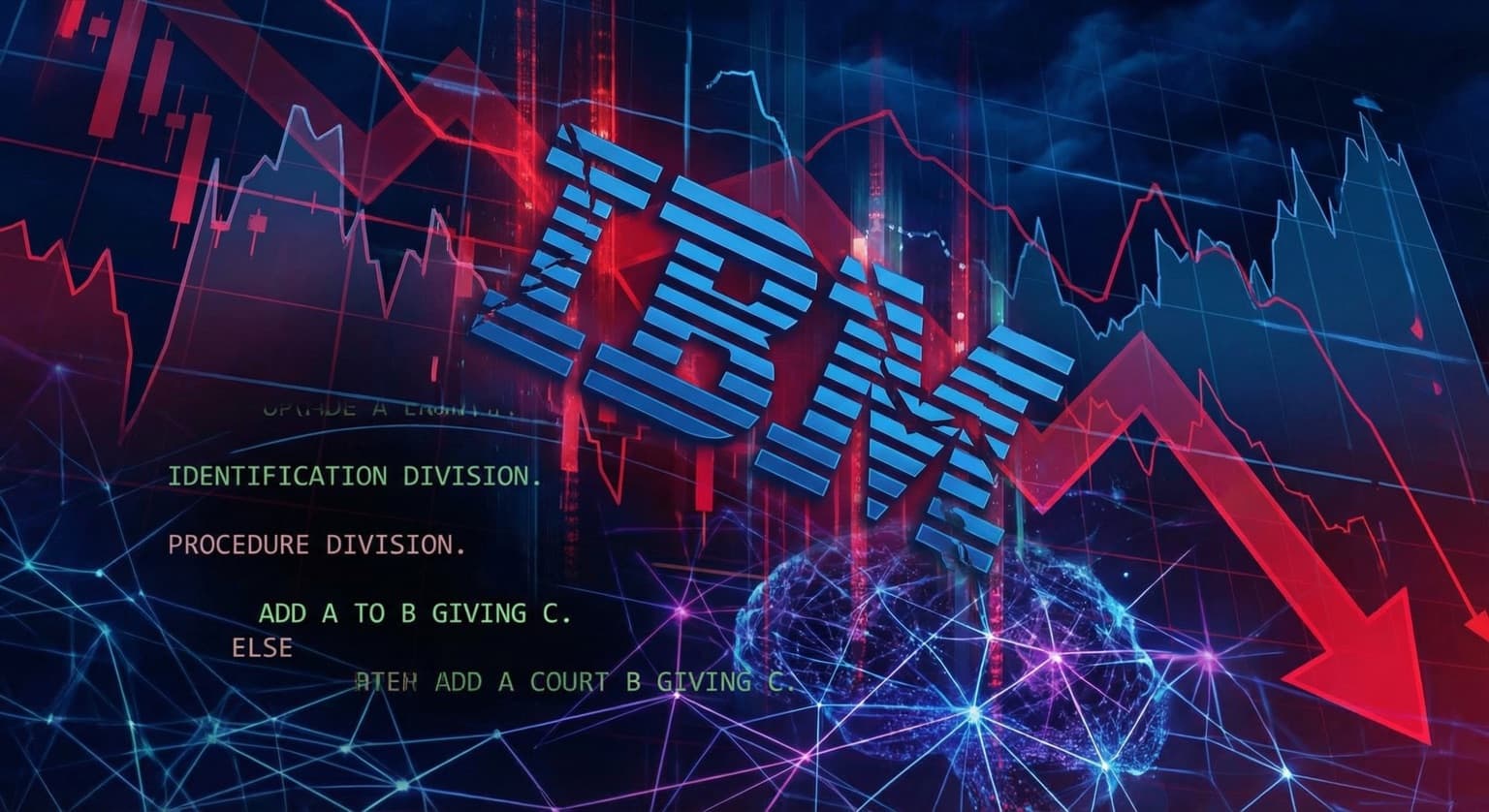
IBM stock plunged 10 to 12 percent in a single trading session, erasing approximately $24.3 billion in market capitalization in just four hours. The catalyst was not an earnings miss, not a product failure, not a scandal. It was a single announcement from Anthropic: Claude Code can now automate COBOL modernization.
The iShares Expanded Tech-Software Sector ETF hit its largest quarterly decline since 2008. Cybersecurity stocks tanked alongside it. The market read the signal loud and clear — AI just came for the legacy cash cows.
Why COBOL Matters More Than You Think
COBOL is not some ancient relic sitting in a museum. It still powers roughly 95 percent of US ATM transactions. It processes 3 billion daily transactions across banking, insurance, healthcare, and government systems. Every time you withdraw cash, pay a bill through your bank, or file an insurance claim, there is a good chance COBOL is working behind the scenes.
The problem has always been that modernizing COBOL is brutally expensive and painfully slow. There are fewer than 200,000 COBOL programmers left, most of them approaching retirement. The big consulting firms — IBM, Accenture, Cognizant — have built multi-billion dollar businesses around being the only ones who can touch these systems. A typical COBOL modernization project at a Fortune 500 company runs tens of millions of dollars and takes years.
That moat looked impenetrable. Until today.
What Anthropic Actually Announced
Anthropic demonstrated that Claude Code, their AI-powered development tool, can read, understand, and translate COBOL codebases into modern languages. Not toy examples. Real enterprise systems with decades of accumulated business logic, edge cases, and undocumented behaviors.
The financial market reaction tells you everything about what investors think this means. As one analyst quoted on Techmeme put it: "The real repricing may be in legacy cash cows."
If AI can automate what thousands of consultants charge hundreds of dollars per hour to do, the entire economics of legacy modernization fundamentally change. We are not talking about incremental improvement. We are talking about a potential order-of-magnitude reduction in cost and timeline.
What This Means for Small Businesses
Here is where this story stops being about Wall Street and starts being about you.
If you are a small or mid-sized business, chances are you have legacy systems of your own. Maybe not COBOL specifically, but aging software that nobody wants to touch. Custom-built applications from the early 2000s. Database systems held together with scripts and prayers. ERP platforms that stopped receiving updates five years ago.
Until now, modernizing those systems has been cost-prohibitive for most small businesses. The same consulting firms that charge Fortune 500 companies $50 million are not going to do your project for $50,000. So the old systems keep running, getting more fragile every year, while you work around their limitations.
Today's news changes that calculus in three specific ways.
1. Modernization Just Got Cheaper
When AI can handle the heavy lifting of reading legacy code and translating it to modern frameworks, the human expertise required drops dramatically. Projects that would have cost six or seven figures could become five-figure investments. For a small business looking at AI integration, this shifts modernization from "someday" to "this quarter."
2. The Talent Bottleneck Is Breaking
The biggest barrier to legacy modernization was never really money — it was people. Finding developers who understand both the old system and the new target platform was nearly impossible. AI tools like Claude Code do not replace developers entirely, but they multiply what a small team can accomplish. One competent developer with AI assistance can now potentially do what used to require a team of ten legacy specialists.
3. The Risk of Waiting Just Went Up
Here is the counterintuitive part. When modernization was equally expensive for everyone, there was no competitive disadvantage in waiting. Now, your competitors — including the bigger ones — are going to move faster. A business that modernizes its core systems this year using AI-assisted tools will operate at a fundamentally different speed and cost structure than one still running legacy software in 2027.
The Opportunity Window
We are in a rare moment where the tools exist but the market has not fully adjusted. The IBM crash is Wall Street repricing the old model, but the new model is still being built. That creates an opportunity for small businesses willing to move now.
Consider what modernization gets you beyond just replacing old code. Modern systems integrate with AI-powered workflows. They connect to modern APIs. They can be maintained by a much larger pool of developers. They scale without calling a consultant. They do not break because the one person who understood them retired.
The practical first step is not to panic or rush into a full rewrite. It is to audit your legacy systems and identify which ones are the most fragile, the most expensive to maintain, and the most critical to your operations. Those are your modernization candidates.
The Bigger Picture
What happened to IBM today is a preview of a pattern we are going to see repeatedly. AI is not just making new things possible. It is making old moats obsolete. The consulting business model built on "we are the only ones who can do this" does not survive when AI can do the same work.
For decades, legacy system maintenance has been a toll road. You paid because you had no alternative. Today, Anthropic punched a hole in the wall and showed there might be a free lane opening up.
The question for small business owners is not whether this transition is coming. The $24.3 billion market reaction makes that clear. The question is whether you will be ready when it arrives — or whether you will be the next legacy system waiting to be modernized.
If you want help evaluating your legacy systems and building a practical modernization roadmap, reach out to us. We specialize in helping small businesses navigate exactly this kind of technology shift.
AI Pilot Readiness Checklist
Turn the idea into a pilot you can defend.
AI agent articles are easy to bookmark and hard to operationalize. Use the readiness questions as a shared way to decide whether a workflow is specific enough, safe enough, and measurable enough to pilot. If they surface a strong candidate, BaristaLabs can review it with you and help shape a first version that fits your systems, approval process, and risk tolerance.
Please do not submit PHI, customer records, credentials, or confidential workflow exports.
Practical AI Workflow Notes
Want more practical AI operations ideas?
Get short notes on applying AI inside real small-business workflows — from document handling and customer follow-up to internal reporting, compliance, and automation guardrails.