

"Humans are the bottleneck."
You've heard it a hundred times this year. Every AI keynote, every LinkedIn thought leader, every VC podcast -- they all land on the same conclusion. AI moves at machine speed, and we're the slow ones holding it back.
They're not wrong. But they're only telling half the story.
The other bottleneck? It's the systems we built around human limitations. The ticketing queues. The approval workflows. The change advisory boards that meet every Thursday at 2 PM to decide whether a one-line CSS fix can go to production.
These systems aren't just slow because humans run them. They're slow by design. And that design assumption -- that skilled intervention is scarce and must be rationed -- is about to become irrelevant.
Every queue is a confession of scarcity
Think about why Jira exists. Not the surface answer ("project management") but the real reason. Jira exists because you have more work than people to do it. Every ticket in a backlog is a unit of demand waiting for a unit of supply. The entire system -- priorities, sprints, story points, velocity tracking -- is an elaborate framework for deciding who gets help and when.
ServiceNow works the same way. So does every IT helpdesk, every change management process, every approval chain. They're all answering the same question: Given that we can't fix everything right now, what should we fix first?
That question only matters when fixing things requires scarce human attention.
SLAs are scarcity contracts. "We'll respond within 4 hours" really means "we don't have enough people to respond faster." Priority matrices exist because someone has to triage. Escalation paths exist because the first person who looks at a problem often can't solve it -- so you need a bureaucratic ladder to route work upward to increasingly rare expertise.
We've spent decades optimizing these systems. Making the queues more efficient. Adding automation around the edges. But we never questioned the premise: Should the queue exist at all?
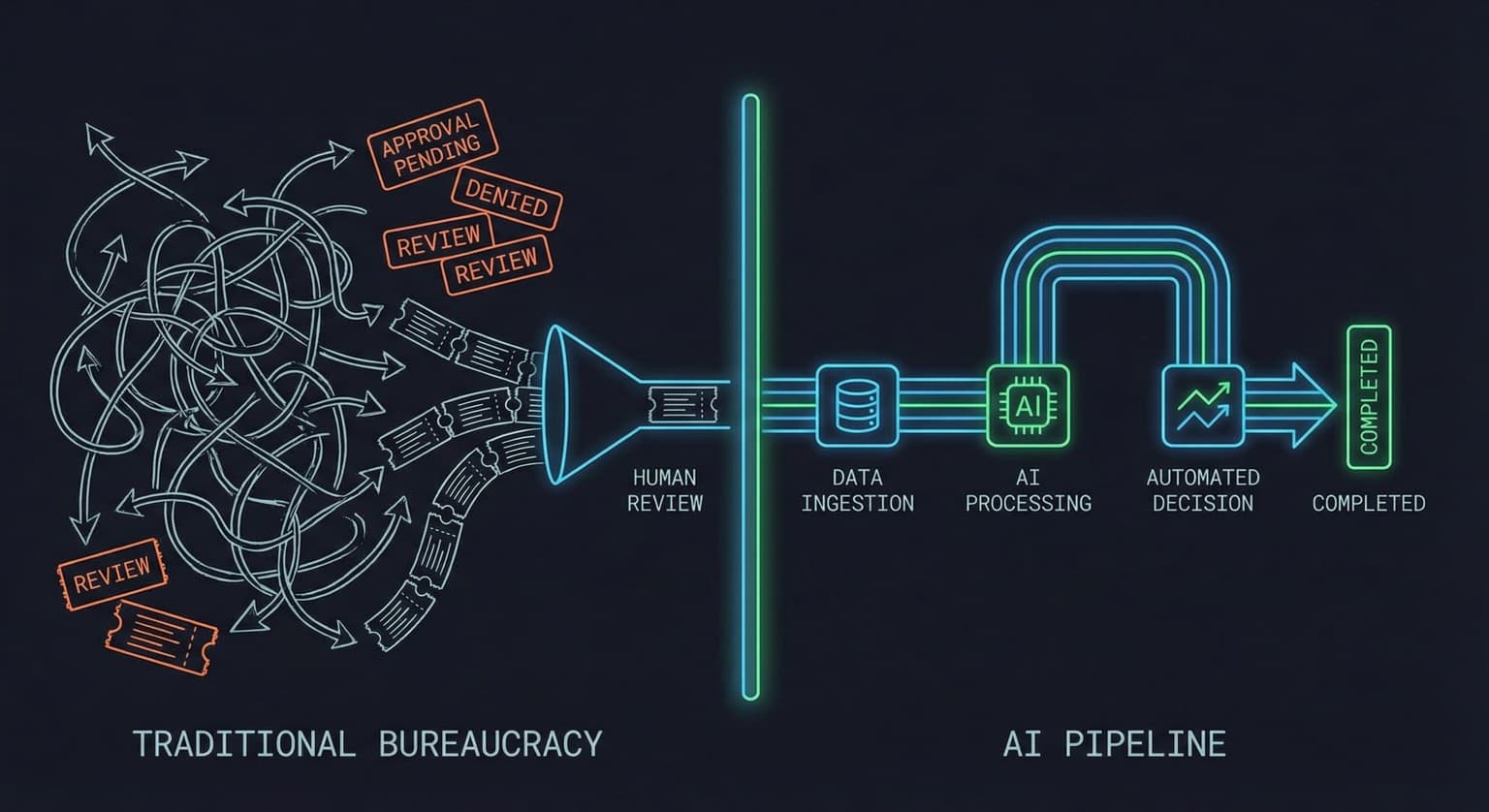
The process became the product
Here's what happened in most organizations. The process designed to manage scarcity calcified into something nobody questions anymore.
Change Advisory Boards (CABs) are my favorite example. A CAB started as a reasonable idea: before pushing changes to production, get a few experienced people to gut-check the risk. Makes sense when deployments are manual, risky, and hard to reverse.
But today? Companies with fully automated CI/CD pipelines, comprehensive test suites, and instant rollback capabilities still route every change through a weekly CAB meeting. The meeting itself has become the product. People prepare slide decks for it. They block their calendars. Someone takes minutes. The change that could deploy in seconds waits five business days for eight people to say "approved" in a conference room.
This isn't oversight. It's organizational habit masquerading as governance.
The same pattern plays out everywhere. Procurement workflows that take six weeks to approve a $200 software license. Security review boards that meet monthly while vulnerabilities sit unpatched. Budget approval chains where four signatures are needed for decisions that three of the four signers don't understand.
These processes were rational responses to real constraints. But the constraints have shifted, and the processes haven't. They've become the hidden cost that enterprise consultants rarely talk about, and it shows up not as a line item but as lost time and missed opportunities.
AI doesn't just speed up the queue -- it removes it
This is where the "humans are the bottleneck" narrative misses the point. The conversation usually goes: "AI will help humans work faster, so we can process more tickets." That's thinking inside the queue.
The real shift is that AI agents can be embedded at every integration point where problems occur. The queue disappears because the work gets done before it ever becomes a ticket.
Consider a production monitoring scenario. Today: an alert fires, a ticket gets created, it sits in a queue, someone triages it, someone diagnoses it, someone fixes it, someone tests the fix, someone deploys it, someone closes the ticket. Eight steps, multiple handoffs, hours or days of elapsed time.
With AI agents embedded in the system: the anomaly is detected, diagnosed, and a fix is proposed, tested, and deployed -- or at minimum, the entire diagnostic workup is complete before a human even needs to look at it. The ticket was never created because the problem was solved, or the human review is a 30-second approval rather than a 30-minute investigation.
This is already happening. Auto-fix pull requests are common in open-source projects. AI-driven monitoring systems diagnose root causes in seconds. Agentic engineering is displacing the old model where every change required a human to write, test, and ship code manually. Site-patrol bots catch broken links, accessibility issues, and performance regressions before anyone files a bug report.
We wrote about how AI agents are moving beyond task automation to full workflow orchestration -- and this is the natural conclusion of that trajectory. When agents can orchestrate entire workflows, the middleware of queues and approvals becomes dead weight.
Self-healing software is already here
The phrase "self-healing software" sounds futuristic, but the pieces are in production today.
Kubernetes has had self-healing capabilities for years -- automatic pod restarts, health checks, rolling updates. What's new is the intelligence layer on top. AI agents that don't just restart a crashed service but figure out why it crashed and push a code fix. Agents that notice a database query slowing down, identify the missing index, and add it. Agents that detect a security vulnerability in a dependency, update it, run the test suite, and open a PR -- all before your morning coffee.
This changes the relationship between software and the organizations that maintain it. Software stops being a thing you babysit and becomes a thing that maintains itself, escalating to humans only for genuinely novel problems.
The implications ripple outward. If software can diagnose and fix most of its own issues, what happens to the L1/L2/L3 support tier structure? What happens to the war room culture around production incidents? What happens to the entire industry of IT service management?
It doesn't vanish overnight. But the center of gravity shifts from reactive queue processing to proactive system design. The valuable work becomes designing systems that heal well, not staffing teams to process tickets quickly.
Small businesses can skip the bureaucratic era entirely
Here's the part that gets me excited, and it's the angle most people miss.
Large enterprises are stuck with these bureaucratic systems. They have years of organizational habit, compliance requirements, and political structures built around queue management. Unwinding all of that is a multi-year cultural project.
Small businesses? They never needed any of it.
A 20-person company doesn't need a change advisory board. They don't need a ticketing system with five priority levels and SLA tracking. They don't need a procurement workflow or a monthly security review meeting. They needed the outcomes those systems were designed to produce -- reliable software, secure systems, smart resource allocation -- but they never needed the overhead.
This is the leapfrog opportunity. The same way developing nations skipped landlines and went straight to mobile phones, small businesses can skip the entire bureaucratic middleware layer and go straight to AI-native operations.
Instead of building a helpdesk, embed AI agents that solve problems at the source. Instead of standing up a change management process, use AI-driven deployment pipelines with automatic testing and rollback. Instead of hiring a security team, use AI agents that continuously scan, patch, and monitor.
This is what we see every day at BaristaLabs. Small businesses that come to us aren't asking for a ticketing system or a governance framework. They're asking for the problem to be solved. And increasingly, the answer is an AI harness that handles it continuously rather than a process that manages a queue of human work. As we've written before, speed beats scale -- and nothing is faster than software that fixes itself.
The real question isn't "how do we go faster" -- it's "why are we waiting at all"
The "humans are the bottleneck" framing accepts the current structure and asks how to speed it up. That's the wrong question.
The right question: why does this work sit in a queue in the first place? Why does a routine fix need three approvals? Why does a known issue need to be triaged when we already know the solution? Why does software wait for a human to notice it's broken?
When you start pulling that thread, you realize that most enterprise software infrastructure is a monument to a constraint that's rapidly disappearing. The scarcity of competent technical intervention -- the fundamental assumption under every ticketing system, every approval workflow, every escalation matrix -- is being dissolved by AI agents that can be everywhere, simultaneously, around the clock.
This doesn't mean humans become irrelevant. It means humans stop doing work that exists only because the queue demanded it. Triage, routing, status updates, escalation, basic diagnosis -- that's queue maintenance, not value creation. When AI handles the digital transformation of workflows, humans can focus on the work that actually requires human judgment: strategy, relationships, creative problem-solving, and the novel challenges that don't have a playbook.
The bottleneck isn't just us. It's the systems we built for a world where we were the only option. That world is ending. The organizations that recognize this -- and rebuild around abundance rather than scarcity -- will move at a pace the queue-bound can't match.
BaristaLabs helps small businesses implement AI-native operations that skip the bureaucratic middleware entirely. If you're tired of building processes around scarcity, let's talk about what's possible when you design for abundance.
AI Pilot Readiness Checklist
Turn the idea into a pilot you can defend.
AI agent articles are easy to bookmark and hard to operationalize. Use the readiness questions as a shared way to decide whether a workflow is specific enough, safe enough, and measurable enough to pilot. If they surface a strong candidate, BaristaLabs can review it with you and help shape a first version that fits your systems, approval process, and risk tolerance.
Please do not submit PHI, customer records, credentials, or confidential workflow exports.
Practical AI Workflow Notes
Want more practical AI operations ideas?
Get short notes on applying AI inside real small-business workflows — from document handling and customer follow-up to internal reporting, compliance, and automation guardrails.